Written and directed by Michael Shaw Fisher, The Amazing Sex Life of Rabbits began as a “what if” in Fisher’s mind and aims to leave the audience wondering “what would I do if this situation happened to me?”
The show opens with married couple Bobby (Schoen Hodges) and Elise (Leigh Wulff) as they nervously and reluctantly prepare dinner. Tonight, they are being joined by Bobby’s ex-wife, Danielle (Rebecca Larsen), and her husband, Carson (Richardson Cisneros-Jones), who have a mystery proposition for Bobby (and by extension Elise).
Schoen Hodges and Leigh Wulff Richardson Cisneros-Jones, Leigh Wulff, Schoen Hodges, and Rebecca Larsen
As the play unfolds and the absurdity of the situation climbs, the themes of trust, wealth, sex, freedom, jealousy, greed, pride, power, capitalism, revenge, love, consent, long term impacts, and the morality surrounding their choices are tested, explored, and shown front and centre. Matching the intensity of the themes is the acting ability of all four actors.
Schoen Hodges and Leigh WulffRebecca LarsenRIchardson, Schoen, RebeccaLeigh Wulff and Schoen HodgesSchoen Hodges and RIchardson Cisneros Jones
The emotions expressed on stage feel raw, real, and vulnerable. Cisneros-Jones’s comedic timing, dry wit, and dark humour was an absolute joy to watch. Combined with Larsen’s ability to visually take glee and delight in twisting her characters proposition into an ever increasing positive was almost magical to watch. Additionally, both Hodges’s and Wulff brilliantly express the conflicting emotions wreaking havoc on their characters.
Leigh WulffSchoen and Leigh
The chemistry between all of the actors was phenomenal. More importantly, though, they all clearly trust each other, respect each other, and are enjoying themselves just as much as the audience is. With the subject matter largely surrounding sex, that comfortability and trust is a must have.
The Amazing Sex Life of Rabbits is a cleverly written, double entendre laden, aphrodisiac filled, dark comedy with an impressive cast that will not only keep you laughing non-stop, but will leave you wondering just exactly what you would do in this situation?
The Production Images in this review are curtesy of Molly Murphy Weinberg. Used by permission, their respective owner(s) reserve Copyright.
Katsura Sunshine’s Rakugo mixes education, storytelling, comedy, and tradition to bring the over 400 years old art form of Rakugo to life. Written, directed, and starring Katsura Sunshine himself, who apprenticed under Master Katsura Bunshi VI (a three year apprenticeship is necessary to become a Rakugo storyteller), is only the second Master of the art form who is not Japanese, and currently the only Western Master performing Rakugo professionally, this show is simply fun.
In an incredibly self-aware show that fully acknowledges and understands that a large portion of the audience has likely never seen or perhaps even heard of Rakugo before. Due to this, we are given a Rakugo 101 crash course — the storyteller begins with a gratitude filled greeting, the audience must applaud at the appropriate time (tradition and culture dictate it), the performance begins with a few opening jokes, then a story is told. The storyteller performs as every character and signifies a character change by turning their head. Additionally the story must end in a punchline. Lastly, we learn that a Rakugo storyteller traditionally wears a kimono, sits in an…uncomfortable position, and the only props used are a folding fan and a handmade hand towel.
Admittedly, I had some concern before I saw this show. My first thought upon seeing Katsura Sunshine’s poster and realising this is performed by someone who is not Japanese was, “Oh no, please don’t be cultural appropriation”. I was very pleasantly surprised to find the entire show to be more of a love letter to the culture, the art, and nothing but respectful. How much Katsura Sunshine loves the culture and his passion to bring Rakugo across the globe is evident.
Posters featuring Katsura Sunshine
As is traditional for Apprentices, three out of four of Katsura Sunshine’s performed as well. Katsura Sunflower was the first to take the stage. She’s also an opera singer and incorporated her singing ability into her story. Katsura Moonlight then took her turn and told a silly story about being young, in love, and getting some help from relatives. In‑between two of Katsura Sunshine’s stories, Katsura Sunny took the stage to tell a story of miso beans – one of the oldest stories to be passed down from Master to Apprentice.
The Program for Katsura Sunshine’s Rakugo.
In what I can only describe as a treat, Katsura Sunshine chose to retell Katsura Sunny’s story, but he offers to do it in neither English nor Japanese. The audience is polled to determine if the language should be Chinese or Italian. With at least one audience member saying they speak Chinese, another who speaks Italian, and a crowd split down the middle, Katsura Sunshine performed one character in Chinese and the other in Italian. And it was brilliant. I found myself even more impressed when he interjected the story to explain the onomatopoeia/sound effect he was making was neither Chinese nor Italian, but a Japanese one used to indicate scooping something.
The entire performance is filled with improvisation, self‑awareness, and funny anecdotes of the cultural differences between Japan and North America. My favourite example of this happened when the audience did not react the way Katsura Sunshine anticipated. The audience was informed of the response the line usually gets, but he blamed himself as the performer, asked if he could try again, reset, delivered the line again, but in a more over‑the‑top, emotional way. When the audience responded with the correct answer, but matching his over‑enthusiasm, we were promptly called out for it.
Katsura Sunshine’s Rakugo mixes education, storytelling, comedy, and tradition to bring the over 400 years old art form of Rakugo to life. With a comedic style similar to Suzy Eddie Izzard, an impressive multilingual story (four languages!), traditional specific phrases or actions by both the performer and the audience, a high level of improvisation, and self‑awareness, this show manages to be nothing but a fun.
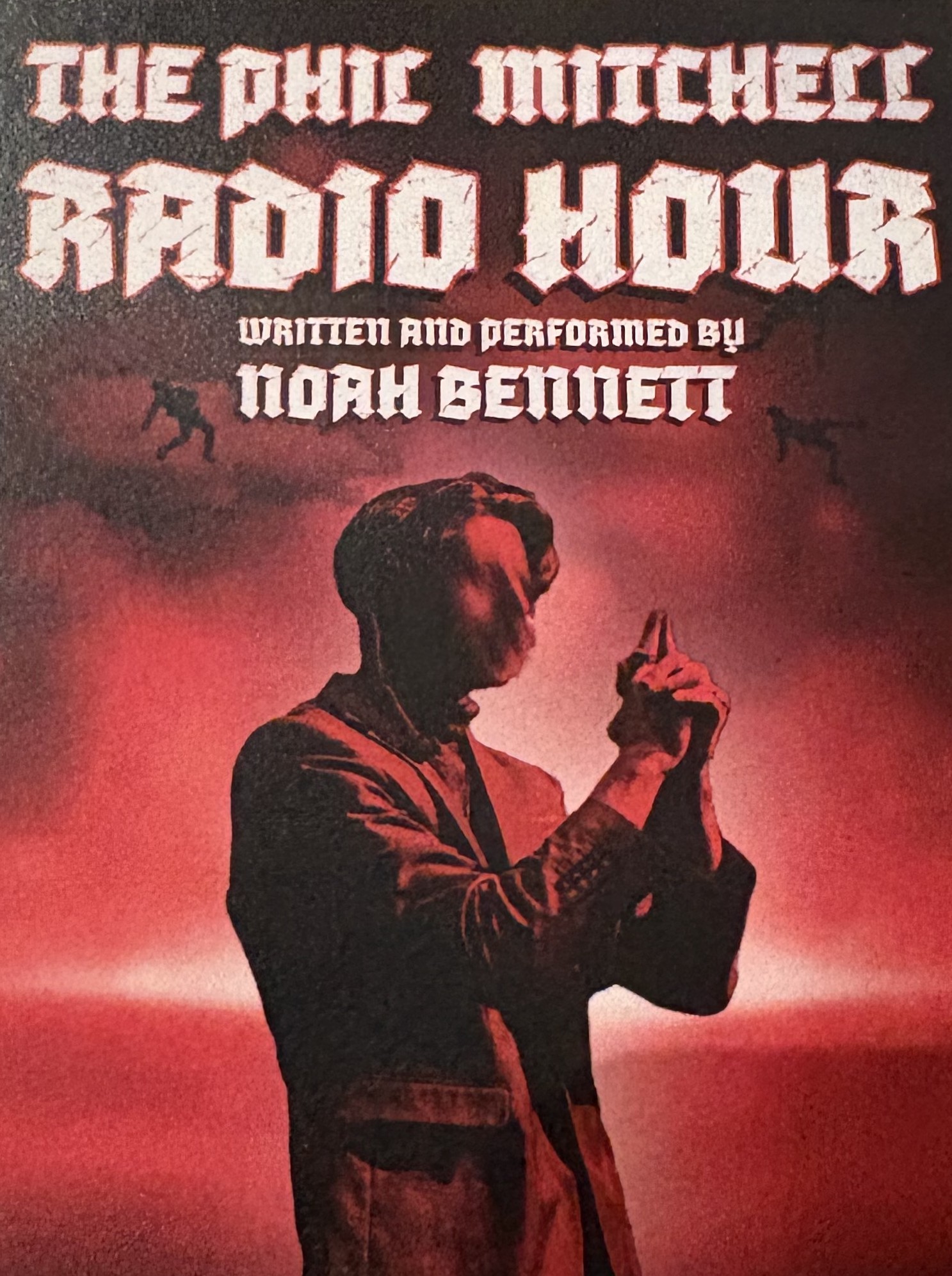
The Phil Mitchell Radio Hour begins as a campy solo show following Evangelical preacher Phil Mitchell (Noah Bennett) as he broadcasts live on air before turning into an intense and supernatural horror.
The Stage of The Phil Mitchell Radio Hour just before the show begins
Written, directed, and performed by Noah Bennett, this semi-immersive show perfectly handles the often divisive subject of religion, while never condemning or condoning it. As Phil preaches, miraculously heals the crowd, asks for donations (in return, you may even receive some “Salvation Soup”, the official soup of Phil’s church), and takes questions from callers — the mood shifts. Outside the studio, the Rapture has begun.
At the end of the show
Complete with the tagline: “It’s the Rapture, so why is this preacher still here?” This show explores themes of nature versus nurture, fear, acceptance, desperation, bargaining, ignorance, ego, expectations, and so much more while the audience, and Phil Mitchell himself, figures out exactly why he’s still here.
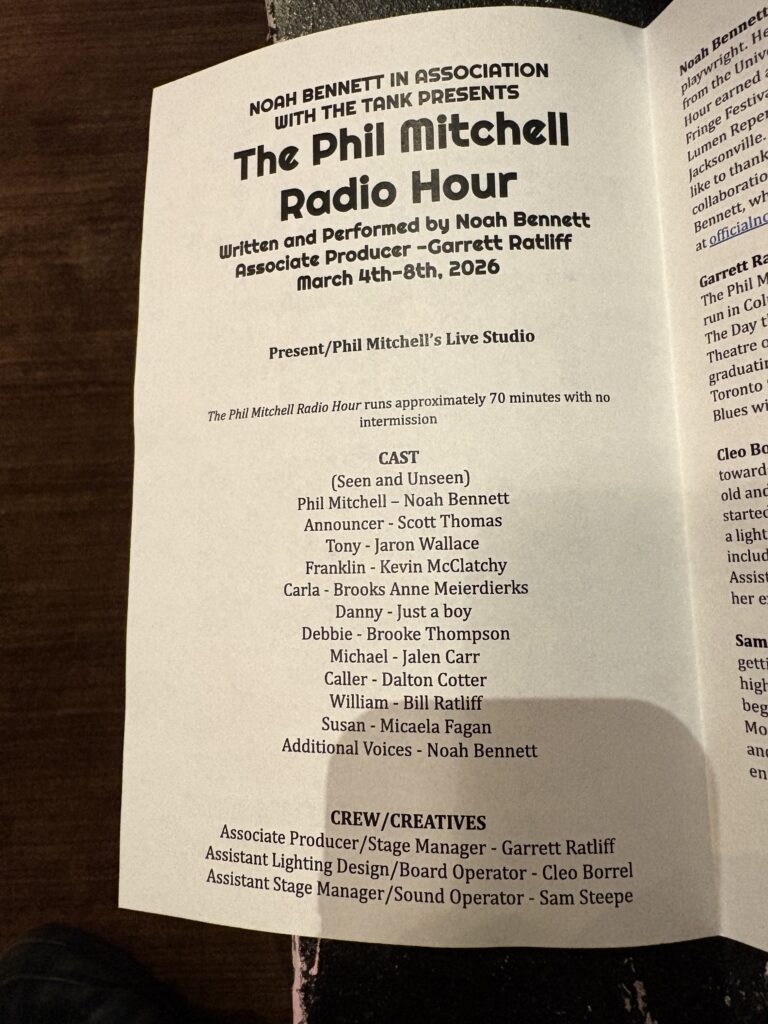
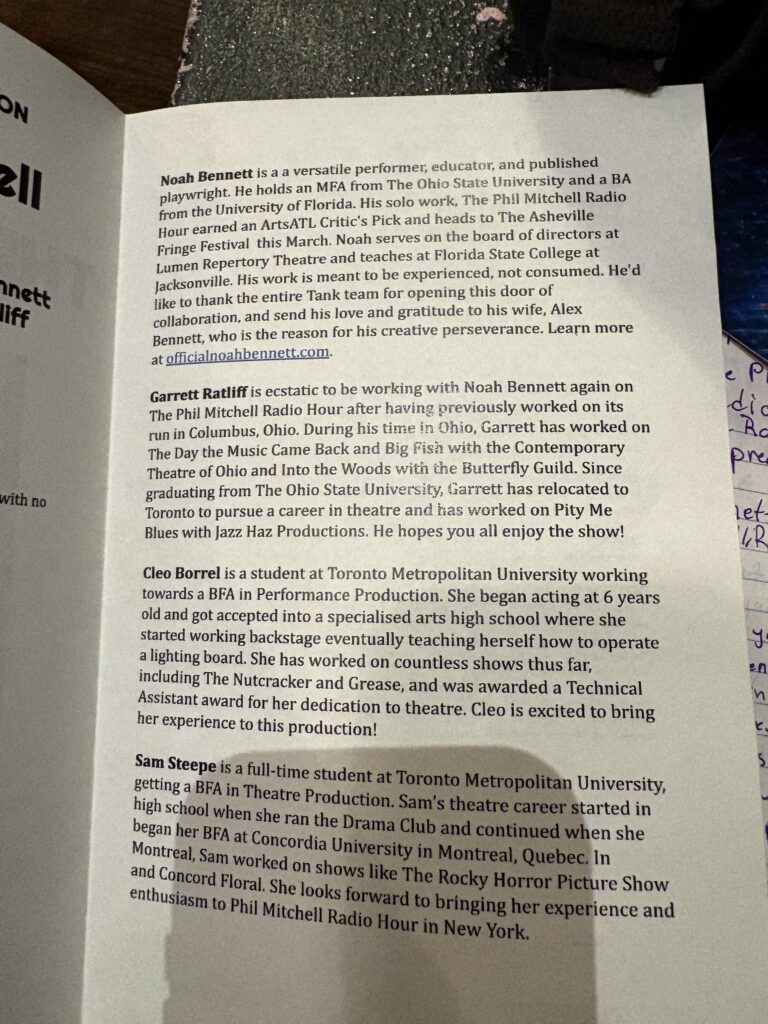
The Program of The Phil Mitchell Radio Hour
Combining the lighting design of Garrett Ratliff and Cleo Borrel, the ever present sound of a crackling fire, projections, and some simple special effects, Bennett is able to physically transform himself with an appearance of ease. As the world is divided into good and bad, the internal battle within Phil takes centre stage.
Will he make it into the kingdom of Heaven? Will you?
Conceived and created by Anthony Logan Cole and Angela Buccinni-Butch, Cirque Le Swing is unlike any theatre I have seen before. Set as an “immersive supper club experience”, this show delivers exactly that.
Performed inside a small and intimate venue with chairs, stools, and even sofas to help establish a relaxed, comfortable, but ultimately classy environment. The room is dimly lit and three people are in the back. One plays the keyboard (Katie-James Rushin), another plays the drums (Molly-Ellen Riviere), and the third is the host of the evening, Evie (Rori Nogee) who create a cabaret-esque vibe. The three of them make up Trio Secret who maintain the vibe and tempo through music and vocals. Once you enter the establishment and check in, one of the first people you’ll likely encounter is Mr. D. (Ambrose Martos). He takes his job very seriously. He’s the Maître D’ and takes pride in providing a fun and classy experience for his patrons.
Rori Nogee and
Despite the wishes of Mr. D. the staff has a tendency to go a bit overboard and become the entertainment. Butchie (Angela Buccinni-Butch) and Dia (Dia Seskin) are the worst offenders. They are often sneaking behind Mr. D.’s back to play games with the audience and show off their skills as contortionist, hand balancing, archery, and more.
Cirque Le Swing truly is immersive, so be prepared to play a game, if asked to. They are all fairly simple, but silly. Myself and the person sat at my table were tasked with playing ring toss with the reward of our champagne being “poured in a fun way”. The rings had to be tossed around the legs of a performer, in a handstand, and doing a split. After both succeeding on the first try (a thing they claimed has never happened before), one performer climbed onto the shoulders of the other, and poured our champagne in an admittedly fun way. Other games included a ring toss around bottlenecks, tossing small objects into bowls, and other carnival style games.
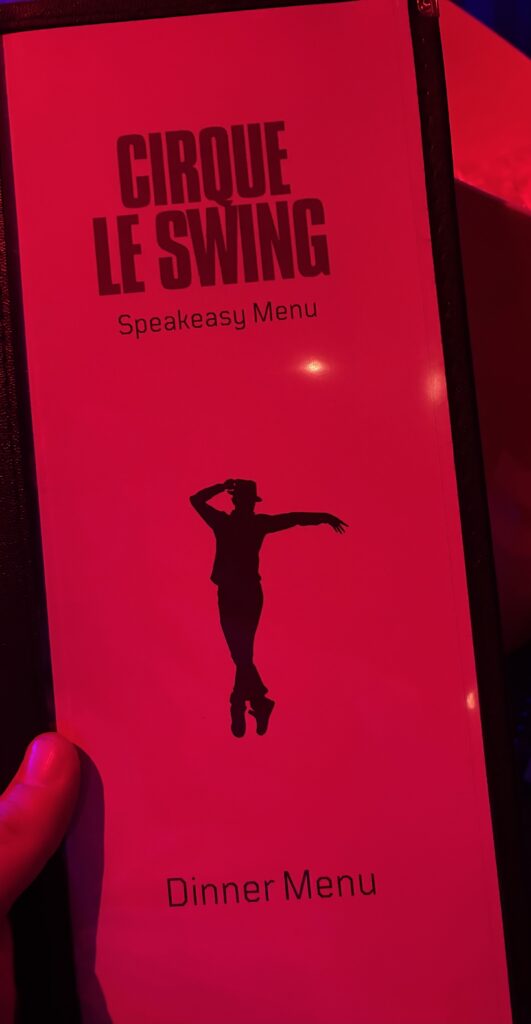
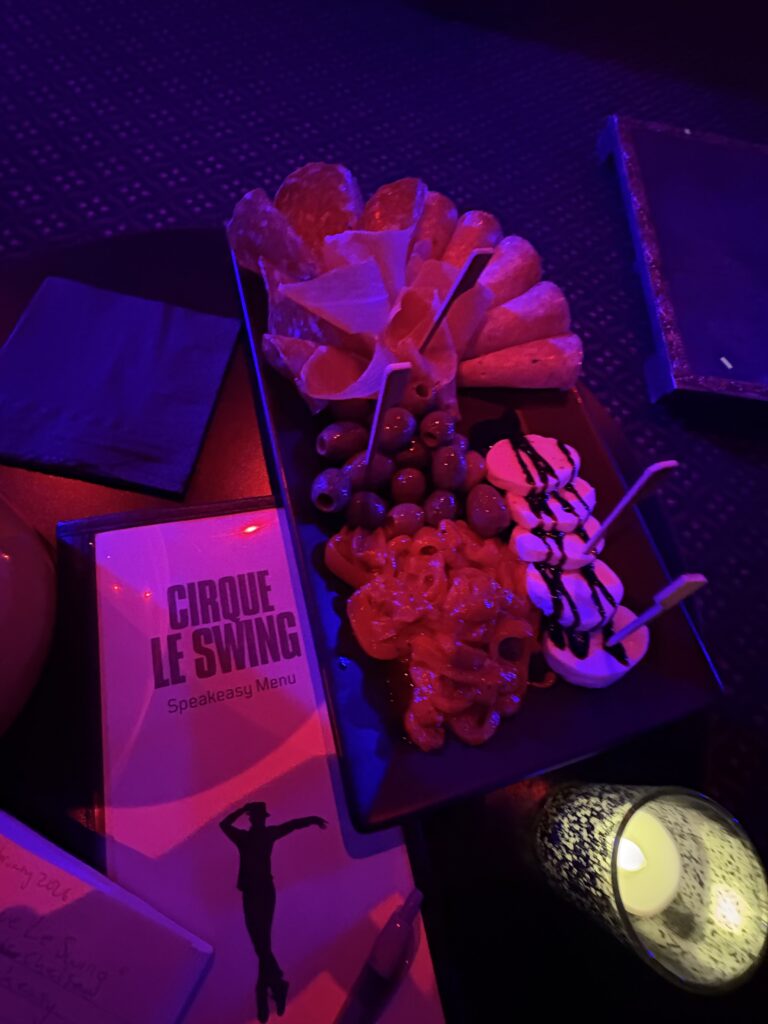
The evening’s menu and a selection of hors d’oeuvres
As the show is about to “begin”, Mr. D. addresses the crowd to awkwardly assure us about the quality of this establishment. He delivers a witty, tongue-in-cheek speech claiming this to not be some gimmicky place like “Ellen’s Stardust Diner or Mars 2112” while maintaining a clearly nervous demeanour, apologising for his staff, hoping we enjoy our evening, and quickly exits.
Evie takes the stage to sing the first number. With each song, it becomes more and more obvious that Nogee has a brilliant voice! Not only can she sing, but she can belt! Evie has the ability to be sultry and seductive, but can also lament and sing with full soul. As host, she announces breaks in her set and the arrival of food. Despite being on a “break”, Evie (and sometimes Mr. D.) are often interacting with the audience as dinner is served. It is also during these breaks that the majority of the circus tricks are performed.
With the circus coordination of Angela Buccinni-Butch, the audience is treated to a variety of live and up-close circus acts. Many of the acts contain a level of danger with the audience being shifted around as needed to ensure everyone’s safety. Combined with the stage direction of Anthony Logan Cole, Cirque Le Swing exemplifies how fun immersive theatre can be.
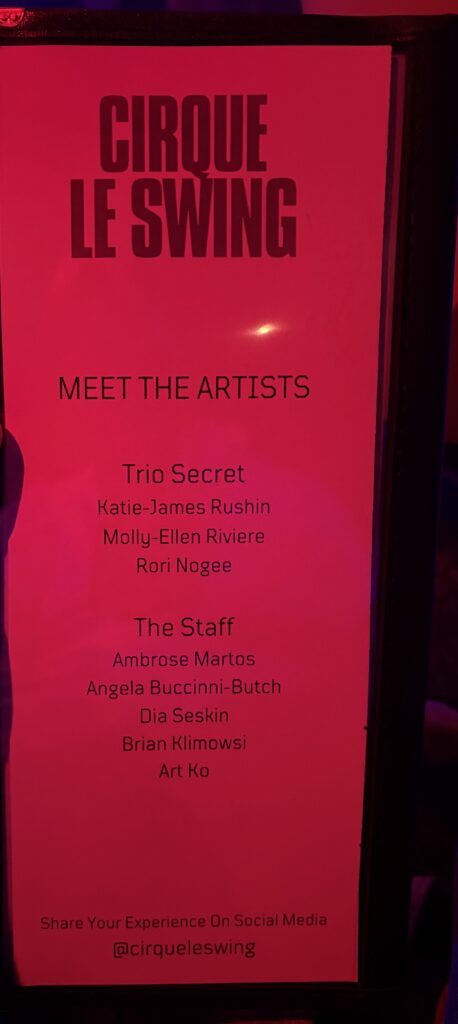
Trio Secret; Katie-James Rushin, Molly-Ellen Riviere, Rori Nogee. The Staff; Ambrose Martos, Angela Buccinni-Butch Dia Seskin, Brian Klimowsi, Art Ko
Combining romance, circus acts, a good meal, comedy, and improv that was so flawless I was left questioning if two of the audience members were actually plants of the production (they were not, but their timing and quips to each other were impeccable). Cirque Le Swing is impressive, fun, and something I would definitely see time and again.
Written by Douglas Lackey and directed by Alexander Harrington, Hans Litten: The Jew Who Cross‐Examined Hitler recounts the true, but often forgotten (or at least untold), historical event in 1931 where Hitler was subpoenaed and called as a witness in a German criminal trial. Dubbed the Eden Dance Palace case, the trial concerned Nazi stormtroopers who entered the Eden Dance Palace, a known communist hang‐out, and were involved in a fight. After sustaining injuries, the communists have brought a criminal case against the stormtroopers involved, who claim self defence.
Cast and Crew of Hans Litten: The Jew Who Cross-Examined Hitler
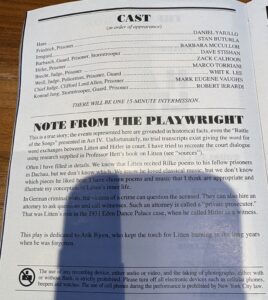
In German criminal court, the victims are allowed to call witnesses and question them, via a private prosecutor. Hans Litten (Daniel Yaiullo) was the private prosecutor for the communist members injured at the Eden Dance Palace. Therefore he was the one to personally question the Nazi stormtroopers and other appropriate witnesses, including Adolf Hitler (Zack Calhoon).
Hans and his law partner, Barbasch (Dave Stishan) have a reputation for representing clients who cannot afford a lawyer, regardless of their background. This means representing some clients who are members of the communist party; a fact Hans is unbothered by. For him, the political affiliations of his clients are irrelevant. What matters is without Barbasch and himself, the clients would not have representation. Hans knows without proper legal representation, the average person is at a disadvantage against the judicial system. This power dynamic, often created due to financial means, renders the idea of true justice impossible in Hans eyes.
The play opens with Hans and his father, Friedrich (Stan Buturla), discussing Hans future. Hans is a young man. An intellectual with dreams of helping others with his art. He’s hopeful, but also naive. He believes in people and the good they can achieve. With a love for classical music and poetry, Hans fully believes in “universal truths” — ideas, morals, concepts, etc. that supersede individual societies and are simply true regardless of nation, backstory, or any other influence or factor. A notion that Friedrich, a university college professor himself, has more difficulties with.
Due to his hope and faith in humanity or perhaps his naivety, Hans truly cannot fathom how the average German can read the words of Mein Kampf and/or listen to Hitler’s spoken rhetoric and then vote him into power. Pointing out the violent and divisive language used by the Nazi party’s leader, Hans truly does not understand how anyone can run on, let alone succeed with, a political platform based in hatred.
What Hans does understand, though, is the power of words. After the attack at the Eden Dance Palace, Hitler and the Nazi party officially adopted a zero tolerance policy against violence and insisted any members found to be in violation of the new policy will be dismissed.
So when the opportunity presents itself, Hans cannot think of a better way to showcase the hypocrisy, violent nature, and consistent track record of Hitler’s political rhetoric than by questioning the rising political figure himself in a court of law.
I imagine the role of Adolf Hitler must be a difficult one to portray. Calhoon’s depiction came across as a deeply layered one. His voice was not booming. His demeanour was almost weak. The tension and struggle to maintain control over his voice, facial expressions, and body language as he seethes in anger and humiliation gives the audience a peek into how depraved he truly is. Without coming across as sympathetic nor shying away from the reality of who Adolf Hitler was and all that he did — Calhoon manages to exude a physical presence of a tiny man, but one who is barely holding back his true emotions. One who is only using restraint for the sake of his own reputation and personal political gain.
The audience does not need to have any prior knowledge of this specific historical event to thoroughly understand, enjoy, and take meaning from this show. The sets piece themselves combined detail with simplicity. Designed by Alex Roe, the scenes taking place within The Law Offices of Barbasch and Litten are filled with tiny details including specific books lying around and the music playing. Yet, as Hitler rises to power, the sets become less defined. More and more detail is left to the audiences’ imagination including the barrack walls holding some of the male Jewish prisoners at the Dachau Concentration Camp.
The set design Hans Litten: The Jew Who Cross-Examined Hitler
The costumes throughout the show were done subtly at first. However, in a parallel of the historical events surrounding Hitler’s quick rise to power, they rapidly change. Designed by Anthony Paul-Cavaretta, the first notable difference in clothing is a tear in the trousers of Hans suit. The next big costume change hits much harder. The striped uniform, the yellow star, and all the emotional weight those items carry stood centre stage, vulnerable, broadly, and saying so much without uttering a word.
There is not a large amount of information to be found on Hans Litten, a fact stated within the playbill itself, in a note from the playwright. There are no court transcripts of the trial remaining. Even minor details including which specific Rilke poems Hans recites or the particular classical composer he loves were filled in by Lackey using a combination of research and judgement to keep the pace and vibe moving along.
Hans Litten: The Jew Who Cross‐Examined Hitler, covers many themes that very well may be the universal truths Litten describes in this show. A sense of belonging, even when it’s not with the group you consider yourself a part of is prominent. Self sacrifice for the greater good of others is also explored. Additionally, the importance of family, the internal struggle of knowing a loved one is being harmed, but also being unable to prevent it. Grief, acceptance, loss of innocence, loss of control, naivety, understanding, self‐preservation, and even hope are at the core of this play. Perhaps most importantly, it is a call to action and a reminder of the consequences inherent with compliance.
Written by David Gutierrez, Retraction is based off a true story. This play warns of the dangers caused by inaccurate journalism and does not shy away from the ramifications faced by the journalist, those mentioned in the article, and even the entire movement it intended to help.
Directed by Caroline Fairweather, sound designed by Katie Reif, and a clever set designed by Julian von Haubrich this show uses projections to keep the audience informed of the date as well as overlapping spoken quotes to drive home just how overwhelming and devastating this real event was to everyone involved.
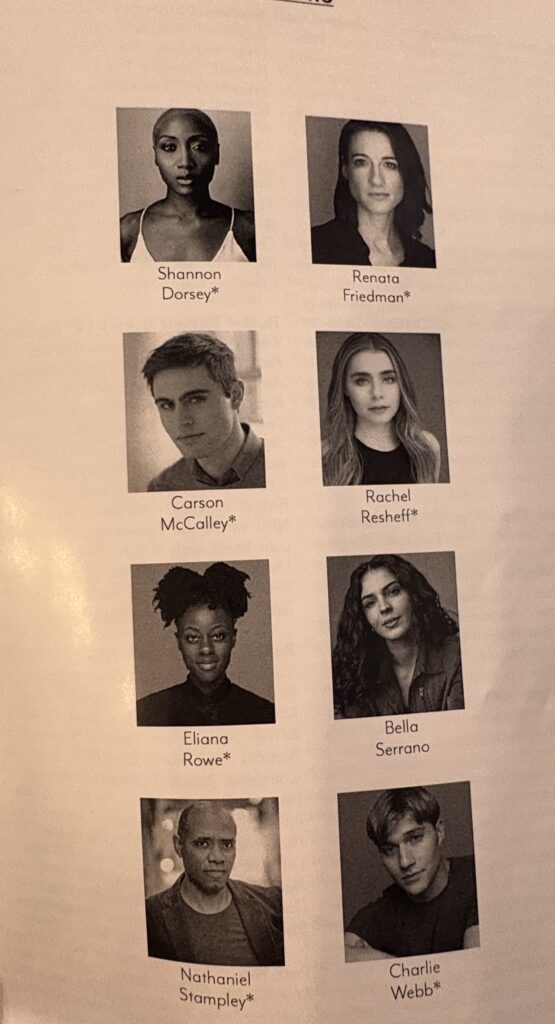
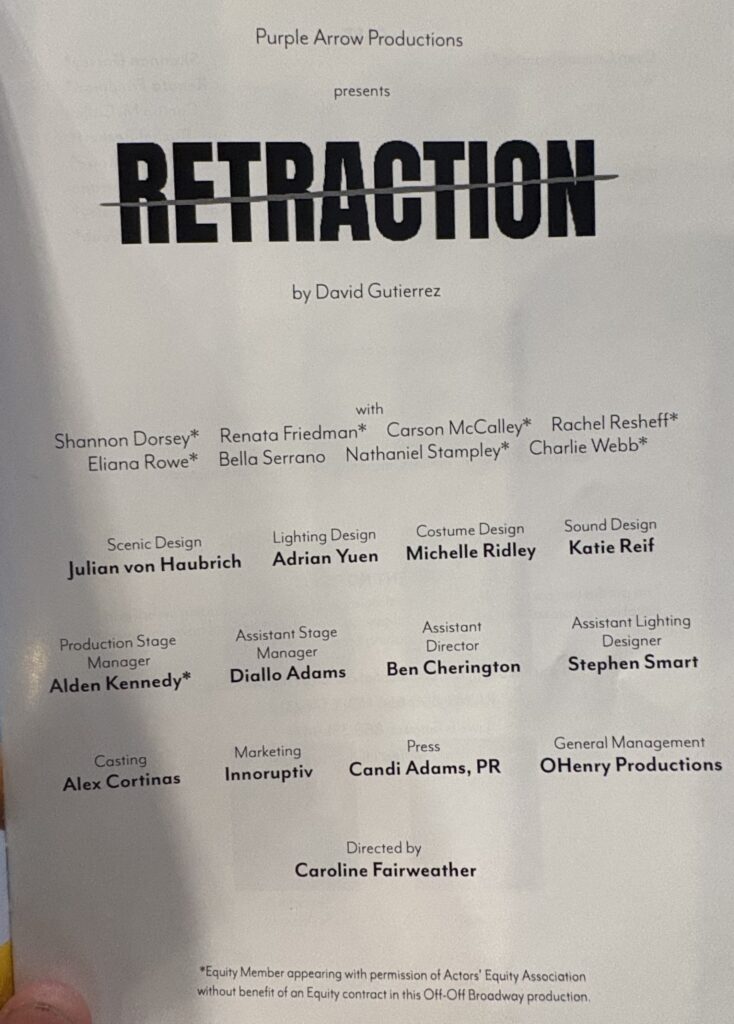
The play follows Wendy (Renata Friedman), an experienced journalist with a focus on sexual assaults occurring on college campuses. She settles on one particular rape case to be the focal point of her article — a violent gang rape, which the play takes great care to admit is far from the typical sexual assault cases reported by colleges and universities. The audience is introduced to Lacey (Rachel Resheff) who is the central figure in Wendy’s article. Her friends Chris (Carson McCalley), Melissa (Eliana Rowe), and Travis (Charlie Webb) all seem to have a different memory of the night in question and convey a multitude of conflicting emotions. Beyond that, Dean Gasso (Shannon Dorsey) the Dean of Carolina Atlantic University is vitally present as well as Zack (Nathaniel Stampley), the editor and person with ultimate approval of what gets published. Additionally there is a sexual assault survivor, Gillian (Bella Serrano) who understands the larger implications a false report may bring and Victor (Carson McCalley), another prominent journalist working to question the accuracy of Wendy’s article.
The Cast of Retraction
Dorsey, McCalley, Rowe, Serrano, Stampley, and Webb all take on more than one role. However, I found it difficult to distinguish when some of these role changes occurred. Dorsey also played Reporter #2, McCalley doubled as both Chris and Victor, Rowe portrayed Ms. Moore as well, Serrano also played Karina, Webb doubled as Reporter #1, and Stampley also portrayed Lawyer #2 and Reporter #3.
Most of the time, the distinction between each character an actor played was clear, but not always. When an actor begins reporting on breaking news, it is clear that is a reporter. When an actor is portraying a lawyer as well as one of the people questioned by another lawyer, that clarity becomes less defined. I found the clarity to halt altogether with the characters of Ms. Moore and Karina — nether of who I remember as distinct characters.
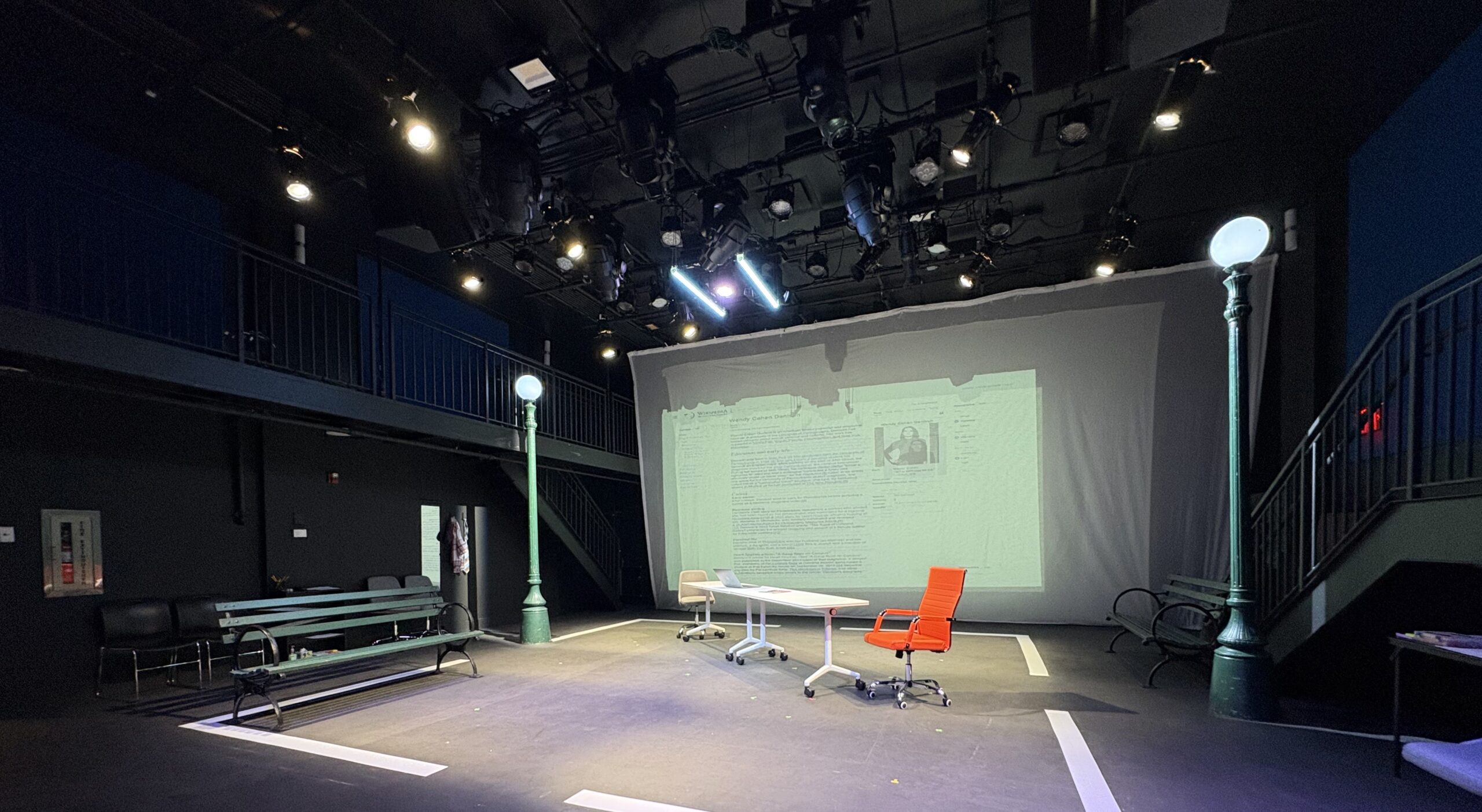
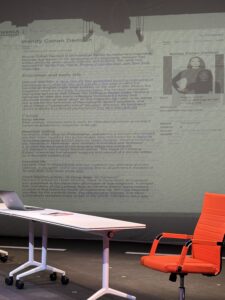
I thoroughly enjoyed how malleable the set is. Using rolling chairs and two folding tables with wheels, the scenes were able to change quickly, freely, and without disrupting any action on the stage. Combined with the use of projections showing everything from the Wikipedia page of the real life Wendy, to emails, and even the date of every prominent plot point — the play felt smooth and well practiced. Since the plot is told in a nonlinear way, it would have been hard to keep track of when the various things happened. That being said, even with the dates easily seen, I’ll admit at times I was still lost.
Projections were used throughout the show. Here, the Wikipedia article of the real Wendy
Retraction recounts the same situation through various perspectives. Beyond the aftermath and everything that encompasses, the audience is left to wonder who, if any of the characters are truly reliable narrators? The answer is unfortunately one I think many don’t want to admit — none of us are. The truth is, memory is fallible. When humans remember a past event, it is not the actual event being remembered, but rather the memory of the last time the event was thought of.
Two people can tell the same story, both whole heartedly believing what they say and seeing it as absolute truth, and both accounts being completely different from the other. The same event can be unrecognisable when told by someone else. I appreciate how subtly this is portrayed throughout while also being a core element.
Retraction is intended as a dire warning against blind belief and a reminder of the consequences — legally, emotionally, and even harming the very thing you were trying to advance. I only hope the audience pays enough attention to it.
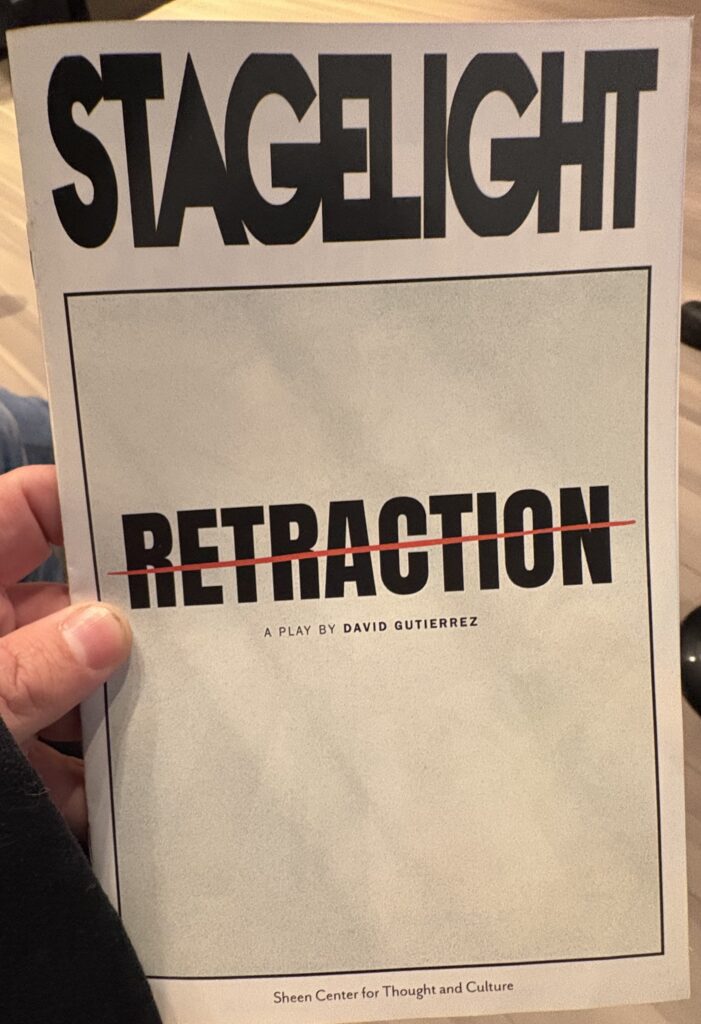
Retraction‘s Program front cover (left) and Cast and Crew list (right)
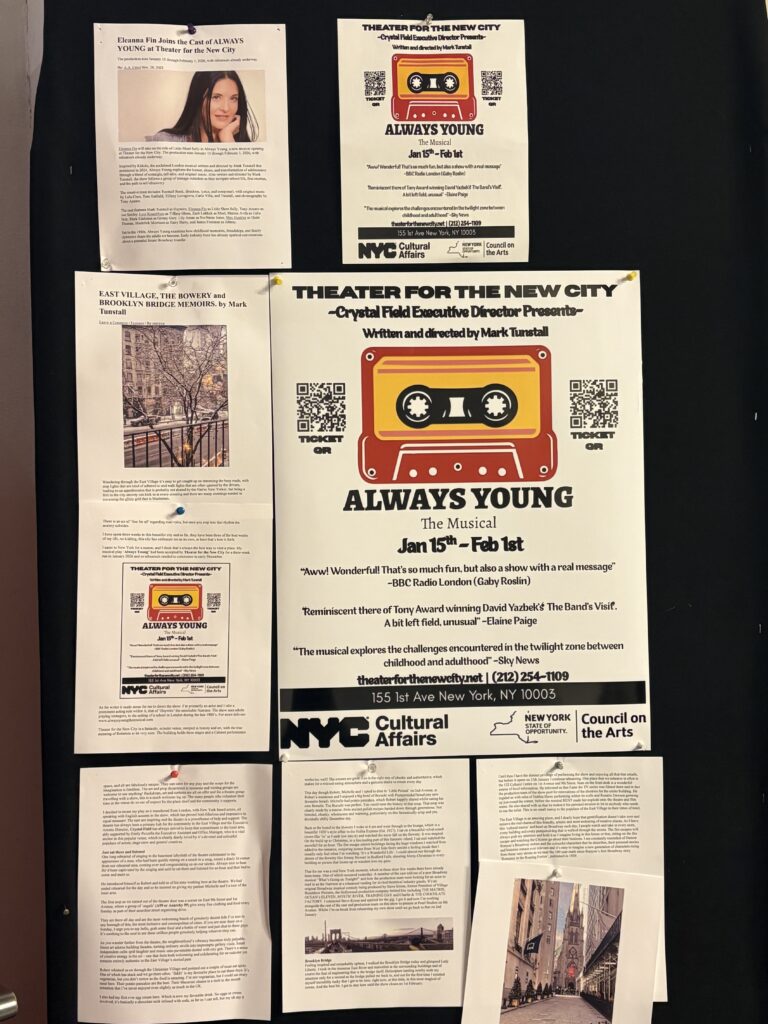
Written and directed by Mark Tunstall, Always Young is about rebellion, memories, desire, what it feels like to be an outcast, and so much more. It takes the concept of the misfit, those who feel alone, lost, unable to fit in with societal cliques and turns it into dark, gritty, sometimes campy, but always brutally honest comedy wrapped in a message of hope.
The Program of Always Young The Musical (Front Cover)
This musical explores how easily children can slip through the cracks of society, unnoticed, regardless of background or social standing. The audience is left to consider “why” that happens, how to change it, and just what type of impact you have on those you know. Everyone, even those who feel alone, still affect everyone around them …even if they are unaware to doing so.
This show is dark, gritty, funny, but most importantly — it’s real. The emotions expressed are raw, complex, taboo even, but always genuine.
Always Young follows the character of James “Haywire” Hayward (Mark Tunstall) — a self described misfit. Haywire serves multiple purposes throughout. At times he is a self-aware narrator, breaking the fourth wall and exuding a bit of sliminess, but also control. He has charisma and charm with also a hint of danger. Reminiscent of a stereotypical side show circus ringmaster, he is a bit over the top and far from polished. Yet you find yourself unable to look away. He’s a series of contractions — someone who feels distrustful, yet only speaks the blatant truth (and you believe him because in the back of your mind, you know it’s true). He understands manipulation. He understands the connotation of that word. Yet he uses it anyway, unapologetically so, because it’s accurate. Don’t mistake his crudeness though, Haywire is far from a villain. He’s flawed, he knows it. He makes mistakes, he misspeaks, he gets angry, he gets bitter, he can even border on sinister, but ultimately he truly cares. He wants to help. He doesn’t mean to mess up. Just like everyone else, he learns as he goes.
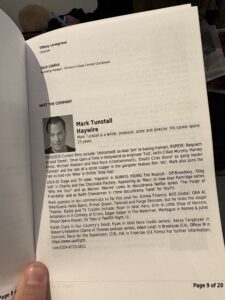
Mark Tunstall’s page in the program
He’s also simply a teenager in school, with his classmates, but not really his friends. He doesn’t know where he belongs. He’s an outcast and he’s angry. He doesn’t have a community — a tribe — who sees the true person behind the hard, rebellious exterior. An exterior he learnt to wear for the comfortability of society, so they never see the depth of his pain.
The show begins at a funeral. The mood is somber, the sound of rain falls, the stage fills with mourners in all black with black umbrellas in hand. The first song begins, soft at first, then rising in intensity as Haywire, the narrator, transforms in front of us, from a simple man into an almost devious, mysterious being. With a knowing look in his eye and a sly grin it’s abundantly clear just how dark he *can* see life, yet mysterious enough to know he’s more layered. Haywire sees life differently than others, or at least differently from how many will admit. For Haywire, life is filled with subjective grey areas.
He understands anger and the need for a rebellious nature. He grasps the power of manipulation and is even a bit of a master it. He learnt how to do this overtime. It began out of anger, a coping mechanism against the bullying and loneliness in his life. Life experience taught him this ability, but also it also taught why it should be used to benefit others.
I felt almost as if I were watching myself on stage. Growing up, it felt like I was the only one who did not see things as purely good or bad. Almost nothing seemed to fit into one category neatly. I saw things as both good and bad, fully dependant on the perspective in which I was approaching the subject or scenario from. I realised how the same person can be called a hero by some and a villain, by others. It became clear if the determining factor of something being good or bad is perspective based, then most things are subjective. Almost everything in life falls into a grey area including the very concept of what is good or bad, what is moral, or even why we live life.
My lived experiences, my personal history tells me the difference between good and bad is how someone chooses to use their power (and we all have some kind of power). Even something with a traditionally negative connotation like manipulation, can be used to help people. It can be used to help facilitate understanding and growth. But, it can also be used to dampen and hinder those around you. Intent, even if not successful, is important. Just be willing to learn from it if you fail (and remember it’s okay to fail, it’s normal to fail, failing is a part of life).
I found, while the entire soundtrack was catchy, fun, and honest — one song in particular stood out for me. “It’s Prob’ly Me” is a number that might as well be my anthem. Sung by Haywire directly to the audience, it exemplifies how it feels to have the best of intentions yet the inability to express them properly for society. The entire song is full of linguistic word play. It applies layers of meaning to the simple act of putting your foot in your mouth — of misspeaking, of using the wrong word choice, and it always being taken differently than expected. Which is something I do often. I choose my words carefully. But I am often lost on the subtext the words may convey because, well, the word doesn’t actually say the subtext. I mean the word as is, no extra subtext. So if something comes off as rude, or crude, maybe even insulting… just know it was probably me. It probably was also not my intention, though.
I am a trans man. I had confidence when I was a child. I was good at sports, I was in shape, I was happy. Then puberty hit. I lost my confidence, my body began to feel like a costume, and eventually I found a stranger looking back at me in the mirror. I grew bitter. I grew angry. Just once in my life did I threaten suicide. My mom understood the grey areas of life, though. She manipulated me out of ever even considering the action. She simply stated, “The dogs will miss you. I may be able to explain to other people why you did it, but it is impossible to explain it to the dogs. They will just know you left and never come back, but they will never understand why.” That broke my heart. I knew it was manipulation, even as a kid. I also knew it was accurate. That’s when I began to understand how manipulation, despite the negative connotation, can be a wonderful tool for helping others.
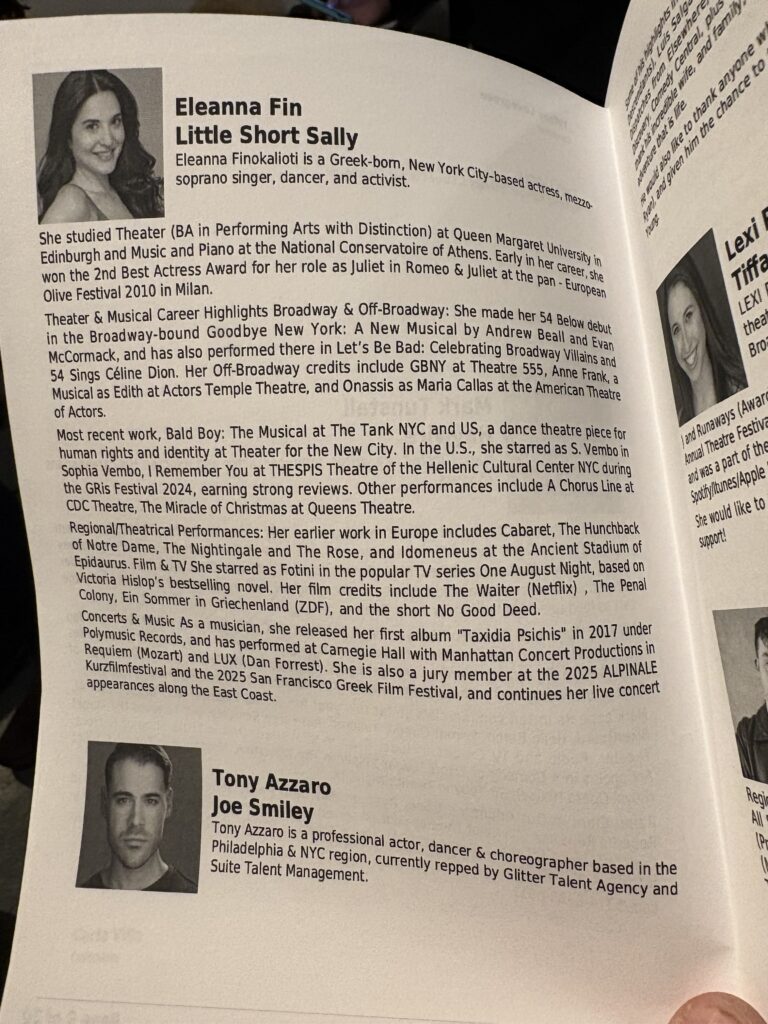
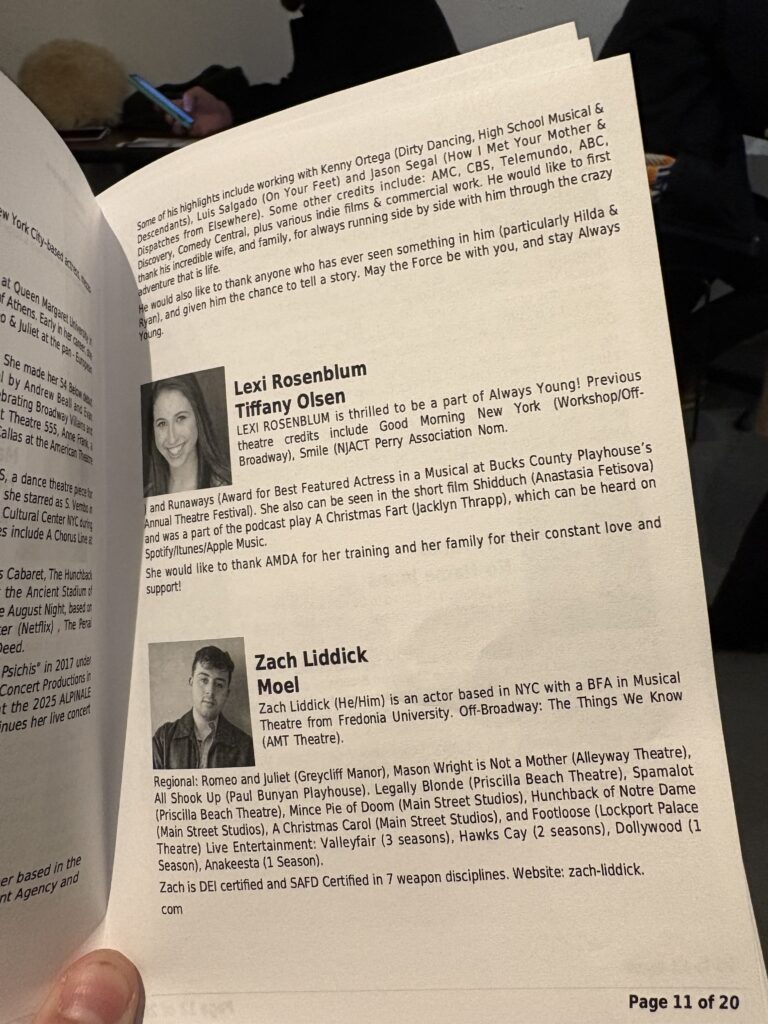
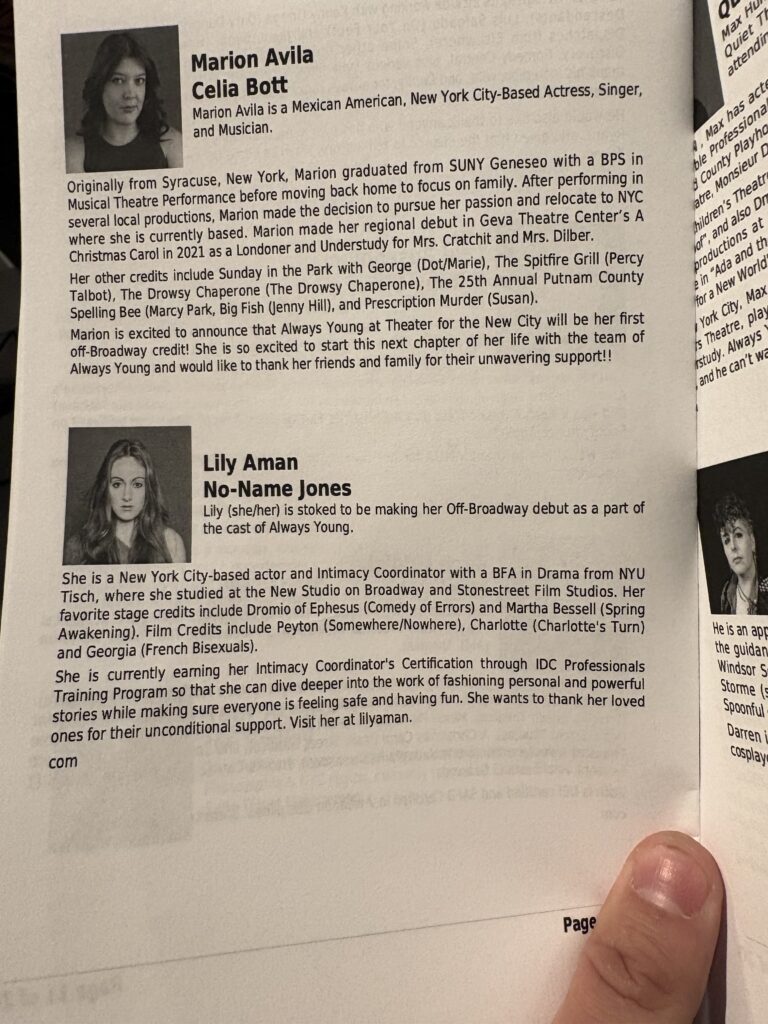
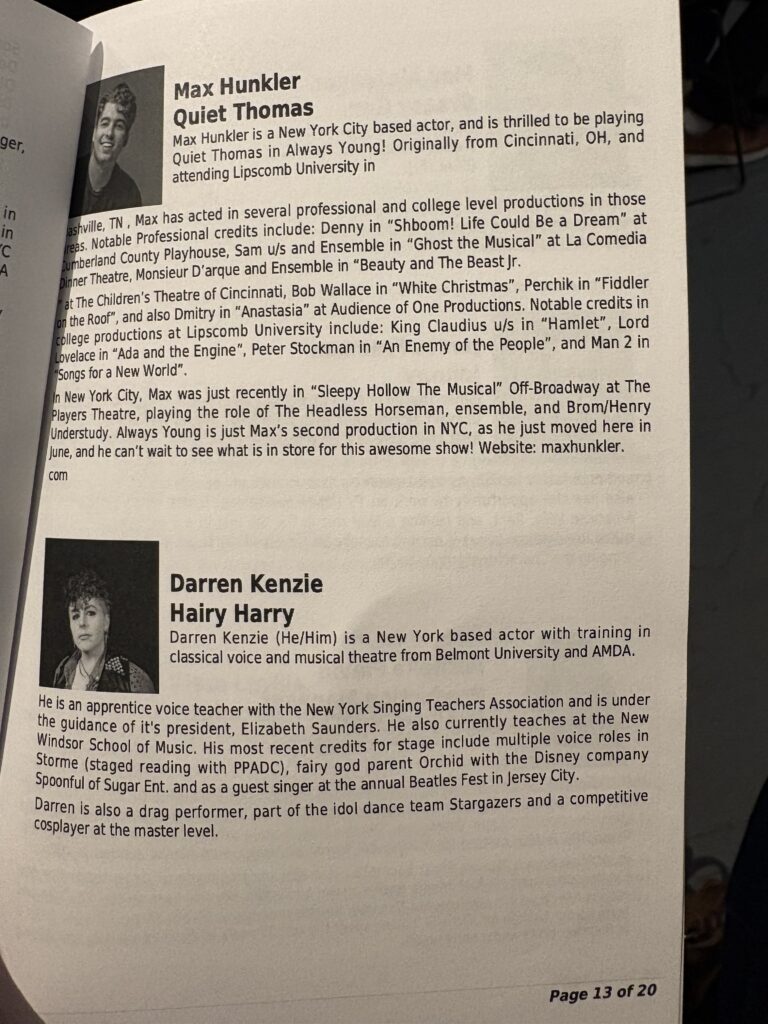
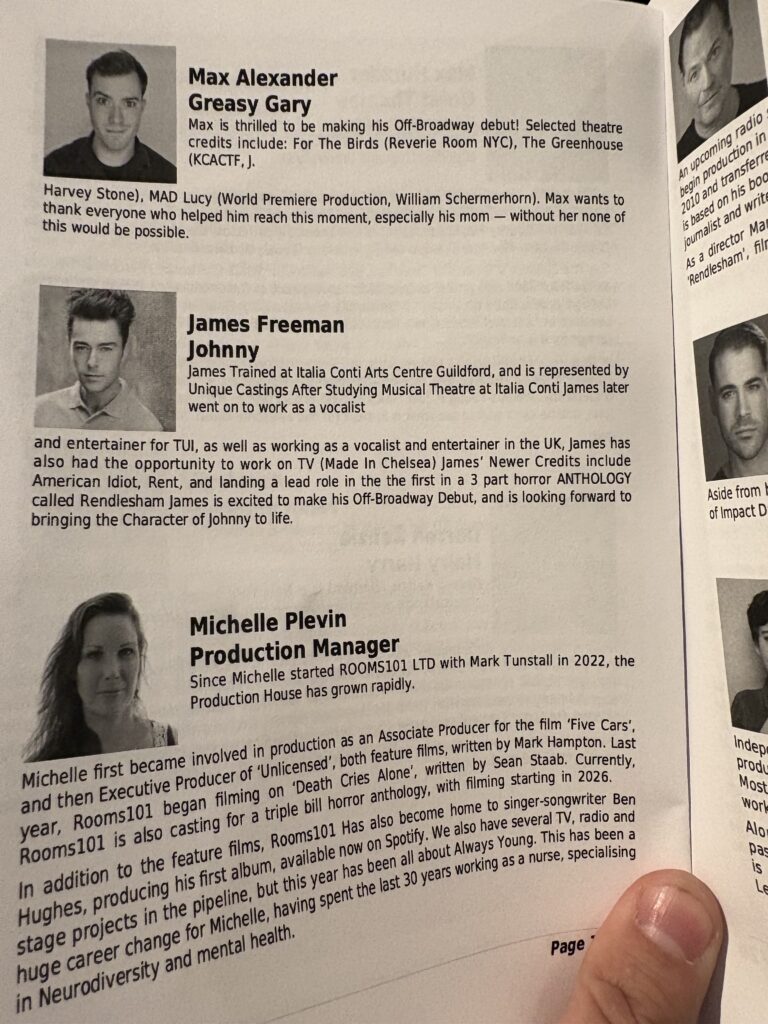
Then the show transforms. Suddenly, the year is 1989, the audience is introduced to the rest of the character — all school students with Haywire. Little Short Sally (Eleanna Fin) is the smallest in the class. Joe Smiley (Tony Azzaro) who doesn’t know how to drop his grin. Tiffany Olsen (Lexi Rosenblum), an American who is desperate to have a new life in England. Moel (Zach Liddick) with a brilliant imagination. Celia Bott (Marion Avila) a foster child. No-Name Jones (Lily Aman) called that because their parents never settled on a name, leaving the character to suffer without an identity. Quiet Thomas (Max Hunkler) who is a traditional, rebellious teen, with an understanding of how powerful silence can be. Hairy Harry (Darren Kenzie) who was given this nickname due to his hair. Greasy Gary (Max Alexander) a child who has a reputation for being smelly, unkempt, even gross. Lastly, there’s Johnny (James Freeman) who lacks a concrete identity, feels he is never good enough, and always aims to be someone else — anyone else — who may be deemed as cool.
Each student is a bit of a stereotype of an “outsider”, which is perfect for a show as self-aware as this. There is even a brilliant moment where almost, if not all, of the cast break the fourth wall only to over explain the upcoming scene to the audience. This perfectly exemplifies the metaphor of sticking one’s foot in your mouth and digging yourself into a verbal hole/grave.
Despite the dark humour, the grittiness, the questionable morals of the characters, even the use of violence to prove yourself to others (a thing I had to do as a child) — Always Young is ultimately about hope, acceptance, and helping others. It refuses to shy away from the subjective nature of life. It’s unapologetically upfront about the complexity of emotions, the dark part of the human mind, and why you should never lose your rebellious way. It reminds the audience that even after death, your legacy, your memory, still lives on.
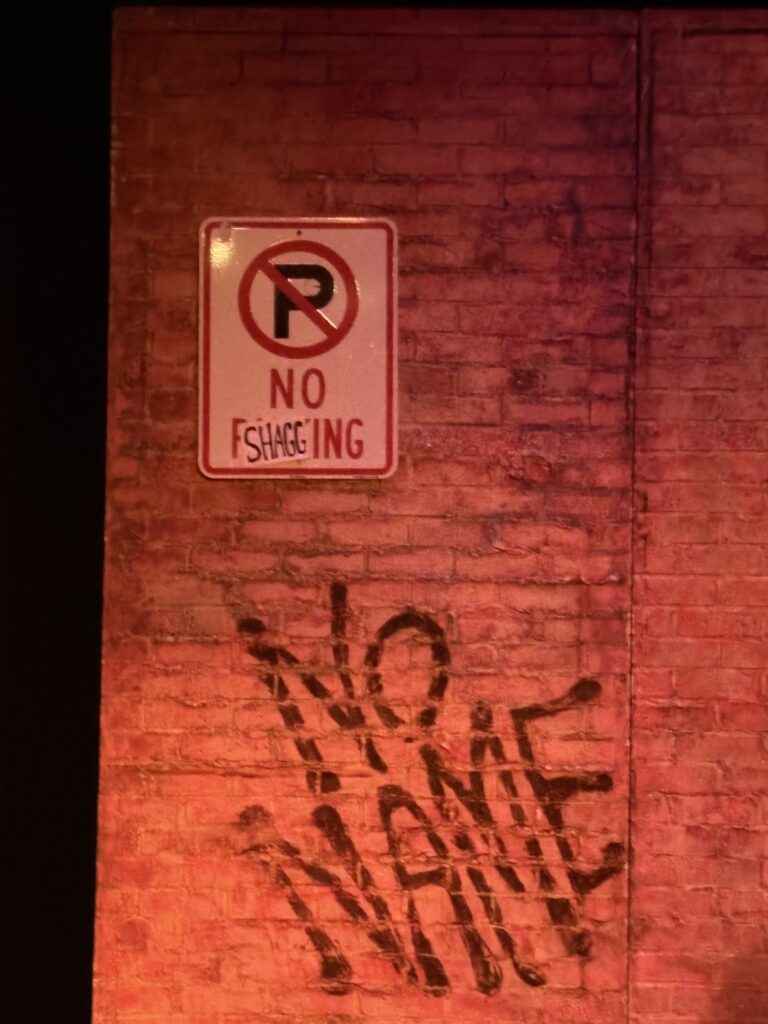
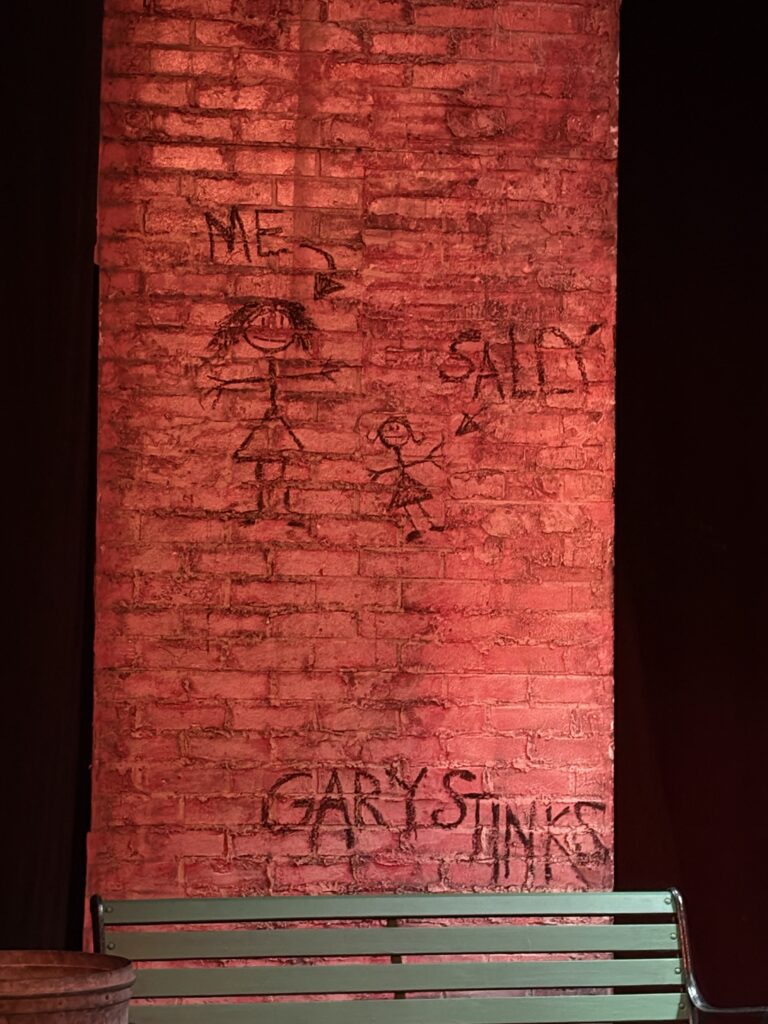
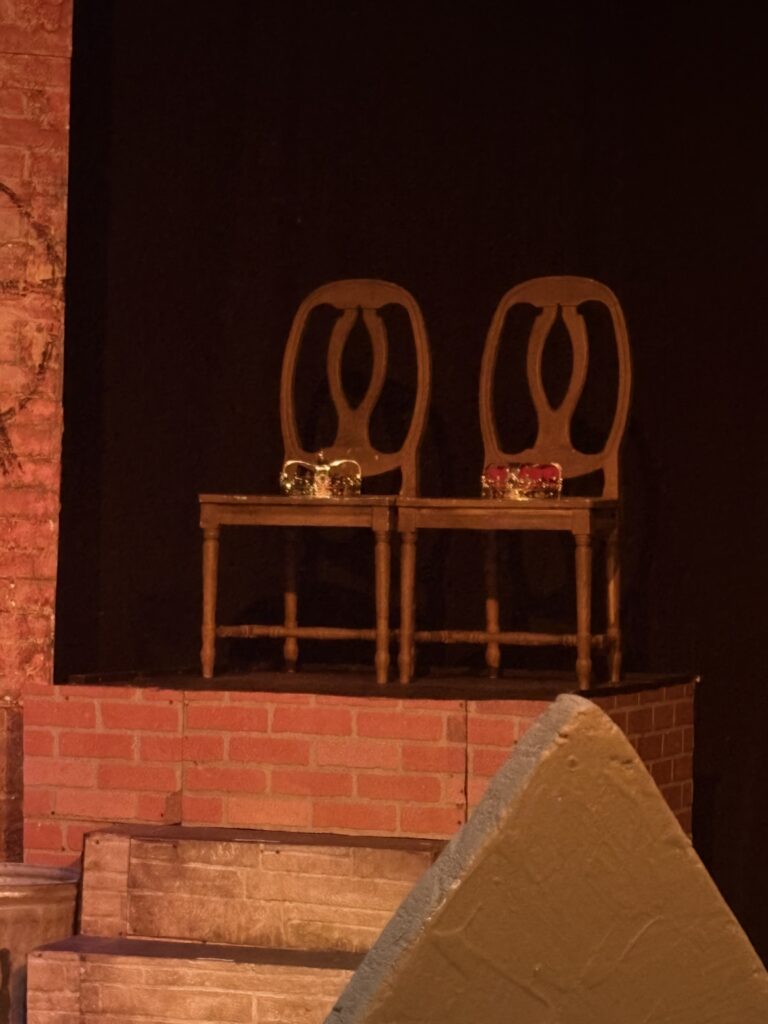
The set for Always Young The Musical
Perhaps it is the final message that is most important — the goal is not perfection. The goal is to try. That’s it. Learn, try, fail, try again. Even if you are unaware of what tribe you belong to, you belong somewhere. So try to help. You may never know if there is a lost soul desperately searching for others like themself and if there is, that person may never realise that you’re also an “outsider”. Sometimes our tribes are a lot closer than we think. It just takes some help from an other to finally figure that out.