

Theatre Row
Philosophy Productions
7 January 2026
Matinee
Written by Douglas Lackey and directed by Alexander Harrington, Hans Litten: The Jew Who Cross‐Examined Hitler recounts the true, but often forgotten (or at least untold), historical event in 1931 where Hitler was subpoenaed and called as a witness in a German criminal trial. Dubbed the Eden Dance Palace case, the trial concerned Nazi stormtroopers who entered the Eden Dance Palace, a known communist hang‐out, and were involved in a fight. After sustaining injuries, the communists have brought a criminal case against the stormtroopers involved, who claim self defence.
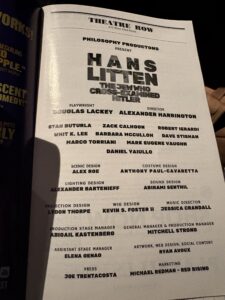
In German criminal court, the victims are allowed to call witnesses and question them, via a private prosecutor. Hans Litten (Daniel Yaiullo) was the private prosecutor for the communist members injured at the Eden Dance Palace. Therefore he was the one to personally question the Nazi stormtroopers and other appropriate witnesses, including Adolf Hitler (Zack Calhoon).
Hans and his law partner, Barbasch (Dave Stishan) have a reputation for representing clients who cannot afford a lawyer, regardless of their background. This means representing some clients who are members of the communist party; a fact Hans is unbothered by. For him, the political affiliations of his clients are irrelevant. What matters is without Barbasch and himself, the clients would not have representation. Hans knows without proper legal representation, the average person is at a disadvantage against the judicial system. This power dynamic, often created due to financial means, renders the idea of true justice impossible in Hans eyes.
The play opens with Hans and his father, Friedrich (Stan Buturla), discussing Hans future. Hans is a young man. An intellectual with dreams of helping others with his art. He’s hopeful, but also naive. He believes in people and the good they can achieve. With a love for classical music and poetry, Hans fully believes in “universal truths” — ideas, morals, concepts, etc. that supersede individual societies and are simply true regardless of nation, backstory, or any other influence or factor. A notion that Friedrich, a university college professor himself, has more difficulties with.
Due to his hope and faith in humanity or perhaps his naivety, Hans truly cannot fathom how the average German can read the words of Mein Kampf and/or listen to Hitler’s spoken rhetoric and then vote him into power. Pointing out the violent and divisive language used by the Nazi party’s leader, Hans truly does not understand how anyone can run on, let alone succeed with, a political platform based in hatred.
What Hans does understand, though, is the power of words. After the attack at the Eden Dance Palace, Hitler and the Nazi party officially adopted a zero tolerance policy against violence and insisted any members found to be in violation of the new policy will be dismissed.
So when the opportunity presents itself, Hans cannot think of a better way to showcase the hypocrisy, violent nature, and consistent track record of Hitler’s political rhetoric than by questioning the rising political figure himself in a court of law.
I imagine the role of Adolf Hitler must be a difficult one to portray. Calhoon’s depiction came across as a deeply layered one. His voice was not booming. His demeanour was almost weak. The tension and struggle to maintain control over his voice, facial expressions, and body language as he seethes in anger and humiliation gives the audience a peek into how depraved he truly is. Without coming across as sympathetic nor shying away from the reality of who Adolf Hitler was and all that he did — Calhoon manages to exude a physical presence of a tiny man, but one who is barely holding back his true emotions. One who is only using restraint for the sake of his own reputation and personal political gain.
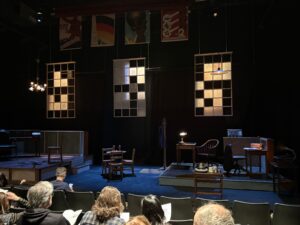
The audience does not need to have any prior knowledge of this specific historical event to thoroughly understand, enjoy, and take meaning from this show. The sets piece themselves combined detail with simplicity. Designed by Alex Roe, the scenes taking place within The Law Offices of Barbasch and Litten are filled with tiny details including specific books lying around and the music playing. Yet, as Hitler rises to power, the sets become less defined. More and more detail is left to the audiences’ imagination including the barrack walls holding some of the male Jewish prisoners at the Dachau Concentration Camp.
The costumes throughout the show were done subtly at first. However, in a parallel of the historical events surrounding Hitler’s quick rise to power, they rapidly change. Designed by Anthony Paul-Cavaretta, the first notable difference in clothing is a tear in the trousers of Hans suit. The next big costume change hits much harder. The striped uniform, the yellow star, and all the emotional weight those items carry stood centre stage, vulnerable, broadly, and saying so much without uttering a word.
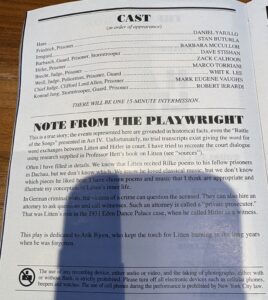
There is not a large amount of information to be found on Hans Litten, a fact stated within the playbill itself, in a note from the playwright. There are no court transcripts of the trial remaining. Even minor details including which specific Rilke poems Hans recites or the particular classical composer he loves were filled in by Lackey using a combination of research and judgement to keep the pace and vibe moving along.
Hans Litten: The Jew Who Cross‐Examined Hitler, covers many themes that very well may be the universal truths Litten describes in this show. A sense of belonging, even when it’s not with the group you consider yourself a part of is prominent. Self sacrifice for the greater good of others is also explored. Additionally, the importance of family, the internal struggle of knowing a loved one is being harmed, but also being unable to prevent it. Grief, acceptance, loss of innocence, loss of control, naivety, understanding, self‐preservation, and even hope are at the core of this play. Perhaps most importantly, it is a call to action and a reminder of the consequences inherent with compliance.