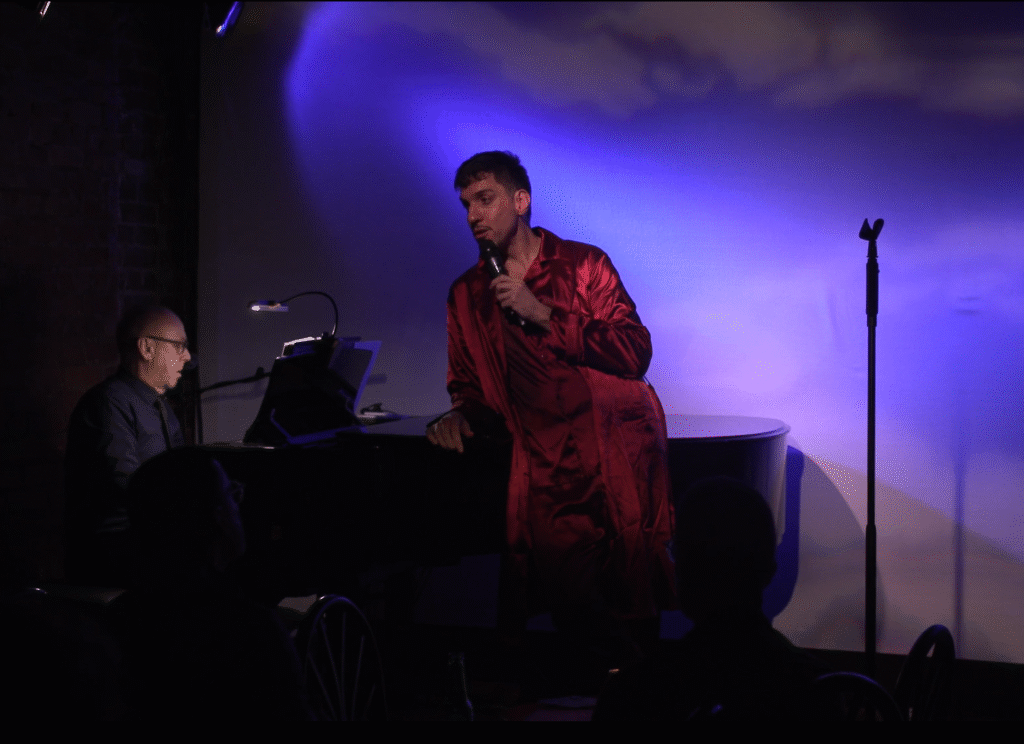
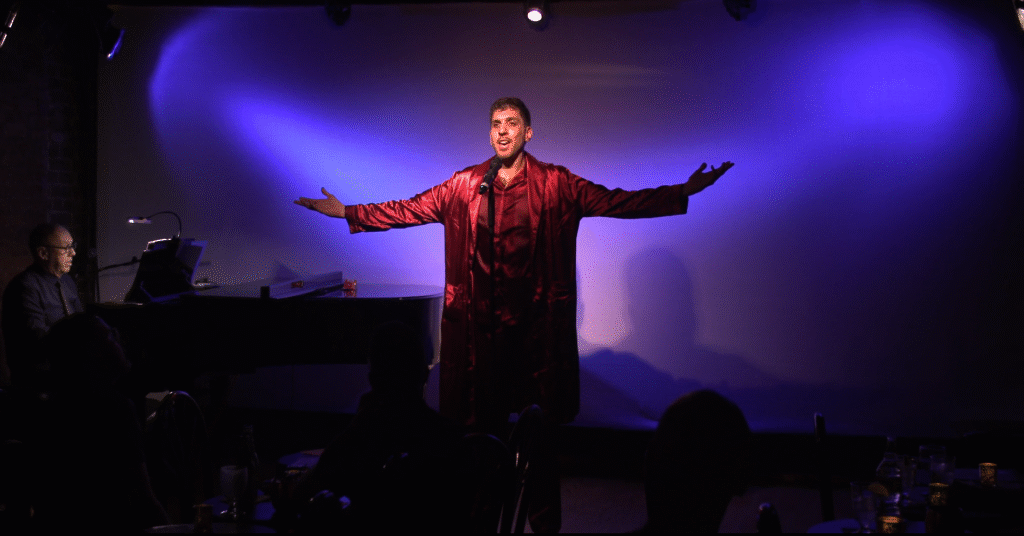
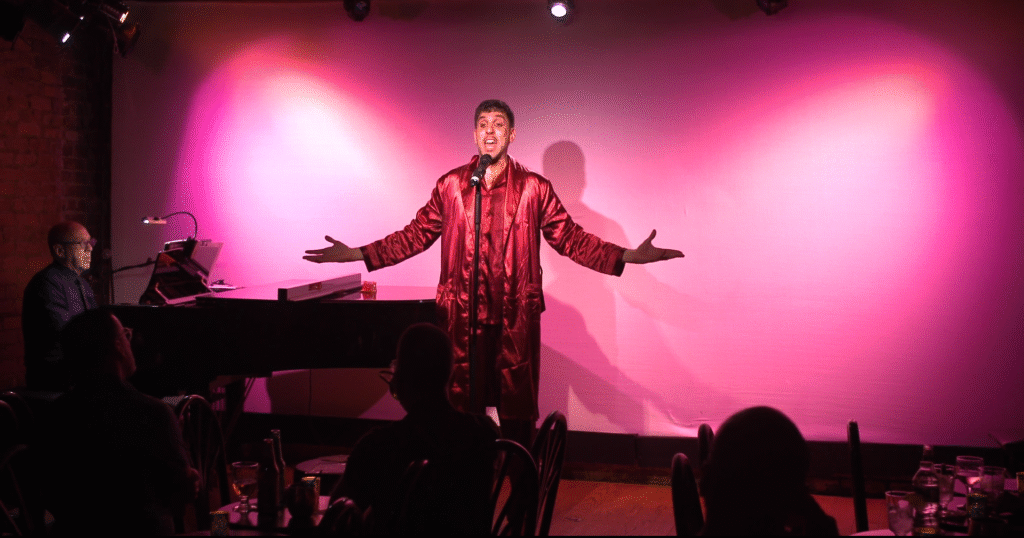
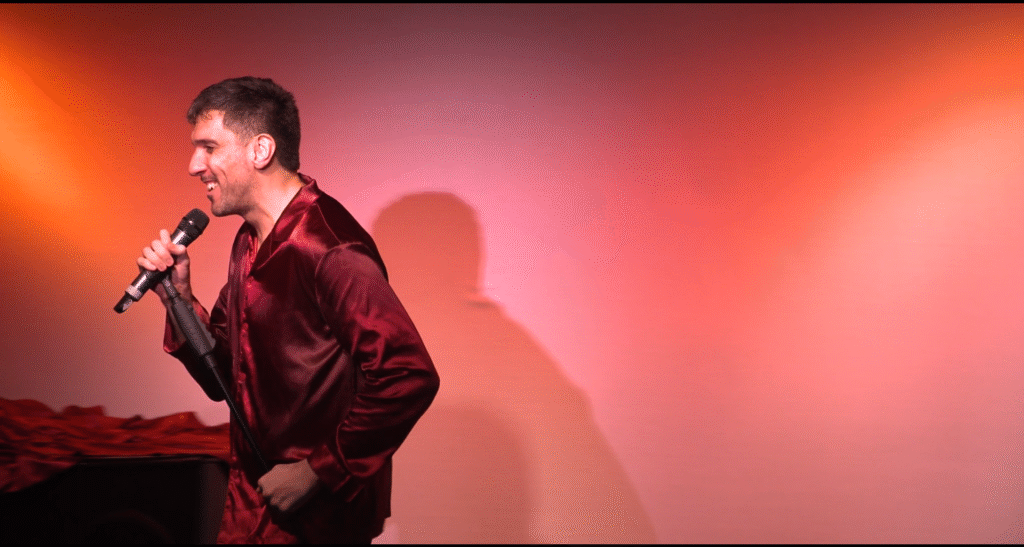
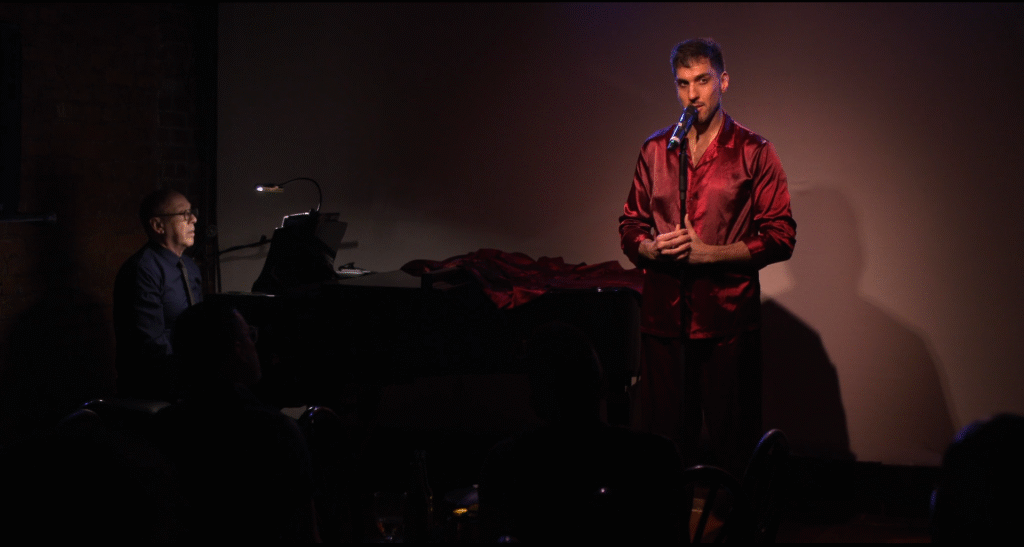
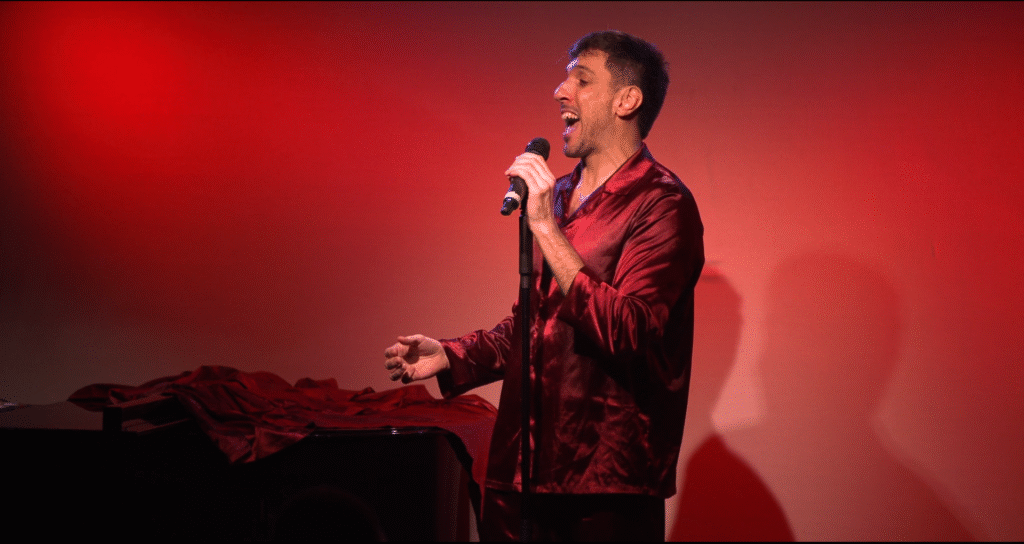
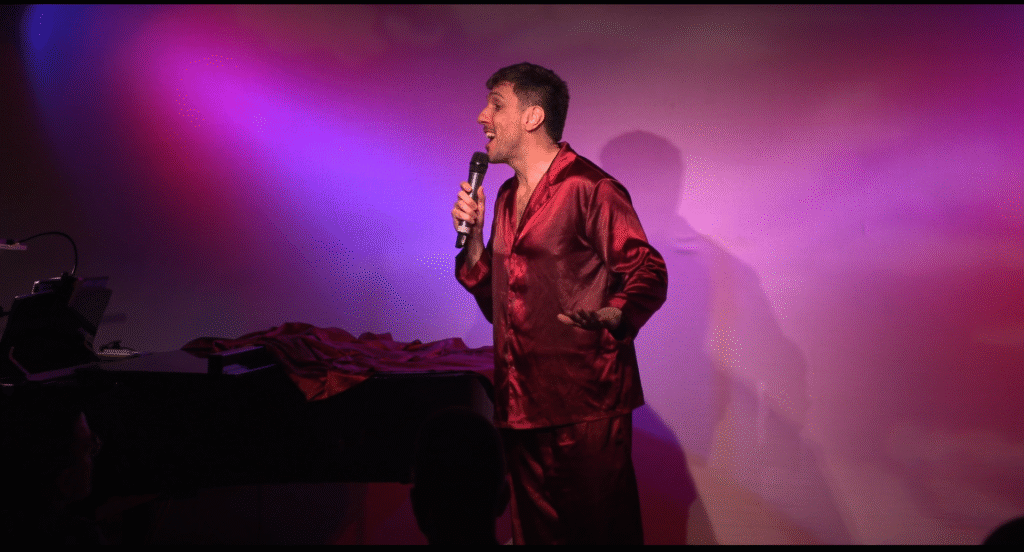
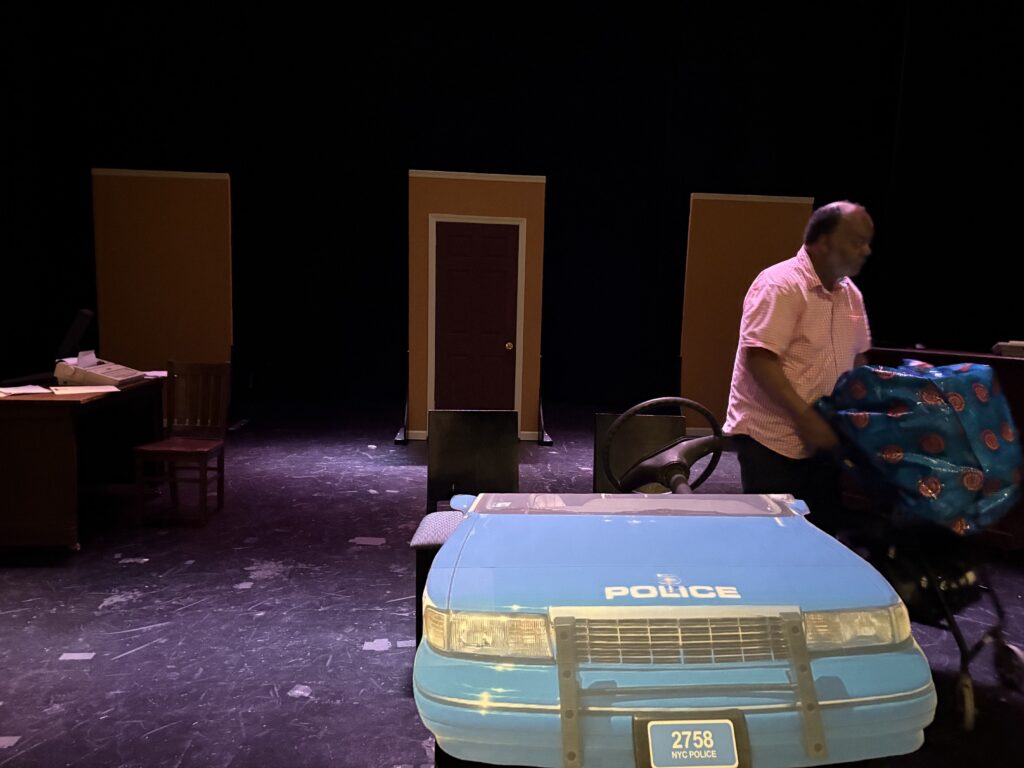
Conceived and created by Anthony Logan Cole and Angela Buccinni-Butch, Cirque Le Swing is unlike any theatre I have seen before. Set as an “immersive supper club experience”, this show delivers exactly that.
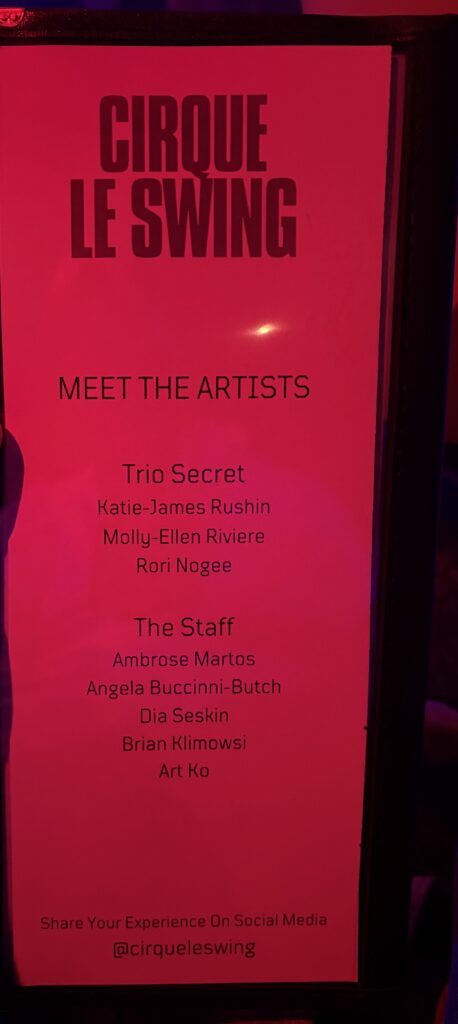
Performed inside a small and intimate venue with chairs, stools, and even sofas to help establish a relaxed, comfortable, but ultimately classy environment. The room is dimly lit and three people are in the back. One plays the keyboard (Katie-James Rushin), another plays the drums (Molly-Ellen Riviere), and the third is the host of the evening, Evie (Rori Nogee) who create a cabaret-esque vibe. The three of them make up Trio Secret who maintain the vibe and tempo through music and vocals. Once you enter the establishment and check in, one of the first people you’ll likely encounter is Mr. D. (Ambrose Martos). He takes his job very seriously. He’s the Maître D’ and takes pride in providing a fun and classy experience for his patrons.
Rori Nogee and
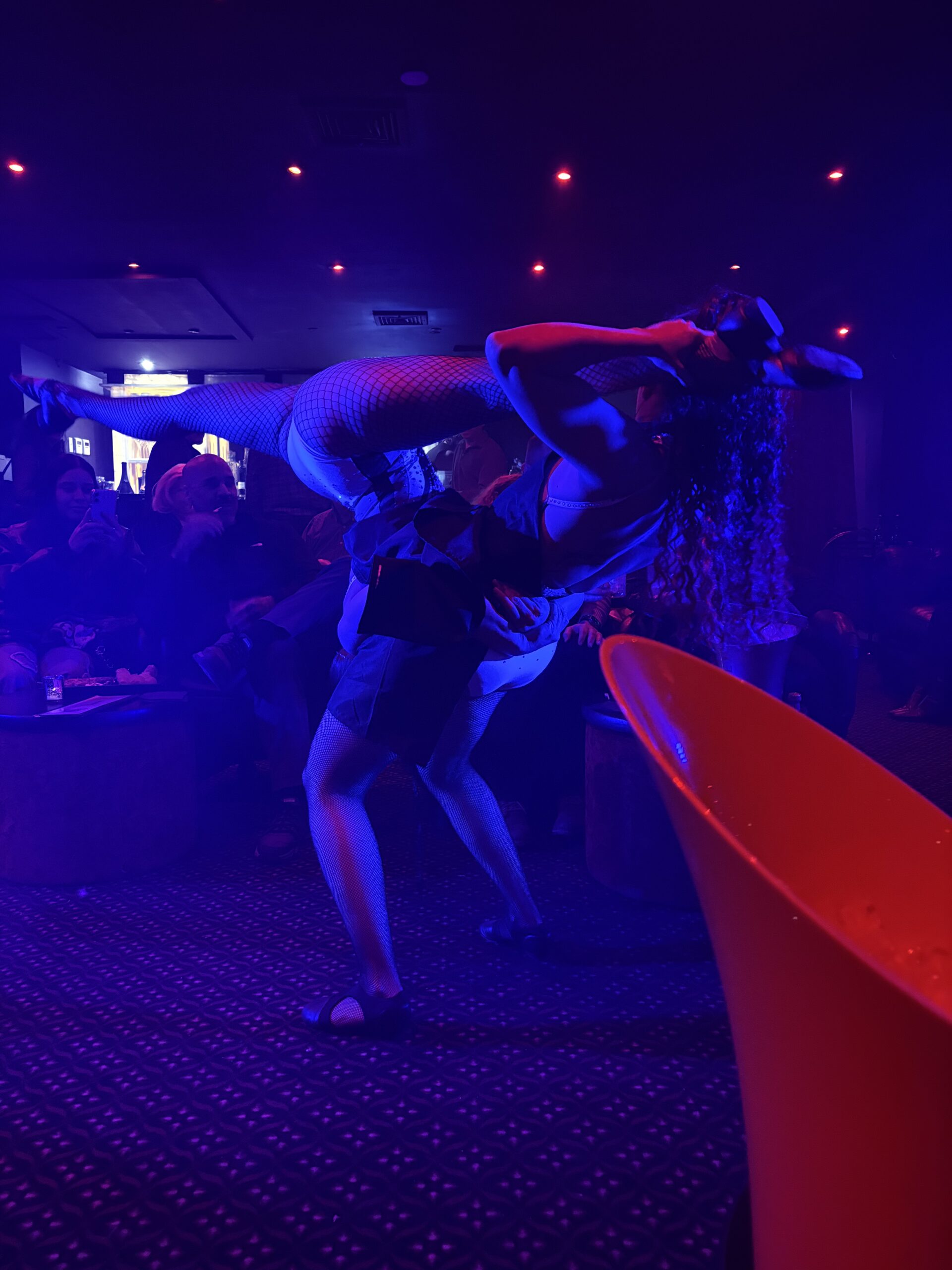
Despite the wishes of Mr. D. the staff has a tendency to go a bit overboard and become the entertainment. Butchie (Angela Buccinni-Butch) and Dia (Dia Seskin) are the worst offenders. They are often sneaking behind Mr. D.’s back to play games with the audience and show off their skills as contortionist, hand balancing, archery, and more.
Cirque Le Swing truly is immersive, so be prepared to play a game, if asked to. They are all fairly simple, but silly. Myself and the person sat at my table were tasked with playing ring toss with the reward of our champagne being “poured in a fun way”. The rings had to be tossed around the legs of a performer, in a handstand, and doing a split. After both succeeding on the first try (a thing they claimed has never happened before), one performer climbed onto the shoulders of the other, and poured our champagne in an admittedly fun way. Other games included a ring toss around bottlenecks, tossing small objects into bowls, and other carnival style games.
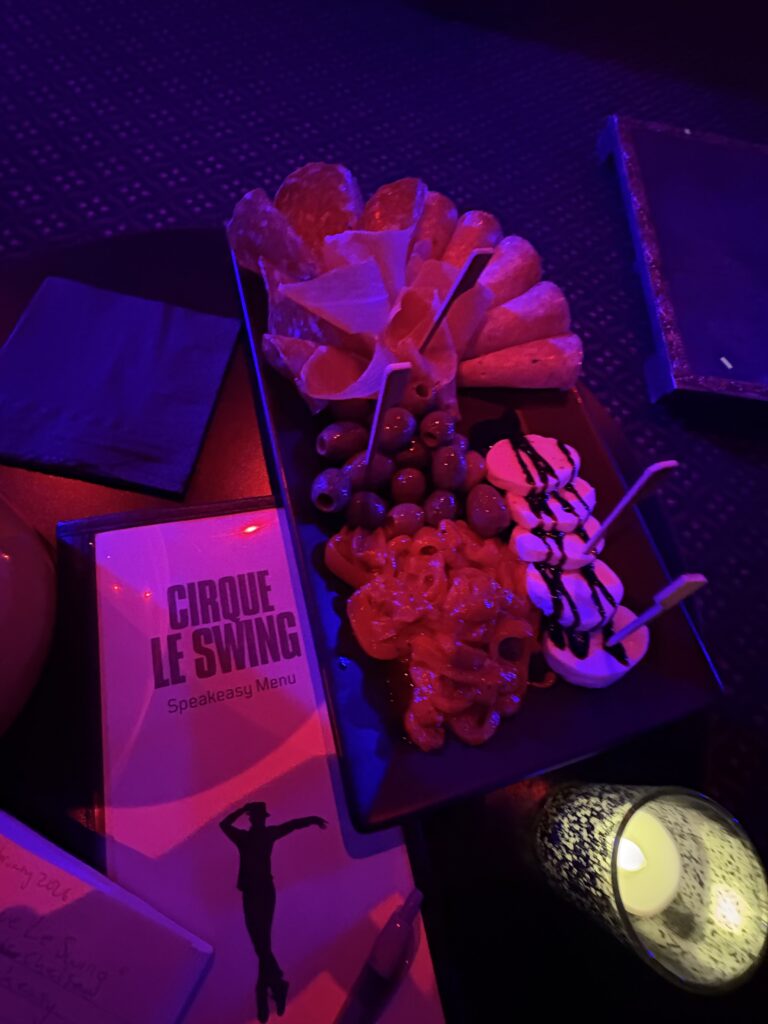
The evening’s menu and a selection of hors d’oeuvres
As the show is about to “begin”, Mr. D. addresses the crowd to awkwardly assure us about the quality of this establishment. He delivers a witty, tongue-in-cheek speech claiming this to not be some gimmicky place like “Ellen’s Stardust Diner or Mars 2112” while maintaining a clearly nervous demeanour, apologising for his staff, hoping we enjoy our evening, and quickly exits.
Evie takes the stage to sing the first number. With each song, it becomes more and more obvious that Nogee has a brilliant voice! Not only can she sing, but she can belt! Evie has the ability to be sultry and seductive, but can also lament and sing with full soul. As host, she announces breaks in her set and the arrival of food. Despite being on a “break”, Evie (and sometimes Mr. D.) are often interacting with the audience as dinner is served. It is also during these breaks that the majority of the circus tricks are performed.
With the circus coordination of Angela Buccinni-Butch, the audience is treated to a variety of live and up-close circus acts. Many of the acts contain a level of danger with the audience being shifted around as needed to ensure everyone’s safety. Combined with the stage direction of Anthony Logan Cole, Cirque Le Swing exemplifies how fun immersive theatre can be.
Trio Secret; Katie-James Rushin, Molly-Ellen Riviere, Rori Nogee. The Staff; Ambrose Martos, Angela Buccinni-Butch Dia Seskin, Brian Klimowsi, Art Ko
Combining romance, circus acts, a good meal, comedy, and improv that was so flawless I was left questioning if two of the audience members were actually plants of the production (they were not, but their timing and quips to each other were impeccable). Cirque Le Swing is impressive, fun, and something I would definitely see time and again.
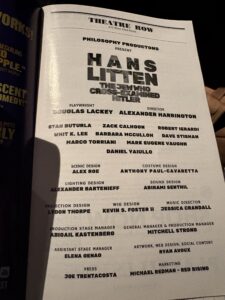
Written by Douglas Lackey and directed by Alexander Harrington, Hans Litten: The Jew Who Cross‐Examined Hitler recounts the true, but often forgotten (or at least untold), historical event in 1931 where Hitler was subpoenaed and called as a witness in a German criminal trial. Dubbed the Eden Dance Palace case, the trial concerned Nazi stormtroopers who entered the Eden Dance Palace, a known communist hang‐out, and were involved in a fight. After sustaining injuries, the communists have brought a criminal case against the stormtroopers involved, who claim self defence.
Cast and Crew of Hans Litten: The Jew Who Cross-Examined Hitler
In German criminal court, the victims are allowed to call witnesses and question them, via a private prosecutor. Hans Litten (Daniel Yaiullo) was the private prosecutor for the communist members injured at the Eden Dance Palace. Therefore he was the one to personally question the Nazi stormtroopers and other appropriate witnesses, including Adolf Hitler (Zack Calhoon).
Hans and his law partner, Barbasch (Dave Stishan) have a reputation for representing clients who cannot afford a lawyer, regardless of their background. This means representing some clients who are members of the communist party; a fact Hans is unbothered by. For him, the political affiliations of his clients are irrelevant. What matters is without Barbasch and himself, the clients would not have representation. Hans knows without proper legal representation, the average person is at a disadvantage against the judicial system. This power dynamic, often created due to financial means, renders the idea of true justice impossible in Hans eyes.
The play opens with Hans and his father, Friedrich (Stan Buturla), discussing Hans future. Hans is a young man. An intellectual with dreams of helping others with his art. He’s hopeful, but also naive. He believes in people and the good they can achieve. With a love for classical music and poetry, Hans fully believes in “universal truths” — ideas, morals, concepts, etc. that supersede individual societies and are simply true regardless of nation, backstory, or any other influence or factor. A notion that Friedrich, a university college professor himself, has more difficulties with.
Due to his hope and faith in humanity or perhaps his naivety, Hans truly cannot fathom how the average German can read the words of Mein Kampf and/or listen to Hitler’s spoken rhetoric and then vote him into power. Pointing out the violent and divisive language used by the Nazi party’s leader, Hans truly does not understand how anyone can run on, let alone succeed with, a political platform based in hatred.
What Hans does understand, though, is the power of words. After the attack at the Eden Dance Palace, Hitler and the Nazi party officially adopted a zero tolerance policy against violence and insisted any members found to be in violation of the new policy will be dismissed.
So when the opportunity presents itself, Hans cannot think of a better way to showcase the hypocrisy, violent nature, and consistent track record of Hitler’s political rhetoric than by questioning the rising political figure himself in a court of law.
I imagine the role of Adolf Hitler must be a difficult one to portray. Calhoon’s depiction came across as a deeply layered one. His voice was not booming. His demeanour was almost weak. The tension and struggle to maintain control over his voice, facial expressions, and body language as he seethes in anger and humiliation gives the audience a peek into how depraved he truly is. Without coming across as sympathetic nor shying away from the reality of who Adolf Hitler was and all that he did — Calhoon manages to exude a physical presence of a tiny man, but one who is barely holding back his true emotions. One who is only using restraint for the sake of his own reputation and personal political gain.
The audience does not need to have any prior knowledge of this specific historical event to thoroughly understand, enjoy, and take meaning from this show. The sets piece themselves combined detail with simplicity. Designed by Alex Roe, the scenes taking place within The Law Offices of Barbasch and Litten are filled with tiny details including specific books lying around and the music playing. Yet, as Hitler rises to power, the sets become less defined. More and more detail is left to the audiences’ imagination including the barrack walls holding some of the male Jewish prisoners at the Dachau Concentration Camp.
The set design Hans Litten: The Jew Who Cross-Examined Hitler
The costumes throughout the show were done subtly at first. However, in a parallel of the historical events surrounding Hitler’s quick rise to power, they rapidly change. Designed by Anthony Paul-Cavaretta, the first notable difference in clothing is a tear in the trousers of Hans suit. The next big costume change hits much harder. The striped uniform, the yellow star, and all the emotional weight those items carry stood centre stage, vulnerable, broadly, and saying so much without uttering a word.
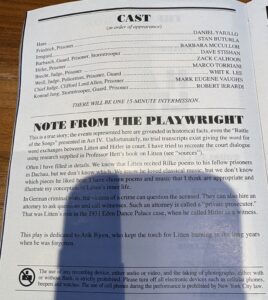
There is not a large amount of information to be found on Hans Litten, a fact stated within the playbill itself, in a note from the playwright. There are no court transcripts of the trial remaining. Even minor details including which specific Rilke poems Hans recites or the particular classical composer he loves were filled in by Lackey using a combination of research and judgement to keep the pace and vibe moving along.
Hans Litten: The Jew Who Cross‐Examined Hitler, covers many themes that very well may be the universal truths Litten describes in this show. A sense of belonging, even when it’s not with the group you consider yourself a part of is prominent. Self sacrifice for the greater good of others is also explored. Additionally, the importance of family, the internal struggle of knowing a loved one is being harmed, but also being unable to prevent it. Grief, acceptance, loss of innocence, loss of control, naivety, understanding, self‐preservation, and even hope are at the core of this play. Perhaps most importantly, it is a call to action and a reminder of the consequences inherent with compliance.
Written by David Gutierrez, Retraction is based off a true story. This play warns of the dangers caused by inaccurate journalism and does not shy away from the ramifications faced by the journalist, those mentioned in the article, and even the entire movement it intended to help.
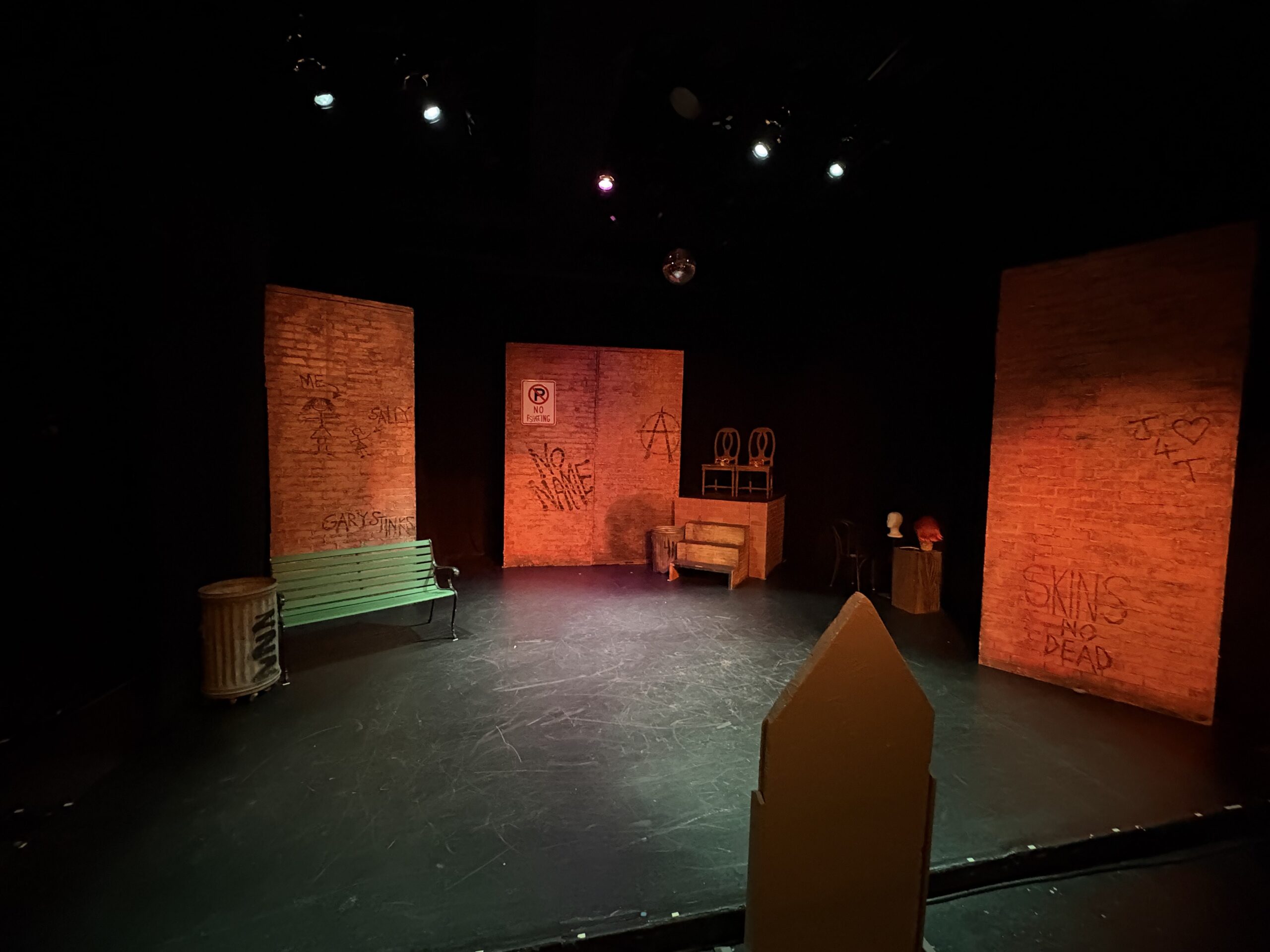
Directed by Caroline Fairweather, sound designed by Katie Reif, and a clever set designed by Julian von Haubrich this show uses projections to keep the audience informed of the date as well as overlapping spoken quotes to drive home just how overwhelming and devastating this real event was to everyone involved.
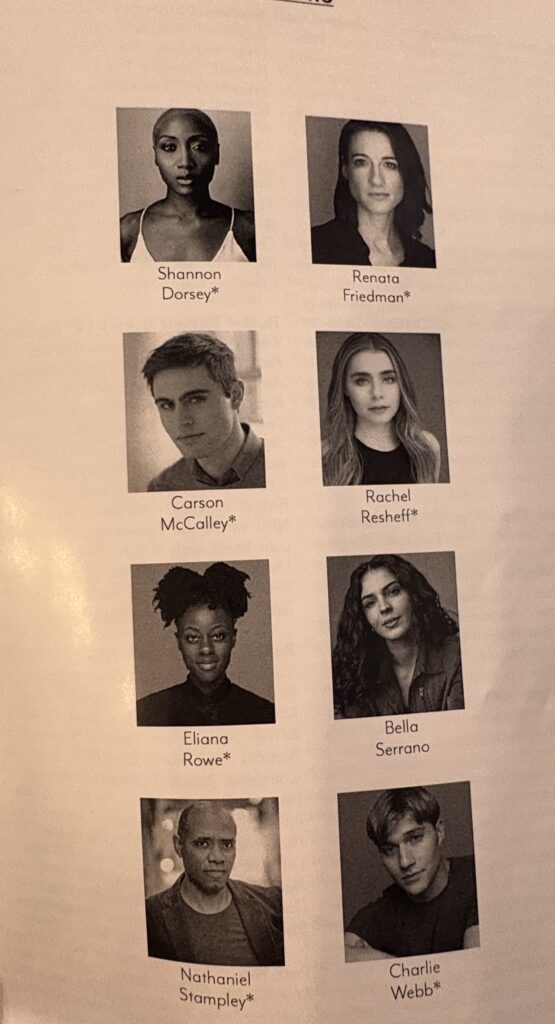
The play follows Wendy (Renata Friedman), an experienced journalist with a focus on sexual assaults occurring on college campuses. She settles on one particular rape case to be the focal point of her article — a violent gang rape, which the play takes great care to admit is far from the typical sexual assault cases reported by colleges and universities. The audience is introduced to Lacey (Rachel Resheff) who is the central figure in Wendy’s article. Her friends Chris (Carson McCalley), Melissa (Eliana Rowe), and Travis (Charlie Webb) all seem to have a different memory of the night in question and convey a multitude of conflicting emotions. Beyond that, Dean Gasso (Shannon Dorsey) the Dean of Carolina Atlantic University is vitally present as well as Zack (Nathaniel Stampley), the editor and person with ultimate approval of what gets published. Additionally there is a sexual assault survivor, Gillian (Bella Serrano) who understands the larger implications a false report may bring and Victor (Carson McCalley), another prominent journalist working to question the accuracy of Wendy’s article.
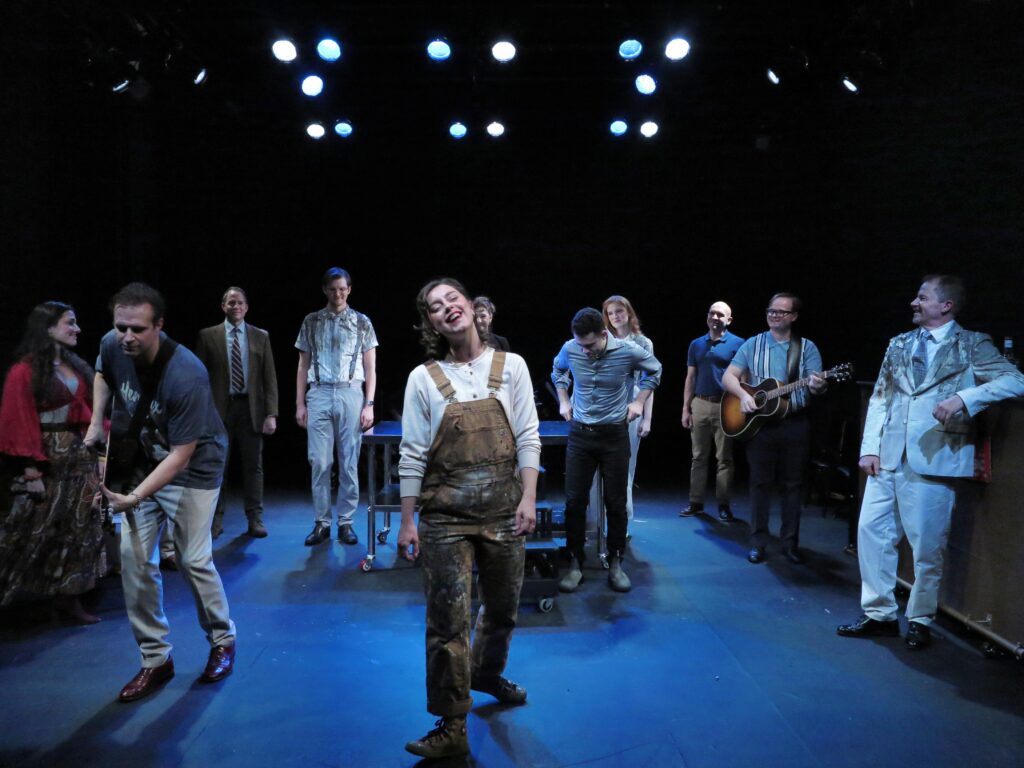
The Cast of Retraction
Dorsey, McCalley, Rowe, Serrano, Stampley, and Webb all take on more than one role. However, I found it difficult to distinguish when some of these role changes occurred. Dorsey also played Reporter #2, McCalley doubled as both Chris and Victor, Rowe portrayed Ms. Moore as well, Serrano also played Karina, Webb doubled as Reporter #1, and Stampley also portrayed Lawyer #2 and Reporter #3.
Most of the time, the distinction between each character an actor played was clear, but not always. When an actor begins reporting on breaking news, it is clear that is a reporter. When an actor is portraying a lawyer as well as one of the people questioned by another lawyer, that clarity becomes less defined. I found the clarity to halt altogether with the characters of Ms. Moore and Karina — nether of who I remember as distinct characters.
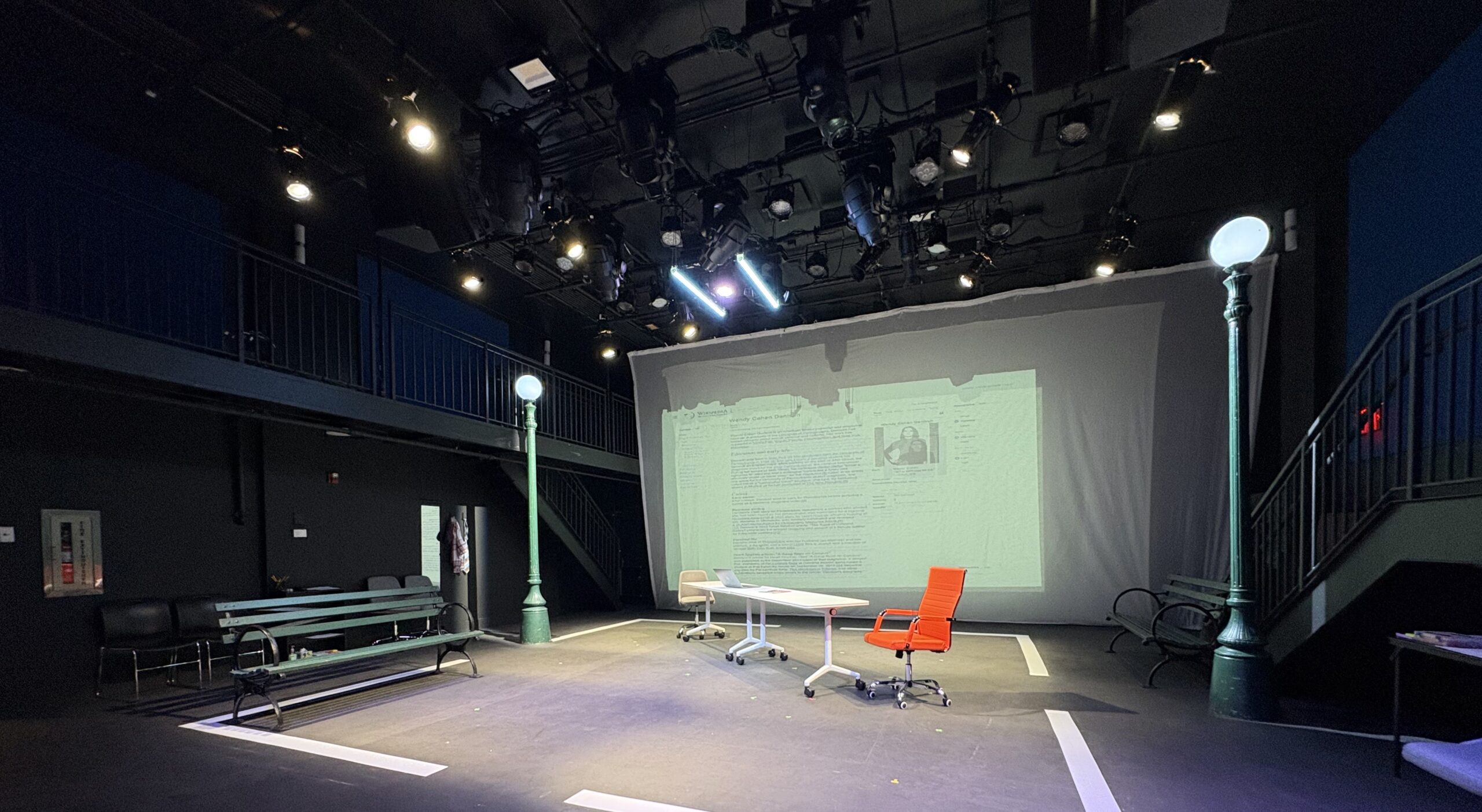
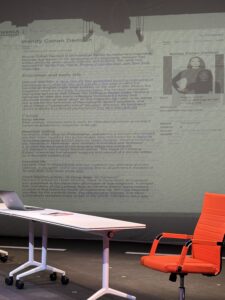
I thoroughly enjoyed how malleable the set is. Using rolling chairs and two folding tables with wheels, the scenes were able to change quickly, freely, and without disrupting any action on the stage. Combined with the use of projections showing everything from the Wikipedia page of the real life Wendy, to emails, and even the date of every prominent plot point — the play felt smooth and well practiced. Since the plot is told in a nonlinear way, it would have been hard to keep track of when the various things happened. That being said, even with the dates easily seen, I’ll admit at times I was still lost.
Projections were used throughout the show. Here, the Wikipedia article of the real Wendy
Retraction recounts the same situation through various perspectives. Beyond the aftermath and everything that encompasses, the audience is left to wonder who, if any of the characters are truly reliable narrators? The answer is unfortunately one I think many don’t want to admit — none of us are. The truth is, memory is fallible. When humans remember a past event, it is not the actual event being remembered, but rather the memory of the last time the event was thought of.
Two people can tell the same story, both whole heartedly believing what they say and seeing it as absolute truth, and both accounts being completely different from the other. The same event can be unrecognisable when told by someone else. I appreciate how subtly this is portrayed throughout while also being a core element.
Retraction is intended as a dire warning against blind belief and a reminder of the consequences — legally, emotionally, and even harming the very thing you were trying to advance. I only hope the audience pays enough attention to it.
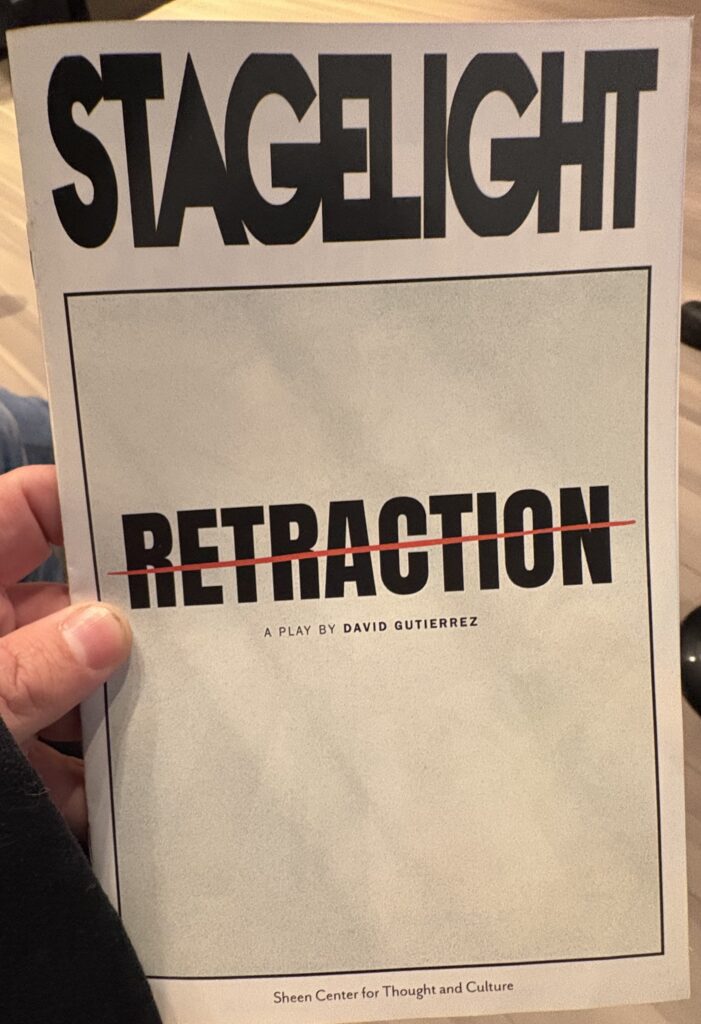
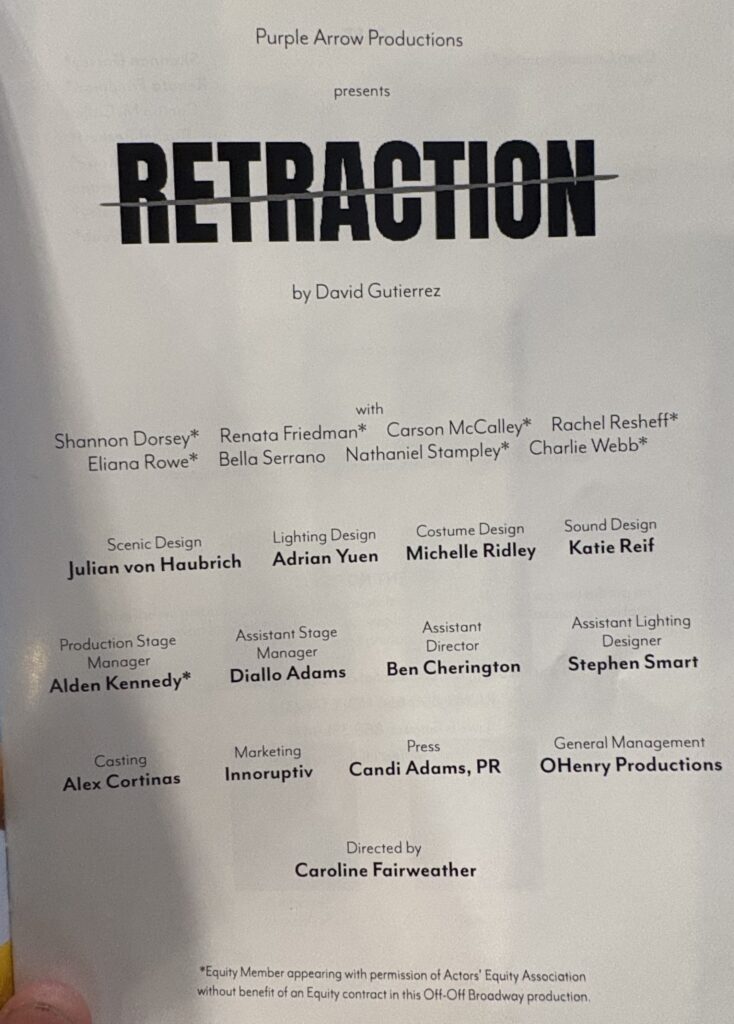
Retraction‘s Program front cover (left) and Cast and Crew list (right)
Written and directed by Mark Tunstall, Always Young is about rebellion, memories, desire, what it feels like to be an outcast, and so much more. It takes the concept of the misfit, those who feel alone, lost, unable to fit in with societal cliques and turns it into dark, gritty, sometimes campy, but always brutally honest comedy wrapped in a message of hope.
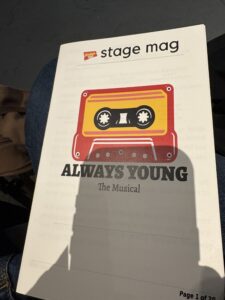
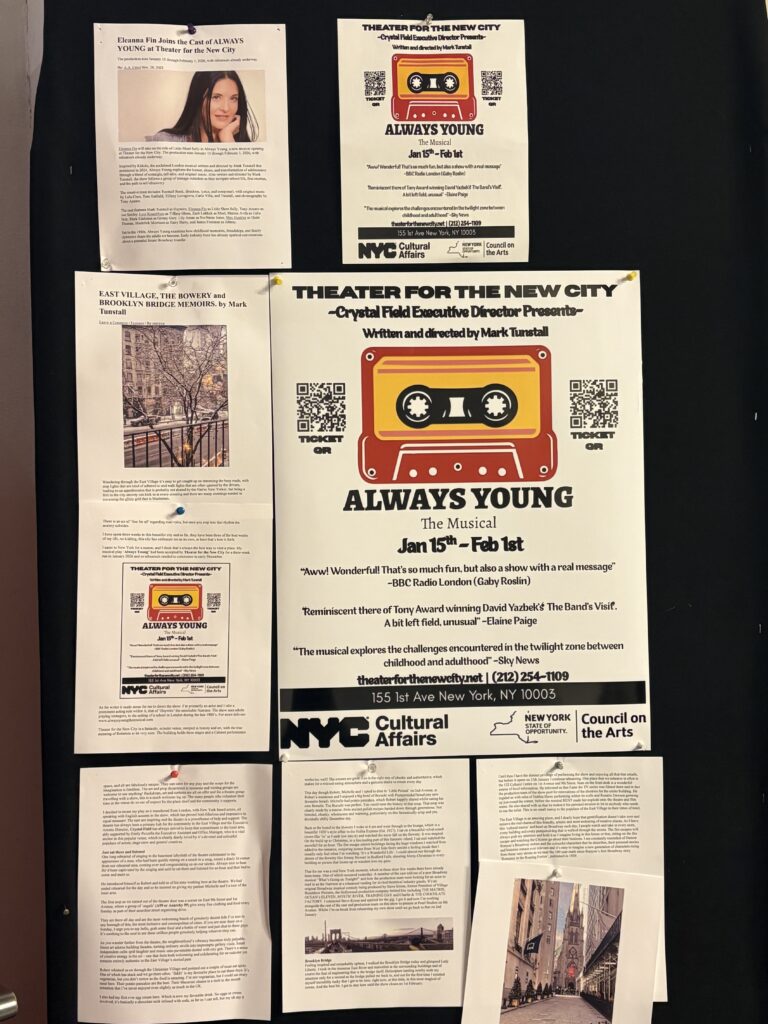
The Program of Always Young The Musical (Front Cover)
This musical explores how easily children can slip through the cracks of society, unnoticed, regardless of background or social standing. The audience is left to consider “why” that happens, how to change it, and just what type of impact you have on those you know. Everyone, even those who feel alone, still affect everyone around them …even if they are unaware to doing so.
This show is dark, gritty, funny, but most importantly — it’s real. The emotions expressed are raw, complex, taboo even, but always genuine.
Always Young follows the character of James “Haywire” Hayward (Mark Tunstall) — a self described misfit. Haywire serves multiple purposes throughout. At times he is a self-aware narrator, breaking the fourth wall and exuding a bit of sliminess, but also control. He has charisma and charm with also a hint of danger. Reminiscent of a stereotypical side show circus ringmaster, he is a bit over the top and far from polished. Yet you find yourself unable to look away. He’s a series of contractions — someone who feels distrustful, yet only speaks the blatant truth (and you believe him because in the back of your mind, you know it’s true). He understands manipulation. He understands the connotation of that word. Yet he uses it anyway, unapologetically so, because it’s accurate. Don’t mistake his crudeness though, Haywire is far from a villain. He’s flawed, he knows it. He makes mistakes, he misspeaks, he gets angry, he gets bitter, he can even border on sinister, but ultimately he truly cares. He wants to help. He doesn’t mean to mess up. Just like everyone else, he learns as he goes.
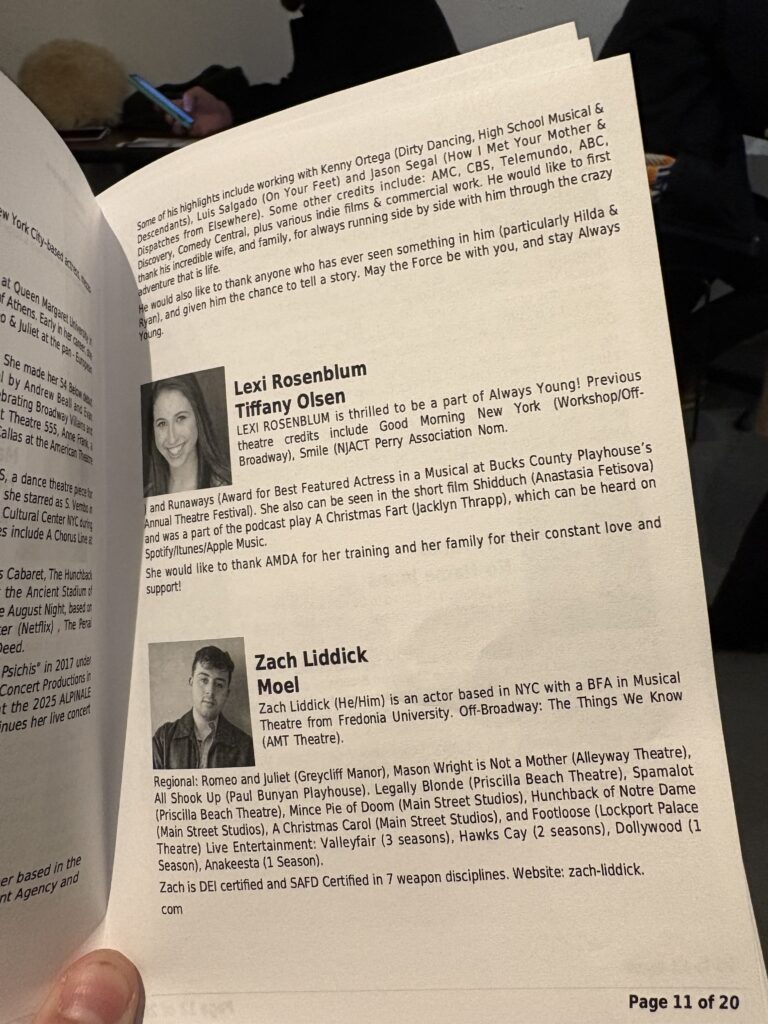
Mark Tunstall’s page in the program
He’s also simply a teenager in school, with his classmates, but not really his friends. He doesn’t know where he belongs. He’s an outcast and he’s angry. He doesn’t have a community — a tribe — who sees the true person behind the hard, rebellious exterior. An exterior he learnt to wear for the comfortability of society, so they never see the depth of his pain.
The show begins at a funeral. The mood is somber, the sound of rain falls, the stage fills with mourners in all black with black umbrellas in hand. The first song begins, soft at first, then rising in intensity as Haywire, the narrator, transforms in front of us, from a simple man into an almost devious, mysterious being. With a knowing look in his eye and a sly grin it’s abundantly clear just how dark he *can* see life, yet mysterious enough to know he’s more layered. Haywire sees life differently than others, or at least differently from how many will admit. For Haywire, life is filled with subjective grey areas.
He understands anger and the need for a rebellious nature. He grasps the power of manipulation and is even a bit of a master it. He learnt how to do this overtime. It began out of anger, a coping mechanism against the bullying and loneliness in his life. Life experience taught him this ability, but also it also taught why it should be used to benefit others.
I felt almost as if I were watching myself on stage. Growing up, it felt like I was the only one who did not see things as purely good or bad. Almost nothing seemed to fit into one category neatly. I saw things as both good and bad, fully dependant on the perspective in which I was approaching the subject or scenario from. I realised how the same person can be called a hero by some and a villain, by others. It became clear if the determining factor of something being good or bad is perspective based, then most things are subjective. Almost everything in life falls into a grey area including the very concept of what is good or bad, what is moral, or even why we live life.
My lived experiences, my personal history tells me the difference between good and bad is how someone chooses to use their power (and we all have some kind of power). Even something with a traditionally negative connotation like manipulation, can be used to help people. It can be used to help facilitate understanding and growth. But, it can also be used to dampen and hinder those around you. Intent, even if not successful, is important. Just be willing to learn from it if you fail (and remember it’s okay to fail, it’s normal to fail, failing is a part of life).
I found, while the entire soundtrack was catchy, fun, and honest — one song in particular stood out for me. “It’s Prob’ly Me” is a number that might as well be my anthem. Sung by Haywire directly to the audience, it exemplifies how it feels to have the best of intentions yet the inability to express them properly for society. The entire song is full of linguistic word play. It applies layers of meaning to the simple act of putting your foot in your mouth — of misspeaking, of using the wrong word choice, and it always being taken differently than expected. Which is something I do often. I choose my words carefully. But I am often lost on the subtext the words may convey because, well, the word doesn’t actually say the subtext. I mean the word as is, no extra subtext. So if something comes off as rude, or crude, maybe even insulting… just know it was probably me. It probably was also not my intention, though.
I am a trans man. I had confidence when I was a child. I was good at sports, I was in shape, I was happy. Then puberty hit. I lost my confidence, my body began to feel like a costume, and eventually I found a stranger looking back at me in the mirror. I grew bitter. I grew angry. Just once in my life did I threaten suicide. My mom understood the grey areas of life, though. She manipulated me out of ever even considering the action. She simply stated, “The dogs will miss you. I may be able to explain to other people why you did it, but it is impossible to explain it to the dogs. They will just know you left and never come back, but they will never understand why.” That broke my heart. I knew it was manipulation, even as a kid. I also knew it was accurate. That’s when I began to understand how manipulation, despite the negative connotation, can be a wonderful tool for helping others.
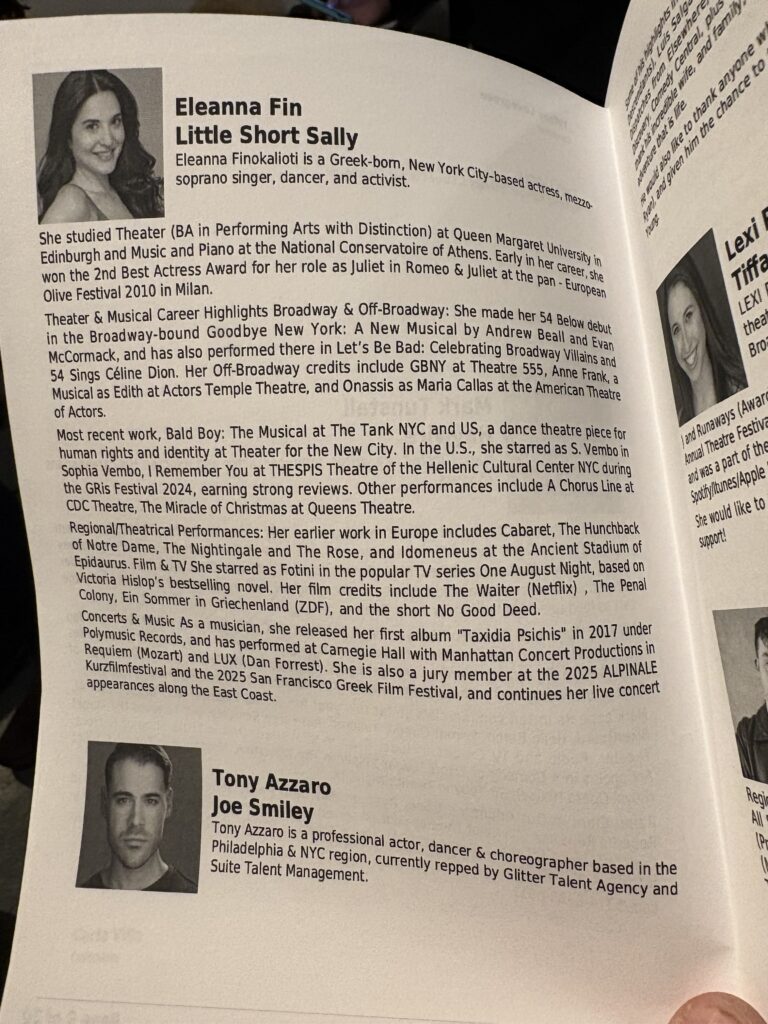
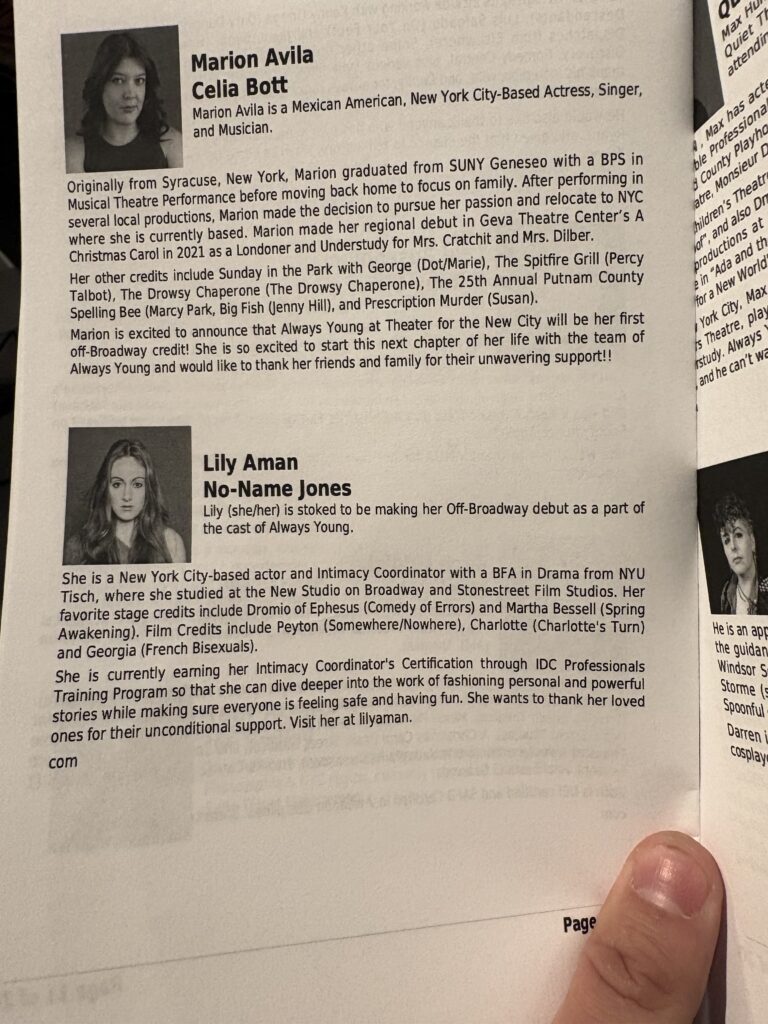
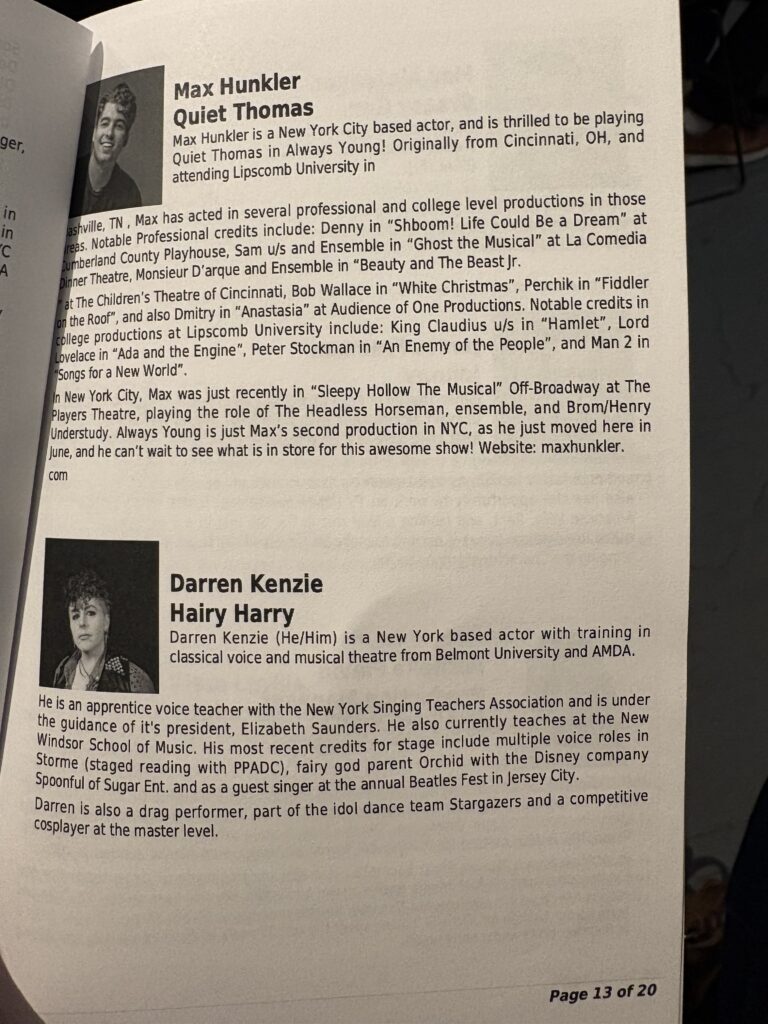
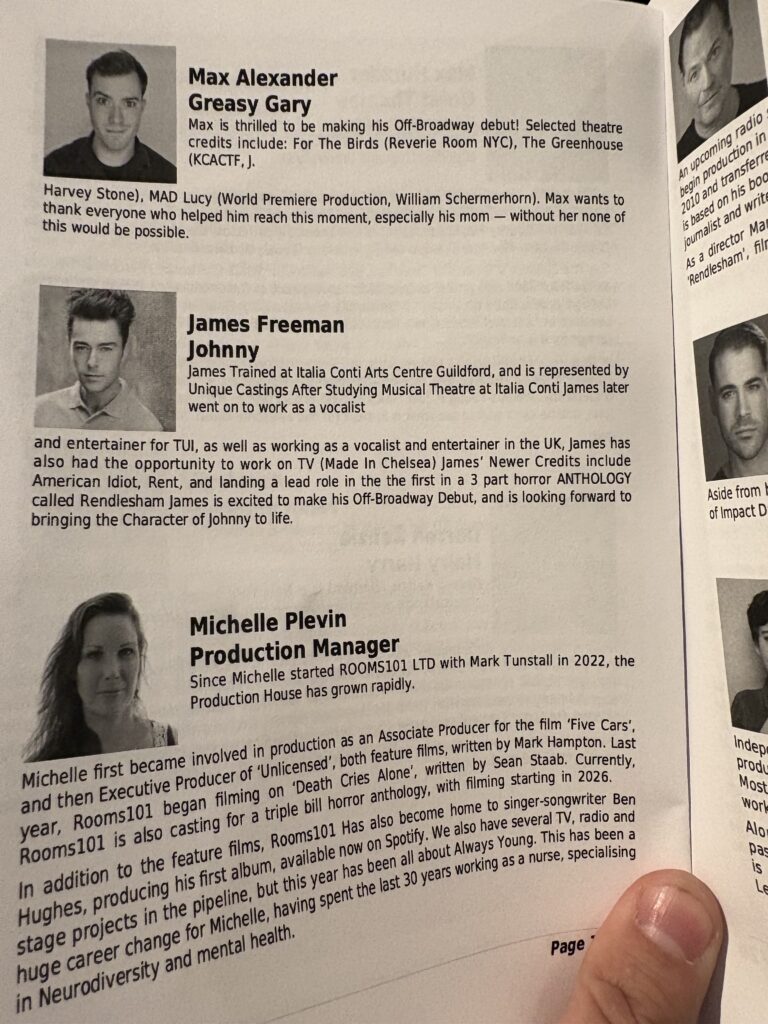
Then the show transforms. Suddenly, the year is 1989, the audience is introduced to the rest of the character — all school students with Haywire. Little Short Sally (Eleanna Fin) is the smallest in the class. Joe Smiley (Tony Azzaro) who doesn’t know how to drop his grin. Tiffany Olsen (Lexi Rosenblum), an American who is desperate to have a new life in England. Moel (Zach Liddick) with a brilliant imagination. Celia Bott (Marion Avila) a foster child. No-Name Jones (Lily Aman) called that because their parents never settled on a name, leaving the character to suffer without an identity. Quiet Thomas (Max Hunkler) who is a traditional, rebellious teen, with an understanding of how powerful silence can be. Hairy Harry (Darren Kenzie) who was given this nickname due to his hair. Greasy Gary (Max Alexander) a child who has a reputation for being smelly, unkempt, even gross. Lastly, there’s Johnny (James Freeman) who lacks a concrete identity, feels he is never good enough, and always aims to be someone else — anyone else — who may be deemed as cool.
Each student is a bit of a stereotype of an “outsider”, which is perfect for a show as self-aware as this. There is even a brilliant moment where almost, if not all, of the cast break the fourth wall only to over explain the upcoming scene to the audience. This perfectly exemplifies the metaphor of sticking one’s foot in your mouth and digging yourself into a verbal hole/grave.
Despite the dark humour, the grittiness, the questionable morals of the characters, even the use of violence to prove yourself to others (a thing I had to do as a child) — Always Young is ultimately about hope, acceptance, and helping others. It refuses to shy away from the subjective nature of life. It’s unapologetically upfront about the complexity of emotions, the dark part of the human mind, and why you should never lose your rebellious way. It reminds the audience that even after death, your legacy, your memory, still lives on.
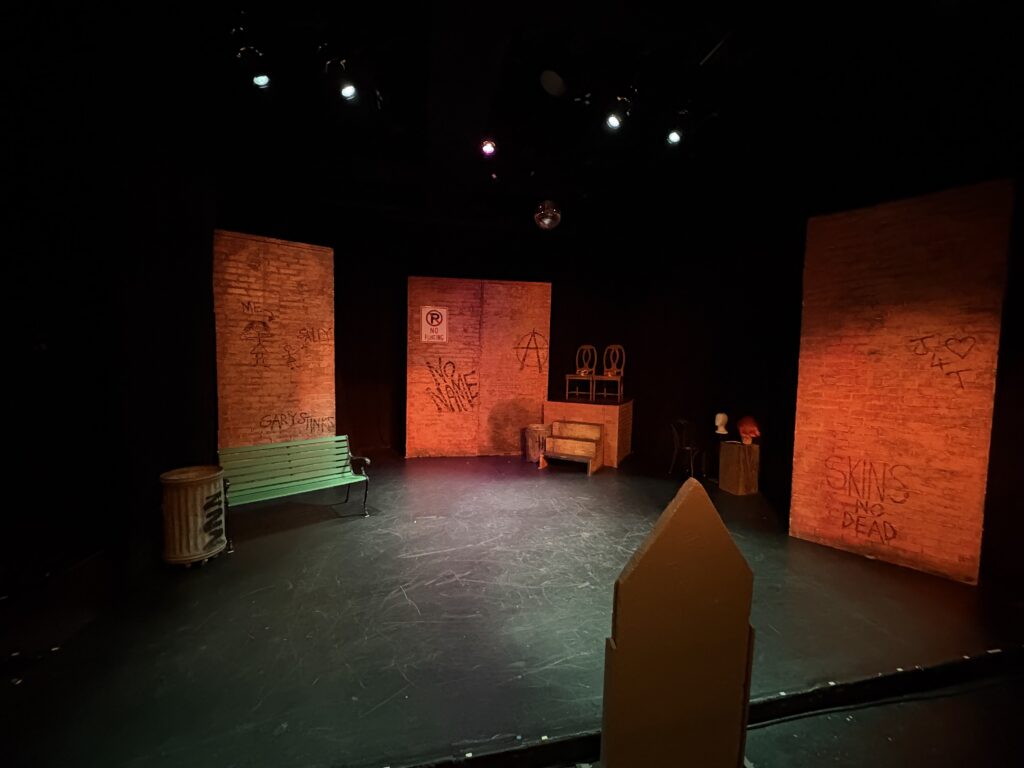
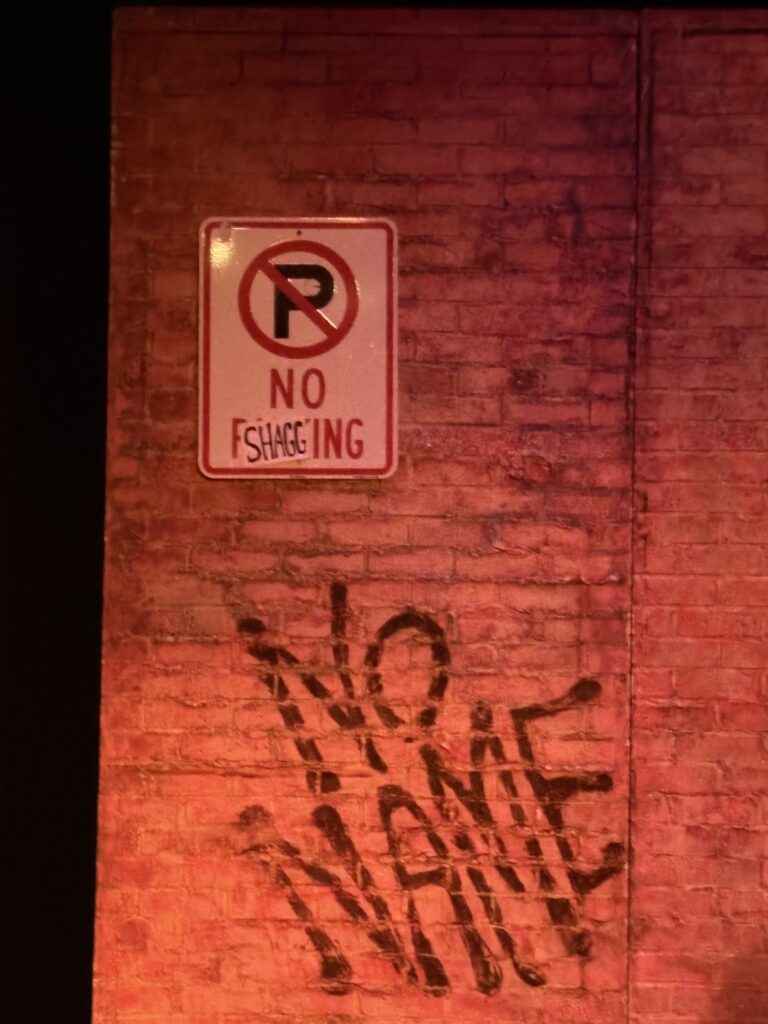
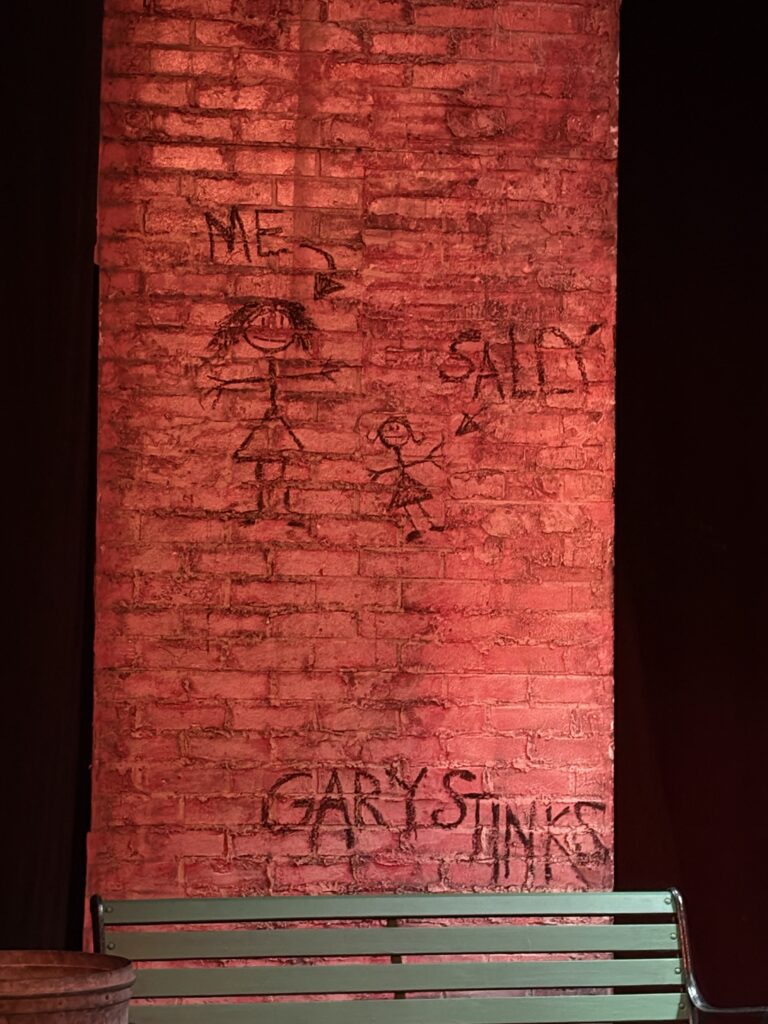
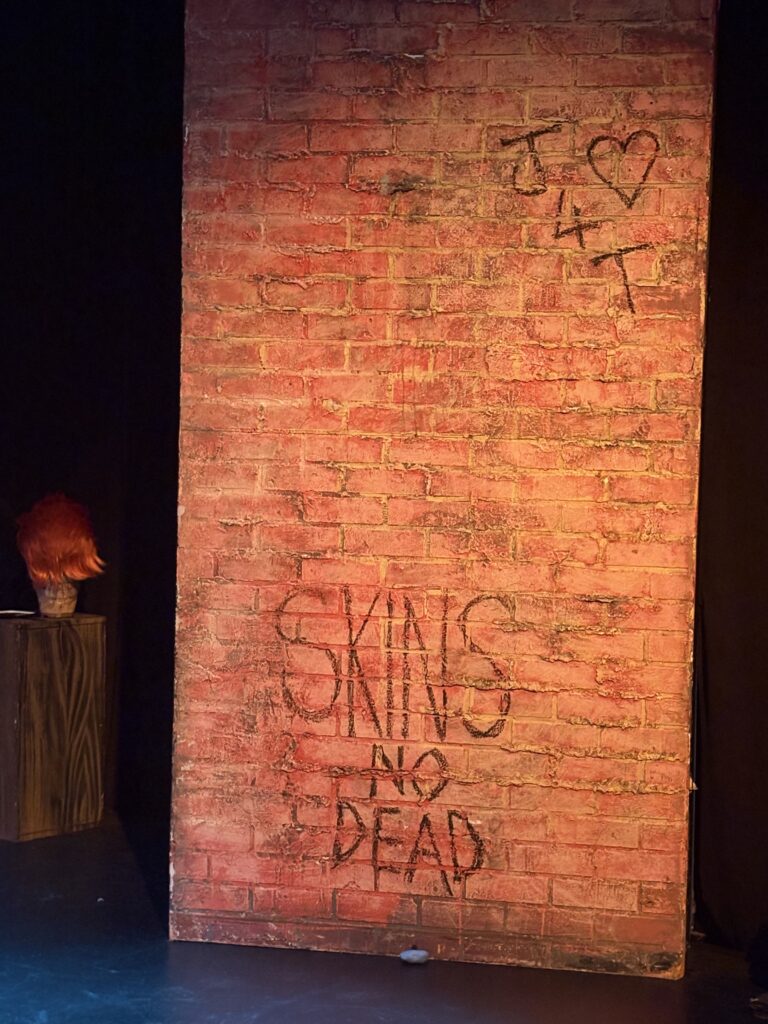
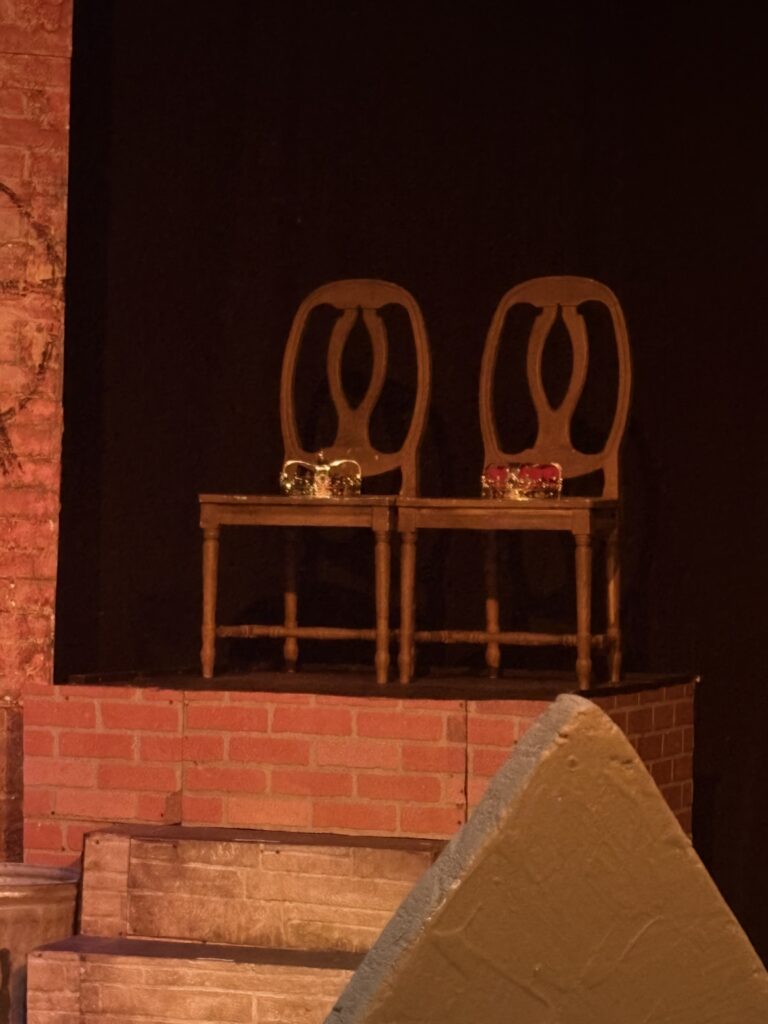
The set for Always Young The Musical
Perhaps it is the final message that is most important — the goal is not perfection. The goal is to try. That’s it. Learn, try, fail, try again. Even if you are unaware of what tribe you belong to, you belong somewhere. So try to help. You may never know if there is a lost soul desperately searching for others like themself and if there is, that person may never realise that you’re also an “outsider”. Sometimes our tribes are a lot closer than we think. It just takes some help from an other to finally figure that out.
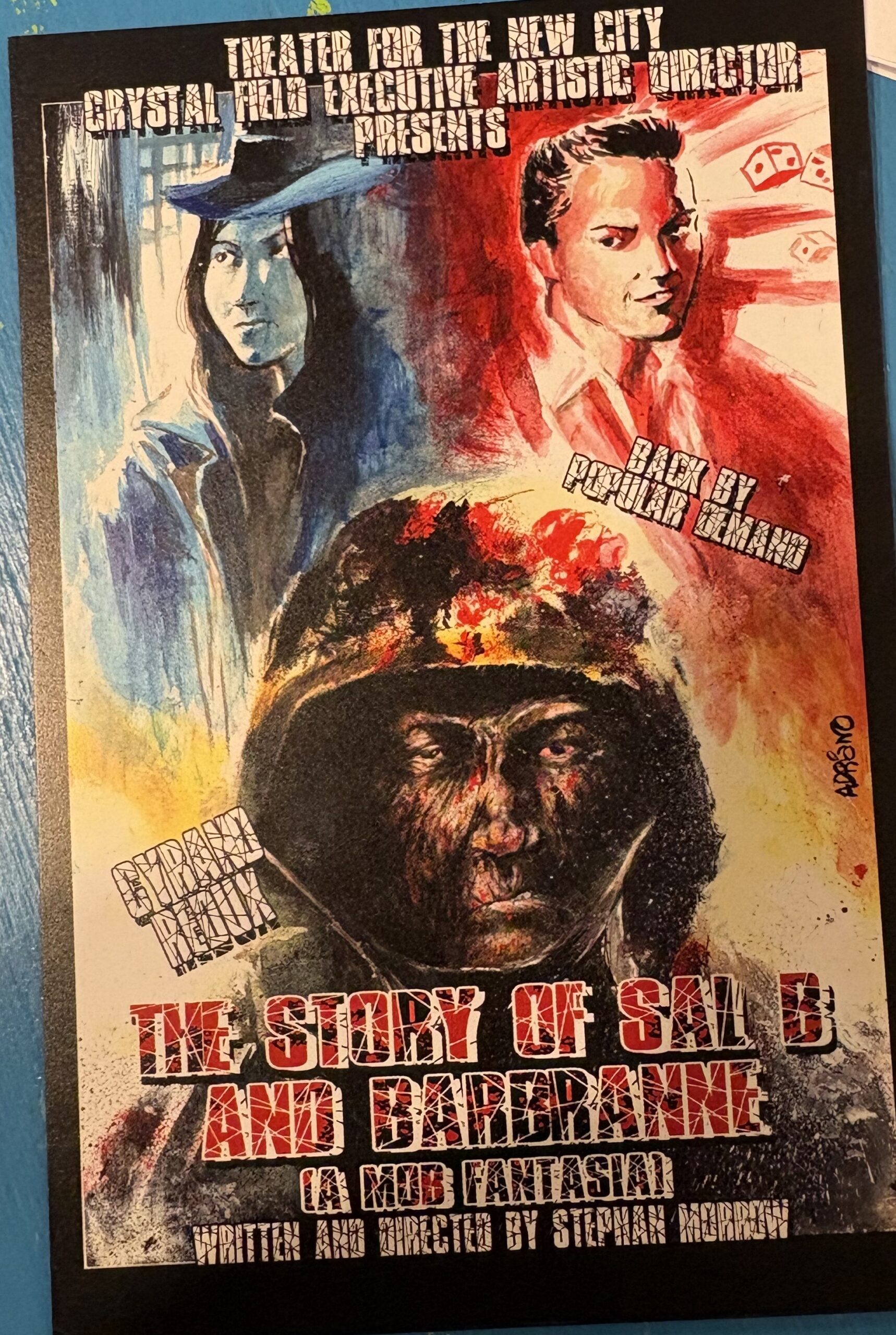
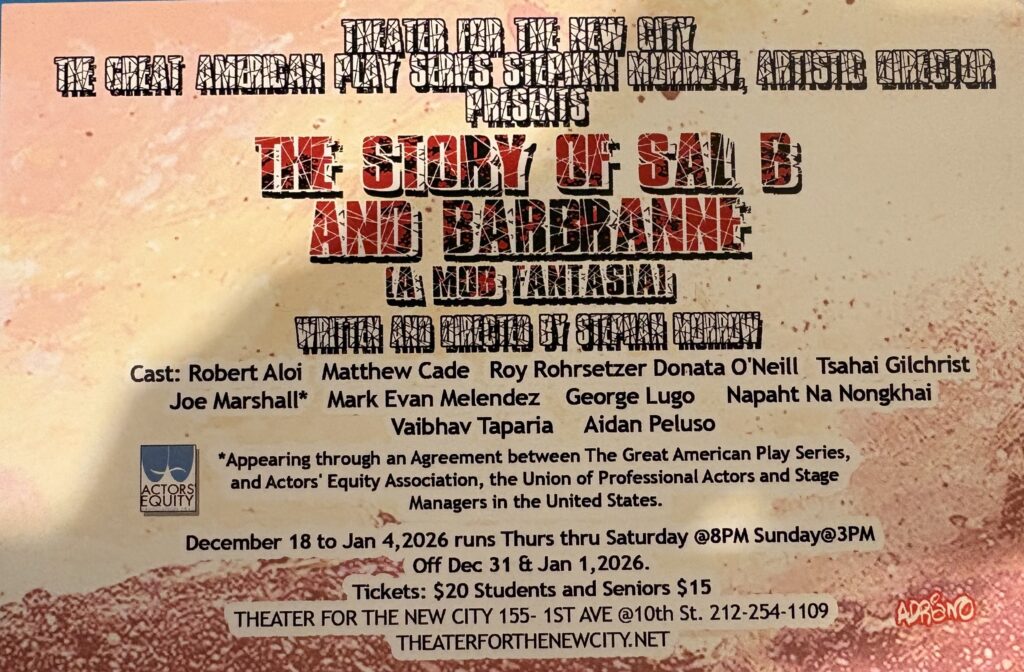
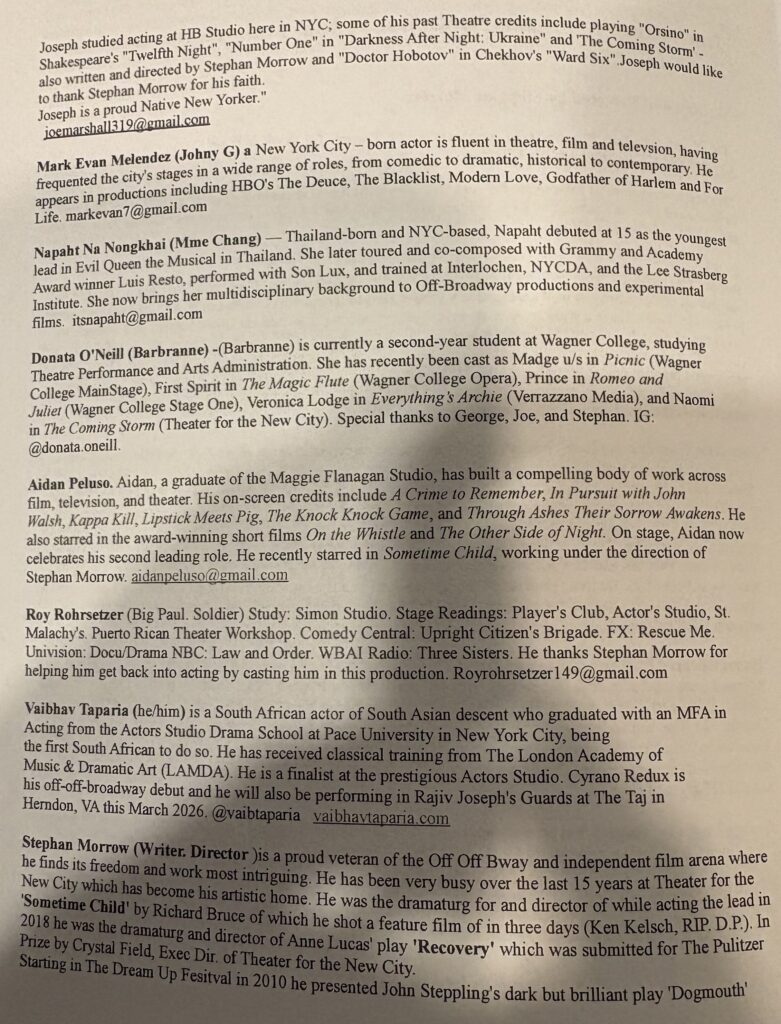
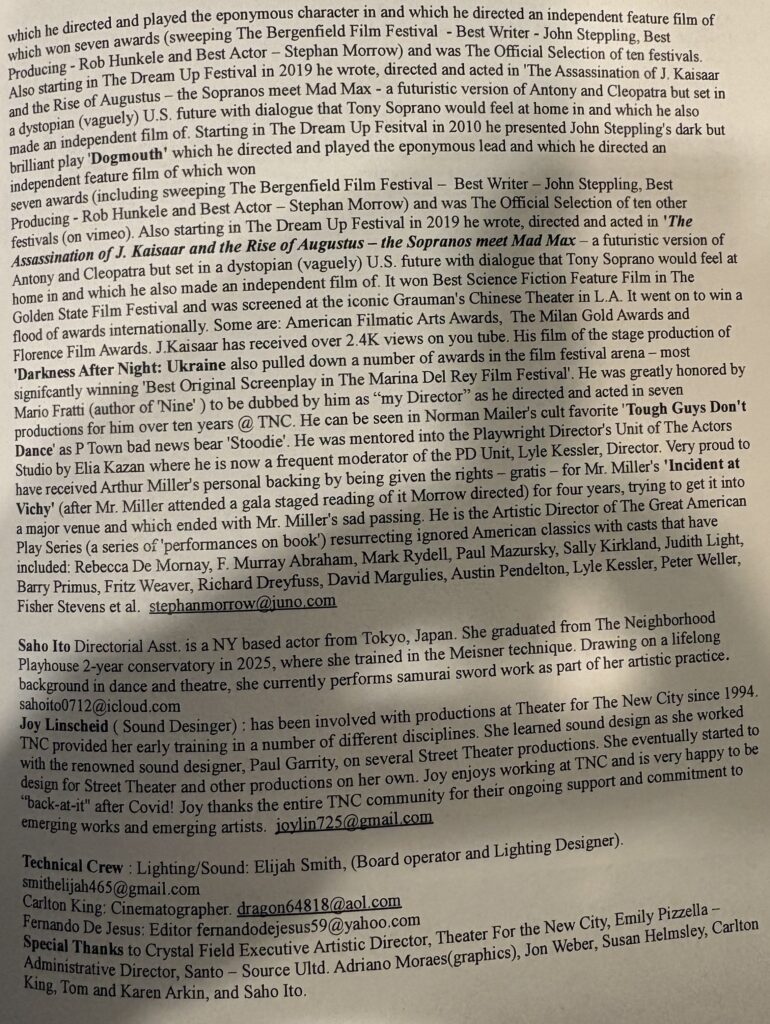
Written and directed by Stephan Morrow, The Story Of Sal B. And Barbranne (A Mob Fantasia), is a “Cyrano Redux”. It’s a re‑imagining of the classic tale set 100 years in the future and after World War III. The mob has merged itself with the United States Military as the country battles with “Eastern enemies” over oil found in the Middle East. As well as the traditional story of unrequited love.
I had some difficulty applying the word “fantasia” to this show. I relate that more to works that are only music. While music is present at times, the majority of the play is dialogue based with songs often setting the mood as scenes change. Many of the songs chosen were famously sung by members of the Rat Pack. In a directorial choice that I absolutely adored, George Lugo, the actor who plays Sal’s closest friend Sy, sang each and every one of these songs live. His voice is phenomenal and never once did it sound tired or felt overdone.
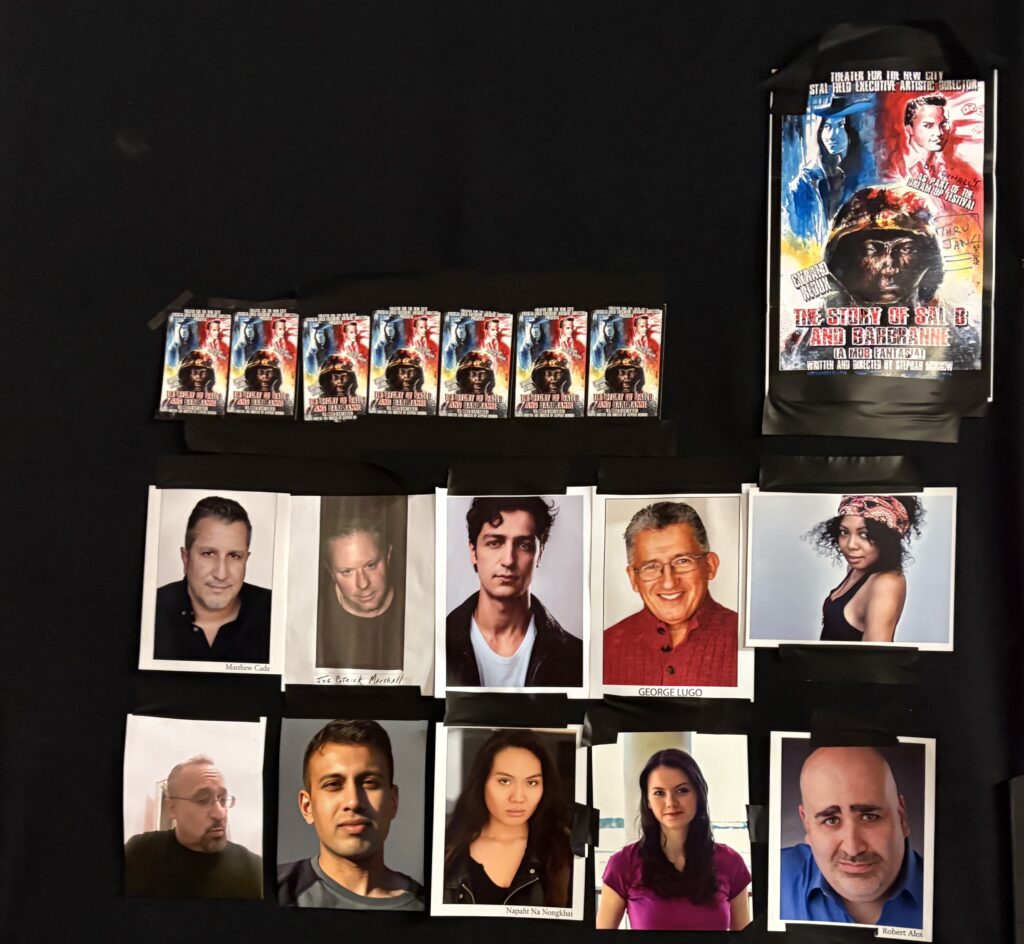
The play follows the titular character of Sal (Joseph Patrick Marshall), a distinguished soldier who has just returned home from his last deployment and a reporter named Barbranne (Donata O’Niell), who is intent on getting her story, but can’t say no to a potential chance at love.
The characters of Sal and Barbranne fill the classic roles of Cyrano and Roxane. Sal’s face has been disfigured in war, which is an effective change from the potentially problematic big nose traditionally associated with Cyrano. I found the choice to make the age gap between the two characters evident from the start to be a tasteful one. While the ages are not as prominent in Edmond Rostand’s original play, it is the main reason that Sal is hesitant to try and pursue Barbranne romantically himself.
I wish I had understood more clearly why the US Military was in the Middle East. The aspect of oil was lost on me and I thought the fighting was over land and properties that the military wished to keep control of. The main aspect I was able to take away was that women were going to be forced into sex slavery, as a comfort to the soldiers (which, unfortunately, has historical accuracy).
The show itself almost had a space western/Star Wars vibe. I found the character of Sal reminded me of Han Solo perhaps a bit too much. With this connection being made, the poetry that Sal comes up with and states with such passion, almost felt out of character. I would like to have been shown more of Sal’s backstory so that his layered nature was more apparent throughout.
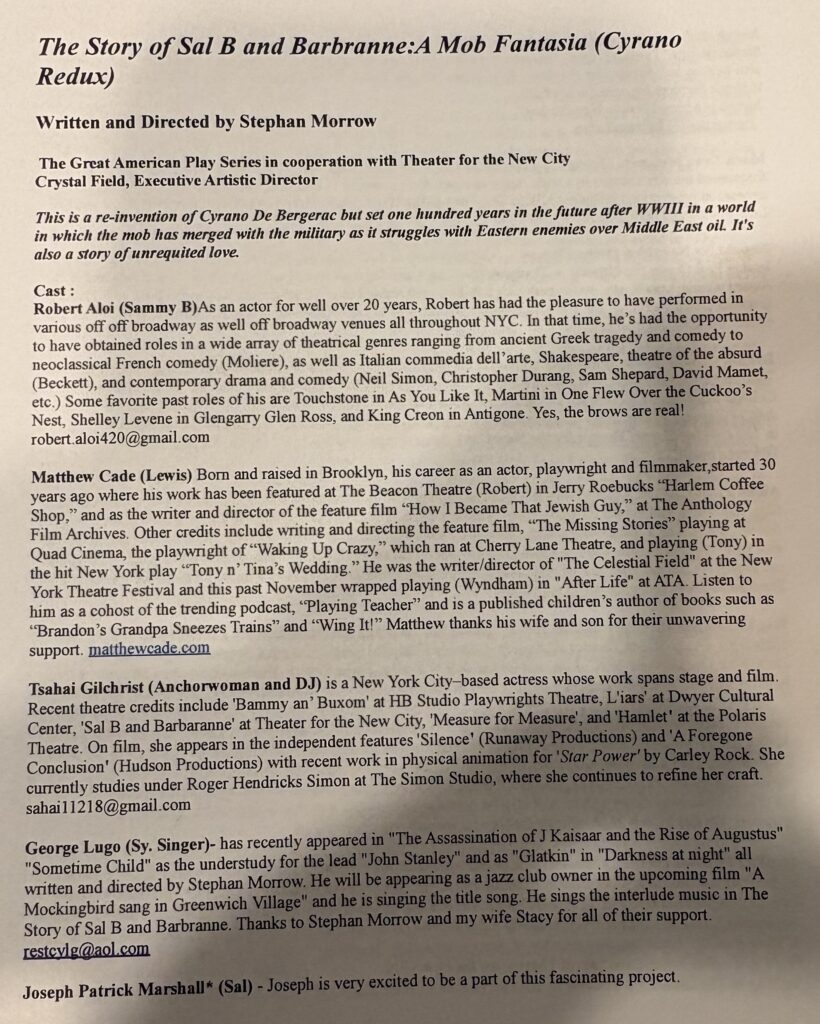
Unfortunately, I did not catch the names of the majority of the characters and the playbill did not include all of them. For example, the character of Paul Jr. is simply not listed next to any of the actors names. I do generally prefer to have all of the characters and actors names, especially presented in an easily understandable way. I wonder if the size of the cast itself (11 actors) may have played a factor in me not catching the character’s names.
The show’s program
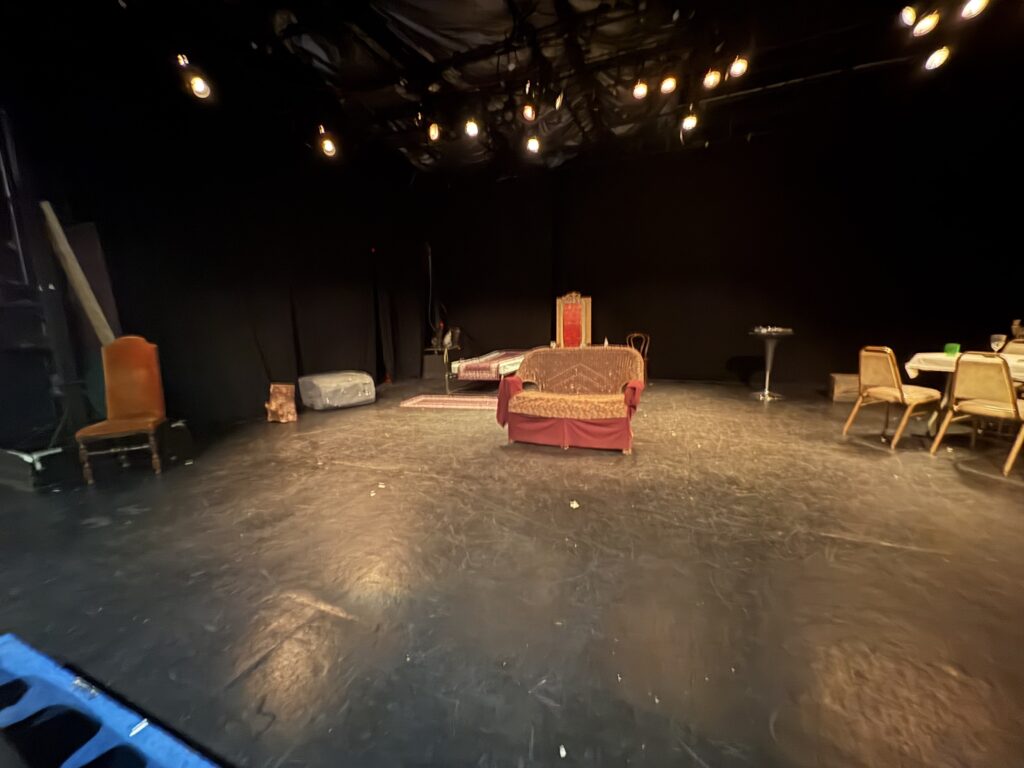
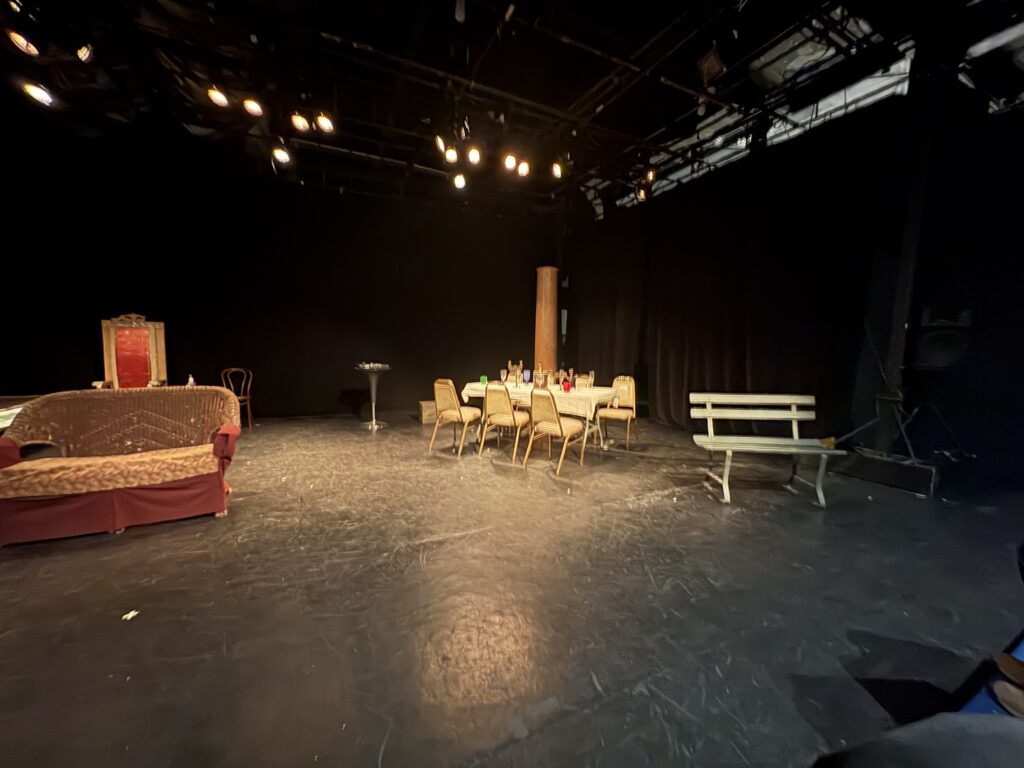
The set was fairly extensive and utilised the entirety of the stage, allowing for quick scene changes and the ability to show a variety of locations. Across the stage were various set pieces: a chair downstage, a bed upstage, a love seat centre, a large table with at least six chairs, and a bench. While I loved seeing so much, I also found it hard to keep track of where specific characters were at times. Without defined borders for some of the set pieces, I had difficulty distinguishing if characters left the room or even the building they were in or not. At times, I believed a character had gone outside and was caught off guard when they could see, hear, and interact with the people they had just left without “reentering” the building.
The Stage
Stephan Morrow, with the collaboration of Saho Ito as the directorial assistant, sound designer Joy Linscheid, and light designer Elijah Smith, brings a new twist to an old classic. The Story Of Sal B. And Barbranne (A Mob Fantasia) does tell the story of Cyrano de Bergerac, but in a futuristic setting. Similar to how West Side Story reimagines Romeo and Juliet, the audience does not need to be familiar with the original play to enjoy this one.
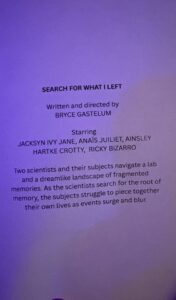
In a bittersweet, high tech, but beautifully emotion-driven show written and directed by Bryce Gastelum, Search For What I Left follows two scientists as they experiment on their subjects to answer a question that is perhaps unanswerable and yet has plagued humanity for as long as we have existed: “What is the root cause of human emotion?” In other words what event, specifically, sparked a particular emotion in someone else?
To be completely honest, when I first read the short write up in the playbill and saw that this was a show surrounding “fragmented memories”, scientists in a lab, and their two “subjects” — I had two immediate thoughts:
This reminds me of the Robin Williams movie called The Final Cut (2004).
In a show that sounds so Frankenstein in nature, why are subjects referred to as “subjects” and not “monsters”?
Search For What I Left is definitely different than The Final Cut and it, without doubt, answers my question on the terminology used.
Starring Jacksyn Ivy Jane, Anaïs Juiliet, Ainsley Hartke Crotty, and Ricky Bizarro this show is an intelligent, thought provoking exploration into the psychology of human nature. It deals with themes of love, life, death, failure, acceptance, the need to know “why”, moving on, letting go, familiar bonds, heartbreak, and even blame. More importantly, though, Search For What I Left delves into these often tragic topics with dignity, care, respect, and without villainising any of the characters.
Beyond the two scientists, there are also two “subjects” that the scientists are experimenting on. At the beginning of show, the audiences watches as the first subject, a woman, comes alive and struggles as she attempts to piece together her own memories. In an attempt to help spark more memories and get to the root cause of her emotions, the scientists decide to introduce her to another subject, this time a male.
The scenes are nicely sparsed between inside the laboratory where the focus is on the two scientists and in this almost in-between world where the body is dead, but the mind can still be explored, where memories can still be thought of, and emotions still felt — even if only through the means of technology — which focuses on the two subjects.
The chemistry between these actors felt genuine. The emotions felt raw, real, and at times bittersweet, while also being understandable and reasonable. There is the scientific appeal of logic and reason, but perfectly balanced and layered with the irrationality of human emotions that everyone feels (even when we know we shouldn’t).
At its core, this is a show of empathy, compassion, and understanding while also accepting the fact that even if complete knowledge or full understanding were actually achievable it cannot change what has been already be done. Learning and understanding the “why” behind another person’s emotions — whether good or bad — can be a very valuable thing, but only for future situations or even future generations, as a whole. A person can examine that “why” and use it for self reflection, self improvement, and even as a teachable moment for others to learn and improve themselves from. However, it can never fix the past. You cannot unsay the words spoken, you cannot change the emotions felt, you cannot fix the past, but you can change the future.
Search For What I Left is a beautiful play set among a science fiction background, encompassing many human emotions, resulting in a call for action to the audience to at least try and understand the “why” behind the emotions of others (and to self reflect on your own) so that society, even all of humanity can improve, grow, build, and ultimately succeed together.
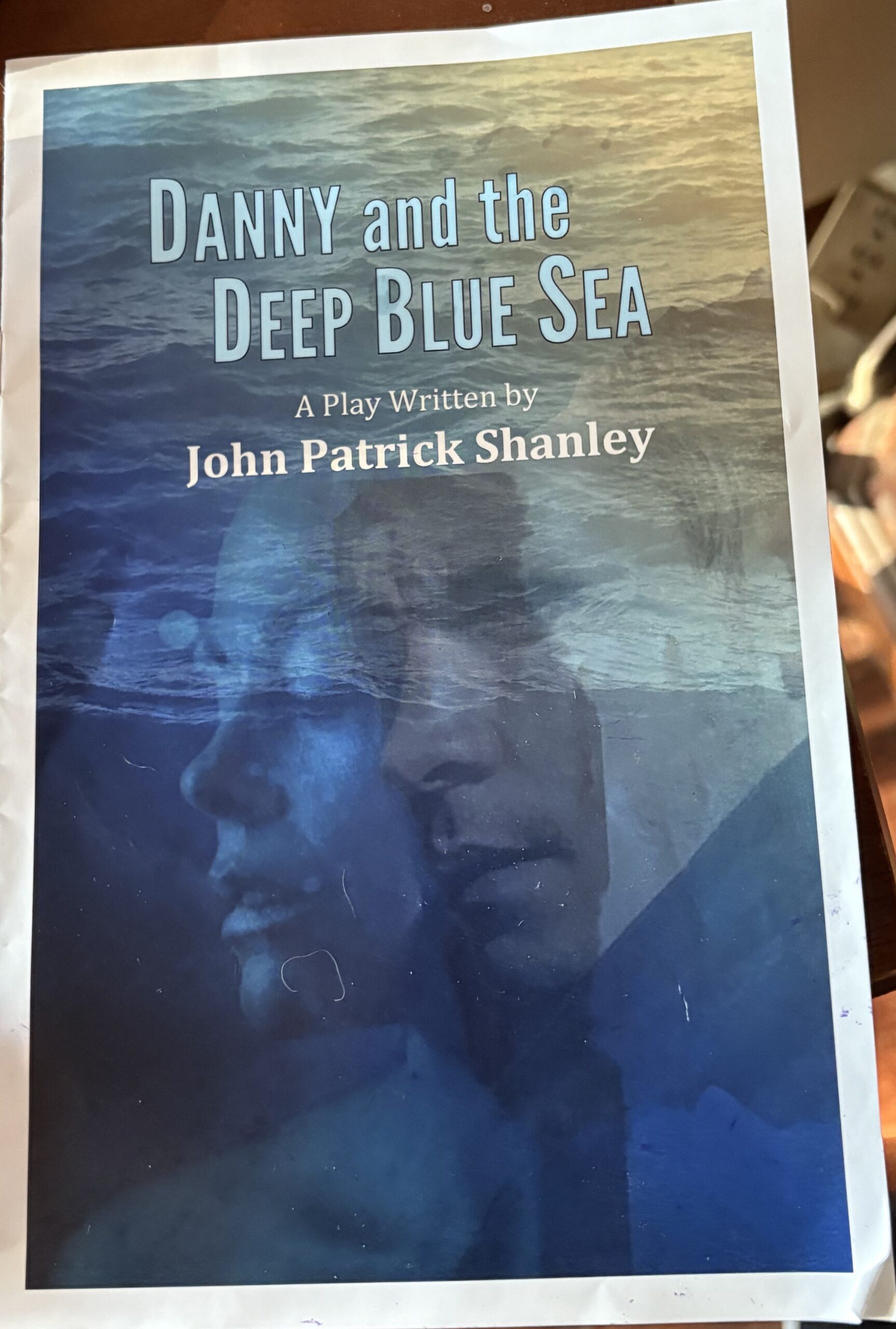
Danny and the Deep Blue Sea exemplifies a statement that I have long considered true: Theatre is a place of healing.
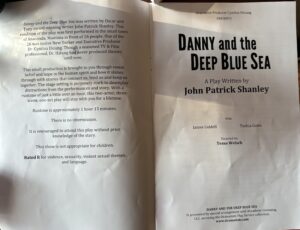
In a note in the playbill it states, “It is encouraged to attend this play without prior knowledge of the story”. Due to this, I will be as intentionally vague as possible while also expressing everything I can.
“It is encouraged to attend this play without prior knowledge of the story”
This show is rough, it’s raw, it’s realistic, it’s organic, it’s emotional, and I think it would be difficult for any audience member to witness this show without either seeing themselves or someone they love in the characters.
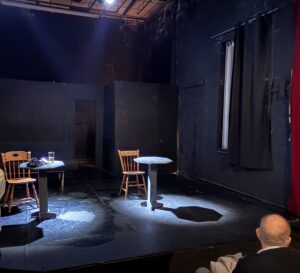
This play seems so simple: one act, two actors, three scenes — that’s it. Most of the scenery is black or the characters reference something that is off stage and not visible to the audience. Which allows for the focus to be on the actors and the actors alone.
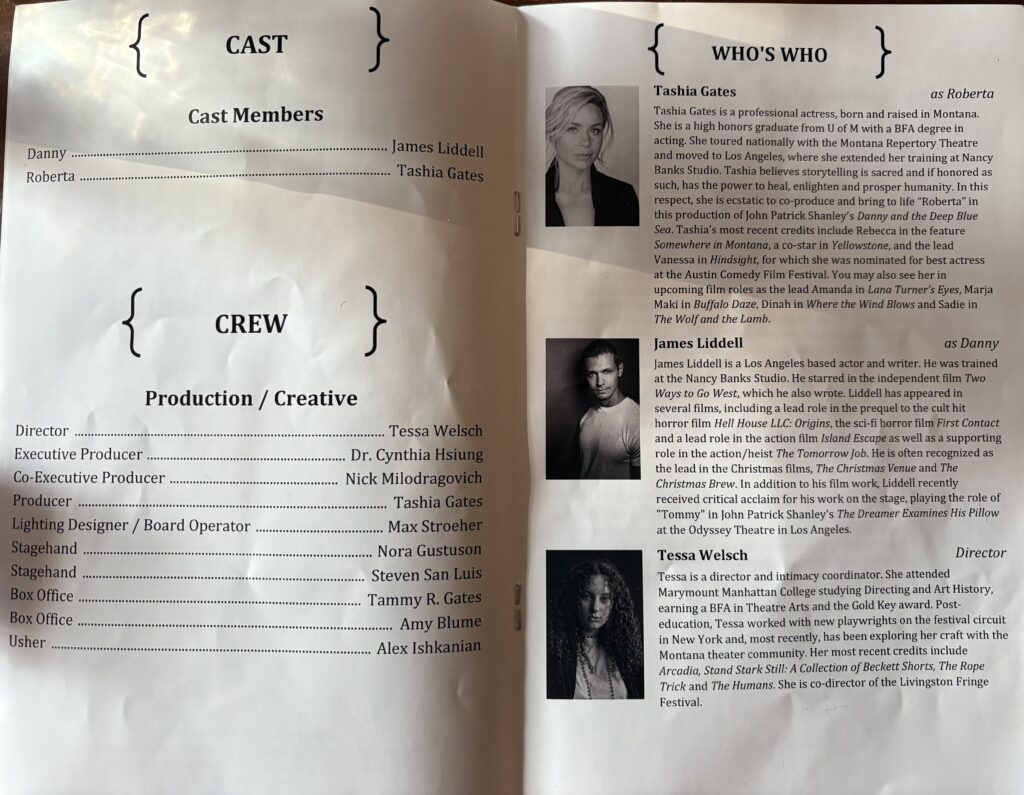
The characters of Danny (played by James Liddell) and Roberta (played by Tashia Gates) are damaged goods — or at least that is how they each view themselves. The characters expand through the show as we witness them try to come to terms with how they see themselves versus how other people see them. This play has moments of violence: one character may hit another or push another or strike another, but it is not a story about violence. It’s a story about vulnerability, desire, love, loss, forgiveness, not feeling worthy, and so much more.
Both actors give all of themselves in this performance. The characters have panic attacks, see through the mask that the other wears (whether or not they want anyone to see through it), fight, dream of possibilities, have hope, as they just try. And the chemistry between the two stars is absolutely phenomenal. It had to be. In a show that requires hitting each other, there needs to be trust between the actors. A show that is as emotionally raw as this one, there needs to be not just chemistry, but realistic chemistry between the actors and this play nailed it.
I know without doubt just how well this show hit the mark and resonated because of how the audience responded. Between audible gasps, laughter at the dark humour (laughter is a vital part of the healing process after all), and the audience member in front of me who sobbed because he saw so much of himself in the characters on stage — the power of this show is very evident.
Written by John Patrick Shanley and brilliantly directed by Tessa Welsch (who is also an intimacy coordinator, which I imagine to be particularly helpful for this show), Danny and the Deep Blue Sea shows the audience themselves on stage. Everyone is damaged in some way or another. Who of us has not felt unworthy? Or blamed ourselves for things beyond our control? Or have just been so hurt that we desperately try to run from anyone or anything that could potentially harm us — even if those same things could potentially love us? Who hasn’t put up walls? Or worn a mask (or even multiple ones varying from person to person and situation to situation)?
Every once in a while, though, we meet someone who sees through the mask we wear. Someone who sees our heart, our pain, our shame, and doesn’t care because despite everything, they see through our defences and can see who we are deep down inside. Sometimes even after we can no longer see who we are anymore ourselves.
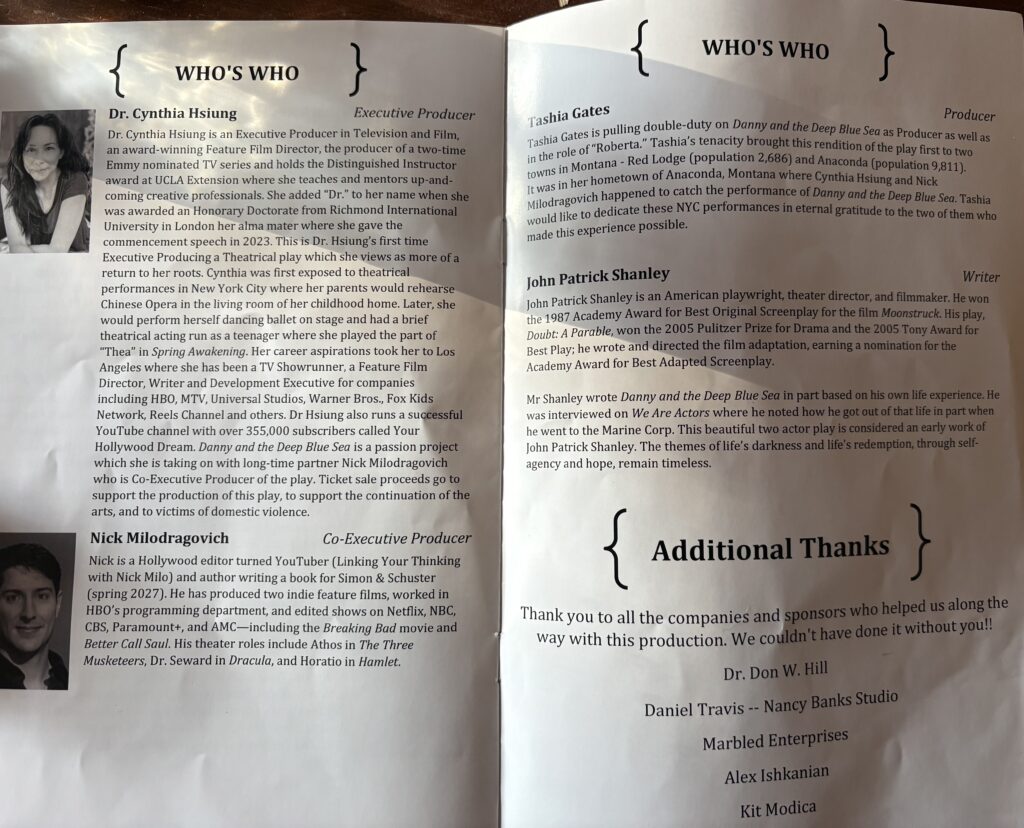
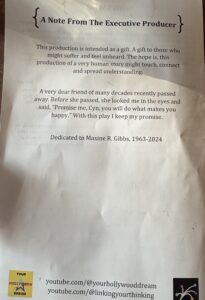
Dr. Cynthia Hsiung and Nick Milodragovich, the Co-Executive Producers of this production presented this show as: “A gift to those who might suffer and feel unheard. The hope is, this production of a very human story might touch, connect, and spread understanding”.
This show succeeds in being a gift. Theatre is a place of healing. All of us are damaged. Whether we see ourselves in Danny or Roberta or we see our loved ones in the characters — Danny and the Deep Blue Sea will make you feel seen, even when you want to hide. Shows like this allow the audience to reflect on themselves and heal from our damage, our trauma, our feelings, our self doubts by so realistically and organically conveying the intensity of the emotions felt.
I just wish it were longer. When you see yourself or your loved ones in the characters, you want to know how, and if, everything will work out. This show leaves you wanting more not because the story isn’t complete, but because it relates so well that you yearn to know how it will end in your own personal life.
When the curtain rises at the beginning of Annie, the audience sees the inside of the orphanage, complete with a line of bunk beds, and large cast of child actors. The number of girls on stage was impressive — there were well over ten orphans (not including the character of Annie herself). All of the colours, including the set and the costumes were fairly muted — even appearing as dingy.
Portraits of the cast of Annie. On display outside the theatre
This made Annie’s costume pop even more (she is the only character who wears bright red). Annie (played by Julia Mueller) is the beacon of hope for the other girls in the orphanage — she has a letter from her parents promising to come back for her. And while the other girls in the orphanage tease her for having this note and for believing that her parents will return, they also wish they had the same.
The girls bond over their desire to be anywhere but in the orphanage and especially over their dislike of Miss Hannigan (played by Anna Hentz) — the woman who runs the orphanage and who goes out of her way to make the girls lives as miserable as she can. This leads to a game of the children pulling pranks, back talking, and getting things over on Miss Hannigan. One example being Miss Hannigan slowly taking a long drink from her flask and announcing to the children who are staring at her that it’s her “medicine”; only for a young girl to retort with wonder, “you must be really sick”.
The choreography was impressive. In the song “Hard Knock Life” all of the child actors were in perfect unison as they slammed their buckets to the floor. And it felt so realistic to see each kid pull a different funny face behind Miss Hannigan’s back.
Mr. Warbucks’ home looked equally as impressive — large, grand, well lit, looking as if the mansion has an open floor plan design. And the stage was once again packed with actors — this time all adults portraying the large number of staff for Mr. Warbucks (played by Jay Casale). All of the staff are dressed in tuxedos, classy maid outfits, or a beautiful gown. Leading the staff is the butler, Drake (played by Edward Forsthoffer III) and Mr. Warbucks’ personal secretary, Grace (played by Deven Miller), who both keep a feel of stoicism and professionalism while also being witty and kind hearted.
The crew of AnnieAnnie’s cast list features over 60 actors!
The acting in this show was phenomenal. The kids looked like they had so much fun being on stage — plus they all could legitimately sing and dance. Miss Hannigan came off as slimy and detestable, yet funny enough to be the comic relief. Joining her are the characters of Rooster (played by Phoenix Fritch) who is Miss Hannigan’s brother and Lily St. Regis (played by Chelsea Connelly Lewis), his girlfriend. All three of them became the villains that the audience loves to hate. They were fun to watch and the actors clearly enjoyed playing these roles.
This show had wonderful moments of satire, tongue-in-cheek dialogue, and plenty of winks and nods to make the audience laugh. It was surprisingly poignant and relatable for a modern day audience in America’s political regime. With a comical look at politics — including making President Roosevelt (played by Sterling Coyne) into a character genuinely invested in the future of Annie (who then forces members of his cabinet to also be personally invested), a silly dance number about how easy life would be with money, and the over all message that having all of the money in the world is meaningless if you don’t have anyone to share that wealth with — this show had a bit of everything.
My absolute favourite aspect of this show, however, is the character of Sandy (played by Russell) who is a veteran in this role — having played this character in a total of five different productions of Annie. The use of a real dog was beautiful. The image of Annie singing centre stage with only the stray dog that she just decided to care for as her only company is a powerful one.
My only suggestion is simple (and honestly not particularly important for the show or the production): have a staff member of Mr. Warbucks lead Sandy (presumably by the leash) or interact with Sandy in some way in the background of a scene or two of Act II. I did spend far too much time during the second act wondering where the dog was and hoping she wasn’t living outside.
Tim Tuttle was a Wall Street banker working hard everyday to make a good living. But it wasn’t until tragedy struck that he realised there is more to life than making money.
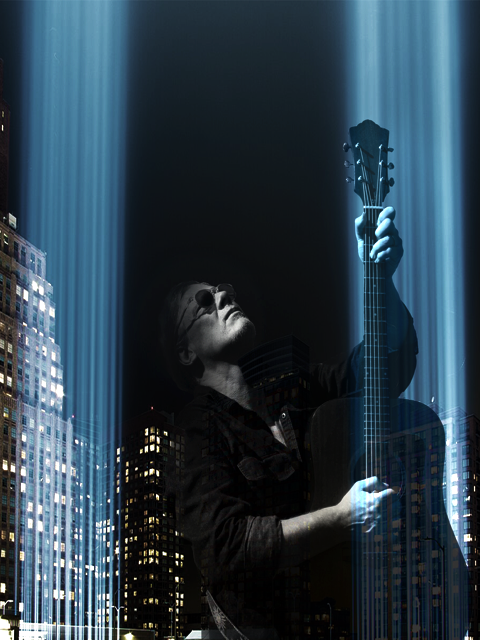
Tim Tuttle is playwright/composer of 44 Lights a new musical theater work for eleven actors and four musicians, in which a man processes his pain and loss over the 9/11 attacks through music and the support of the circle of his friends. Photo by Robin Richardson.
He was at Ground Zero, working on September 11th, 2001. He survived. He made it out. Not all of his friends did. And ultimately, surviving the attack itself is only part of making it on out alive on that day.
The confusion of what is happening around you. The horror in the eyes of the people you see. The hoping and praying that your friends who you hadn’t seen on that one day that they did not make it into work. The slow understanding of the lives lost. The survivors guilt. The anger. All of those things stay with a survivor long after the physical event happens. Surviving the initial attack is only part of it because the emotions and trauma from that day is something every survivor will have to confront and that is when they can start healing.
Tim Tuttle found that healing in music. For 24 years, he has been writing and performing songs about that day to not only help himself heal and continue to move forward in life, but for the other survivors too.
Tim Tuttle. Photo by Robin Richardson.
Healing is a long and often painful journey. It can be difficult to express and come to terms with the multitude of emotions created from tragedy. It can be hard to cry in private, let alone with a community of other survivors. Yet, tears and community can be vital to getting through grief. Off-Broadway will be that place that community can come together, not have to say a single word, and allow people to heal.
In a time when community is needed more than ever, when politics have broken the bridge of humanity — this is the time for everyone to come together, to cry, to remember, and to just give ourselves the opportunity to heal.
Cast in Finale. Photo by Jonathan Slaff.
Tim Tuttle stopped being a Wall Street banker after 9/11. Instead, he dedicated his life to making art — songs and a show — so that everyone, not just himself, but the community can continue to heal. All of which culminated into a musical called 44 Lights. For Tim, helping people continue to live their lives is how he learned to not just make money, but to truly live. Because honestly, even without terrorist attacks, no one knows how long they have — so let’s live life while we can.
How long should a person work for the sole purpose of making money when the job they have is not one they enjoy? What would make a person up end their life, end their successful career, and learn to truly live with the goal of happiness and helping others?
For Tim Tuttle — the writer, creator, and lyricist of the show 44 Lights it was tragedy.
Tim Tuttle is playwright/composer of 44 Lights . Photo by Robin Richardson.
44 Lights is the story of the survivors of the 9/11 terrorist attack beginning from before the attack happened and continuing through their healing process. And while this is very autobiographical — the message of hope and healing is much more universal.
Creating a show, especially a musical, about real life horrific events will always be a controversial move. It requires the writing, the acting, the staging, even down to the lighting to be done delicately so as not come off as disrespectful or even possibly leave the impression that the entire show was created to profit from tragedy.
This show walks that line perfectly.
The staging was simplistic — actors walking in a well rehearsed formation as they try to understand what is happening and why these firefighters are running past them. The lighting was done effectively — leaving the ones who did not make it in a heavenly blue glow which resulted in the characters being perfectly grey scaled. The emotions, however, were very complicated.
Confusion, wonder, disbelief, horror, realisation, acceptance, grief, anger, depression — all of it is expressed in this show. Whether it was the character not knowing if their coworkers made it into work that day or the realisation that your action put someone else in a part of the building that they cannot escape from or the grief that comes when understanding that you survived but others did not.
Cast in Finale. Photo by Jonathan Slaff.
And once everyone has figured out what exactly happened that day, the audience is shown how that knowledge doesn’t fix things. It doesn’t fix the anger or the sadness or the despair and it doesn’t make things okay. Even after knowing the cause, knowing why this attack occurred — well, that’s really just the beginning of being able to heal.
The characters, and the people who were in the towers that day and survived, had to learn how to live again. And they had to learn to live for someone or else those that perished will simply be forgotten. For some, that means anger. For another, tears. But for the character of Nick — it was music. Specifically music about being at Ground Zero.
Tim Tuttle was a Wall Street banker who survived the 9/11 attack and the destruction of the Twin Towers. It took losing his friends, literally, to make him see that he wasn’t living — he was merely existing. In order to keep the memory of his lost loved ones alive, he has spent the last 24 years writing and performing music to honour his friends that perished on that day. That is how he was able to heal and keep the memories of his friends alive. And this show is that story. 44 Lights is the story of survival, of guilt, of horror, and ultimately of living life while you still can.
The images in this article are curtesy of Robin Richardson and Jonathan Slaff. Used by permission, their respective owner(s) reserve Copyright.
Letters is a show spanning four generation, two countries, two World Wars, and possibly even multiple planes of existence.
The play begins in Italy during the year 1920, as the audience is introduced to the matriarch of the family that this story revolves around. Her name is Maria and she will do anything for her children, even if what she is doing is morally questionable, her intent for the long run is always good. Finances were not great for the family and once WWI began, Maria’s first born son was drafted into the war. Unfortunately, he never made it home. This is the catalyst that sets the rest of the play into motion.
Maria, reasonably, decides it would be best for her family, especially her youngest son Peter, if they were to move away from war. So they move to America. And from there the audience is treated to a beautiful story about love, loss, loyalty, fairness, greed, desire, and so much more.
This is a show that is not afraid to address serious topics such as abuse, bankruptcy, societal and even familiar expectations, and many different points of view. More importantly, however, Letters is self-aware enough that even the characters within the show are able to deconstruct those serious issues and examine why they exist in the first place. And I find that to be a rare delight in live theatre.
In a show that starts in 1920 Italy and goes all the way through at least the year 2000 (by the time the curtain closes) in America — I think having the different generations of characters questioning the actions of the generation before them is a beautiful way to express how society, culture, and even life as a whole shifts and changes not only by country, but just as the years pass by.
The main cast of characters is fairly small. Mentioned above is Maria, she is the head of the household and the main bread winner for the family while they are still in Italy. There is the character of Peter, Maria’s youngest child, who the audience sees at various points and ages throughout his life. Evangeline is Peter’s girlfriend, but she is not who Maria would have chosen for Peter. So what is a mother to do? The next character of note is Margaret. She is the first wife of Peter and the mother of Peter’s only daughter, Laura. Laura is the most self aware character in the show — or at least the most out spoken when it comes to recognising patterns and hypocrisies in people’s behaviour. Beyond that, there are a good number of minor characters to fill out the script and allow for deeper character development.
Letters does not shy away from showing the complexity of emotions — even within the most stoic of characters. Whether the character is able to actually state what they are feeling out loud, write it in a letter, or it is just expressed through body language and facial expressions — this show deals with it all. Aging traditions, jealousy, betrayal, and the ultimate question of all humanity — “why?” That is the main question of this show: why?
This show starts as a mother’s desperate attempt to save her son, becomes a story of love and betrayal, and ends in the quest of just wanting to understand why everything happened the way it did.
I guess the question is — does this show answer that “why”? I think that is up to each individual audience member to decide for themself.
All images in this review are curtesy of Gloria Schramm. Used by permission, their respective owner(s) reserve Copyright.
Bruno Giraldi’s show asks a number of questions — what does it mean to be “in love”? What happens when being in love crosses with self destructive behaviour? Is it okay to feel love when the person responsible for loving you was also your abuser? And even, what happens when that love you feel so strongly, is gone?
At its heart, this is a show about philosophy and vulnerability, with a satirical dash of humour, that intertwines the concepts of love and of death to show the complexity of emotions that both create — and even what happens when they overlap.
The show takes a comedic approach to some very serious topics and handles them in stride. Sexual abuse, the loss of a parent, the ending of relationships, and even the idea that love will always last (this last one being exemplified in a beautifully satirical up‐tempo version of “My Heart Will Go On” by Celine Dion).
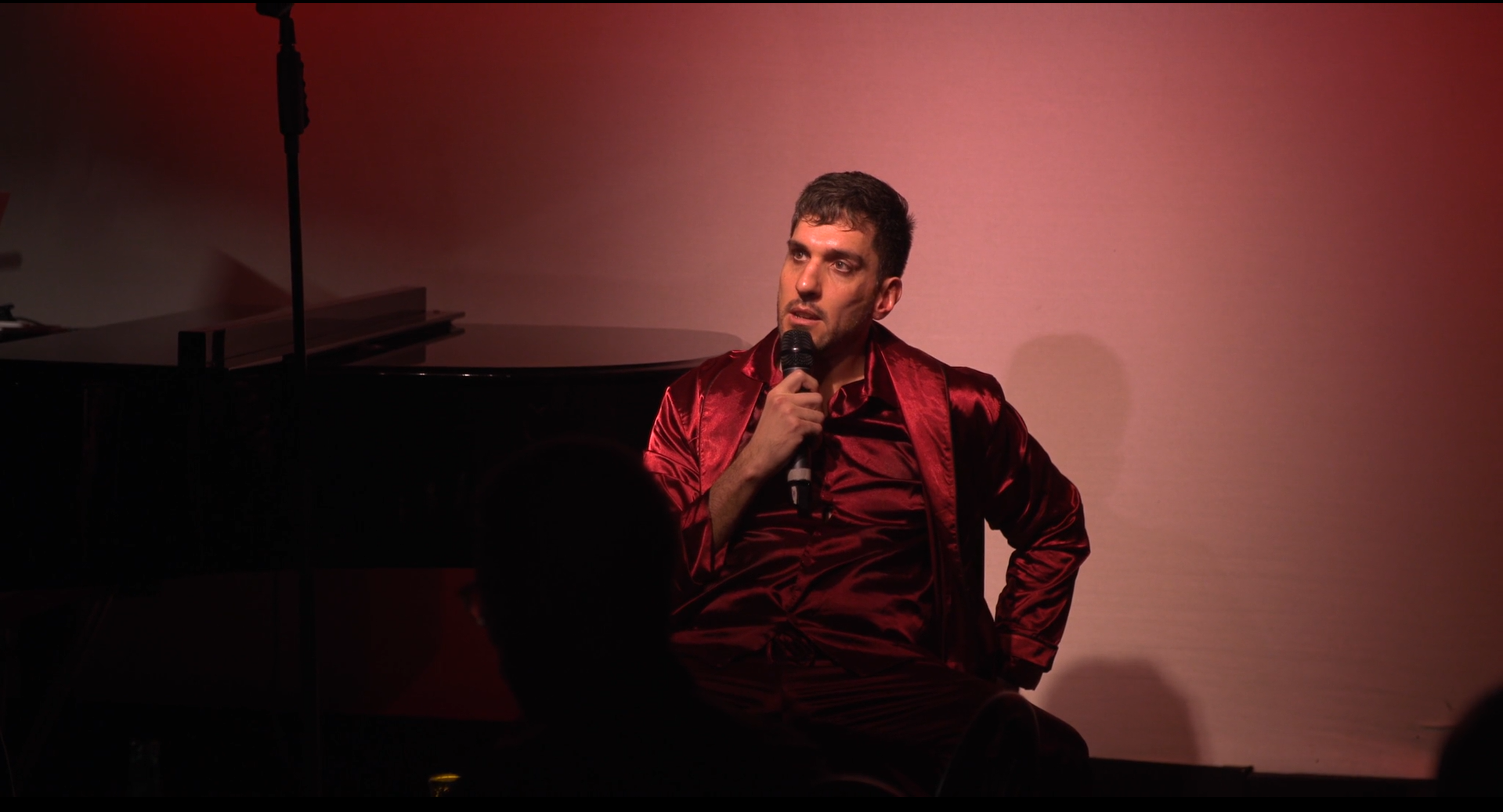
Bruno Giraldi Waking Up
The show opens with Bruno waking up in the morning and searching for someone to love (shown by singing “Somebody To Love” by Queen — which must be a hard song to open with), but as the show progresses, the audience learns that Bruno falls hard when he loves someone which can often lead to some self‐destructive behaviours. This doesn’t need to be something extreme — perhaps just wanting to give your partner everything that you feel they deserve? But the thing is, it’s impossible to have love without pain even if your desire is to simply protect your partner. There is no way to completely separate pain and heartache from love and romance. Even with the best of childhoods, everyone has some sort of trauma and that will ultimately affect their love life. Even if the relationship is generally a good one — that innate urge to give your everything to your partner, to be perfect for your partner (and for your partner to do the same for you) is just simply not realistic; even if many philosophers through the ages put the concept of love on some unattainable pedestal.
So perhaps to love is to suffer? Perhaps love and suffering are just opposite sides of the same coin?
I really enjoyed this show. It was nice and refreshing even to have a show not attempt to sugar coat how difficult and painful love (and death) can be. But mostly, I loved Bruno’s willingness and ability to be so blunt and vulnerable with the audience. It is not an easy thing for a lot of people to speak openly about their own experiences and traumas. Let alone, write a show and perform songs, to inform the audience of these past events. I know that it is scary for people to drop their mask, to stop acting, and to let themselves be vulnerable. And that is exactly what Bruno did. He was vulnerable. And it was beautiful to see.
Bruno Channels His Inner Freddie Mercury
More Pictures From The Show
All images in this review are curtesy of Bruno Giraldi. Used by permission, their respective owner(s) reserve Copyright.
Imagine this: you’re sitting on the sofa in your New York apartment — the lights are turned off and you’re watching a video on your phone, in the dark. Suddenly you receive a phone call and it is the worst news that you could receive: your mom has passed away. And if that wasn’t bad enough, she died by being choked to death — accidentally — by a dominatrix! And your dad knew your mom was seeing a dominatrix and was okay with it! And you just found out all of this information about your now dearly departed mother…
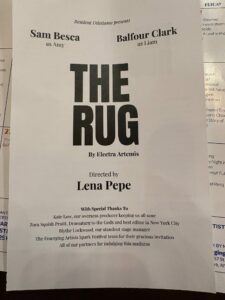
The Program’s front cover
How does one cope with the grief, the responsibility, the knowledge of their parent’s bedroom habits, the anger, the fear — all of the emotions that come with losing their mother?
That is the core of the this show.
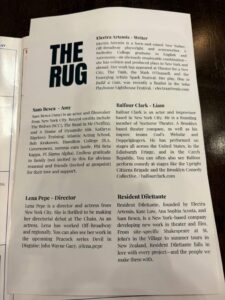
The Rug centres around two characters: Amy (played by Sam Besca) and her boyfriend, Liam (played by Balfour Clark). The entire show takes place within one set, with zero scene changes. And it flows beautifully despite the fact that the premise, while a very real situation — losing one’s mother and especially suddenly — being crossed with the absurdity of how that mother ceases to be; the whole show felt natural.
Credits Page of the show’s program
Both characters go through an emotional roller coaster. Whether they are crying one minute, laughing the next, fighting a second later, or ready to rip each others clothes off (special shout out for the prop of the futon — turning the sofa into the bed just felt so amazingly appropriate for a New York City apartment and was a wonderful touch), the complexity of the emotions never wavered.
Throughout the show, the audience learns back story about the two characters. Liam, for instance, had a drinking problem at some point and Amy does not feel that she can count on her father to handle anything, including her mother’s funeral. But what makes this show so amazing aren’t these plot points or the character development — it’s how natural the dialogue, the chemistry between the two stars, and most importantly how natural the complexity of grieving comes across. Not once during this show did I feel like I was watching two actors on a stage. This entire production felt very genuine.
Written by Electra Artemis and directed by Lena Pepe, this show has the unique ability to remind the audience that it’s okay to laugh — even in the bad times. In fact, you have to — especially in the bad times. Because if you don’t, then the bad times can simply be too miserable. So you laugh.
I lost my own mother back in 2021. She certainly didn’t die in any similar fashion as the one in this show, but the emotions were the same. The panic of realising you are helpless to change the situation, the anger at not just her being gone, but at the universe for allowing it. The fear of having to pick up some of her responsibilities. The whirlwind of putting together a funeral and picking out what your mother should be buried in — hell, even having the very realistic thoughts including what happens to the body after death. And wondering the very basic question of “was she scared?”
I remember feeling all of those things and more.
I don’t know if any of the actors, the director, or the writer has lost their own mothers, but they all certainly nailed what it feels like.
As the show is now, the run time is just under an hour. Which is admittedly a bit short for even most one act shows. However, this show does work, as is. If the creative team would like to expand the script, I would think mostly for time, it could be worth diving more into Liam’s past alcohol usage. There is a beautiful moment where he is left alone with a glass of alcohol and he pauses with it in his hand and you can actually see the character thinking about drinking it.
The only other plot element that I felt could potentially be expanded is the relationship between Amy and her father. The audience gets glimpses of why Amy feels she must do everything for him, but we don’t necessarily get the full depth of it. That being said, again, it isn’t actually needed because the script just feels so genuine as is.
I highly recommend this show. You will certainly laugh, you will most likely cry, and you’ll leave the theatre a better person for it.
This show was so simple, so elegant, and so moving. And it is told entirely through letters.
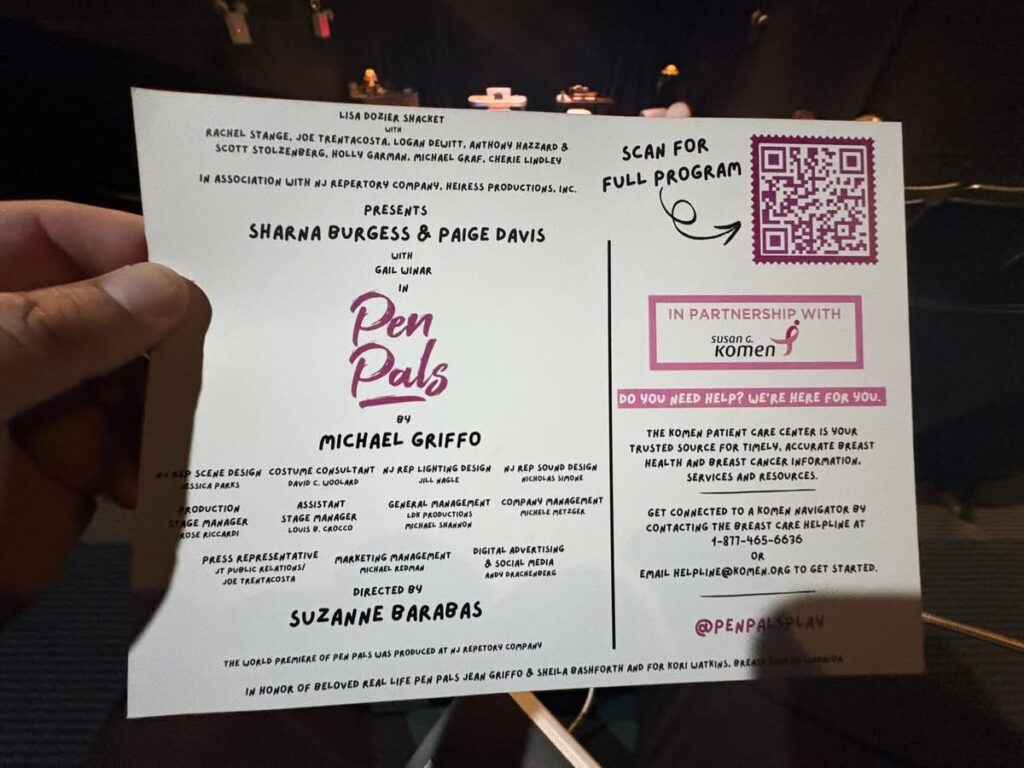
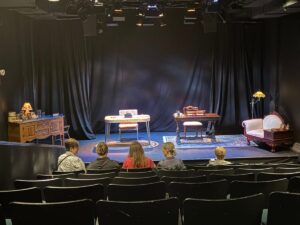
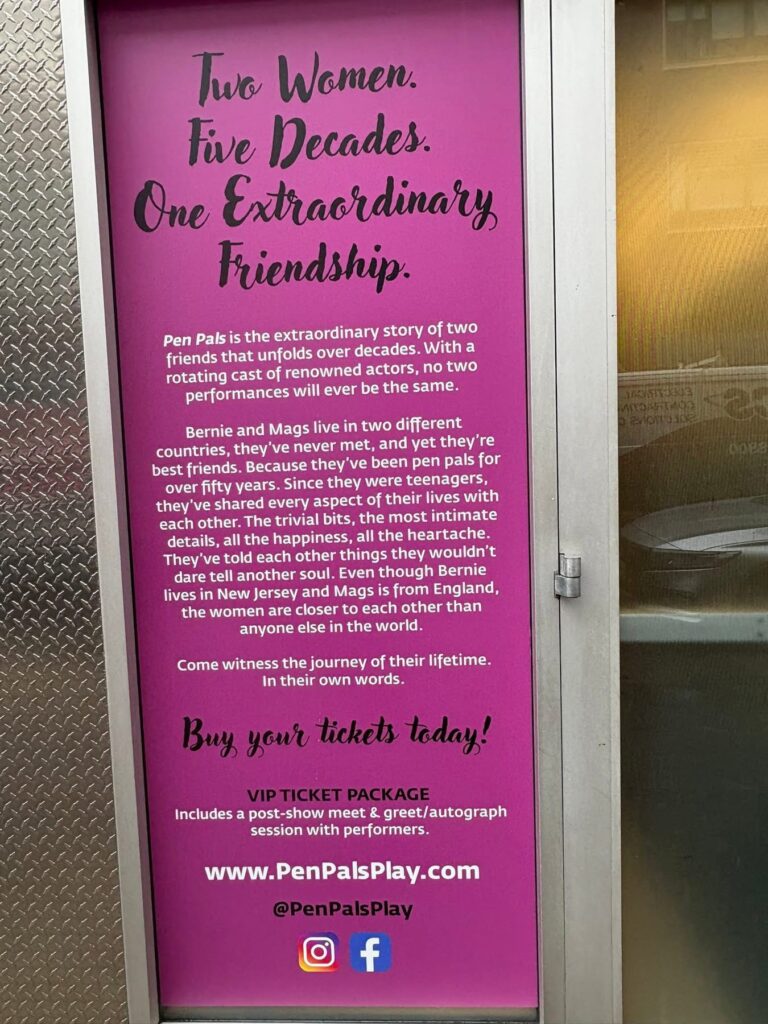
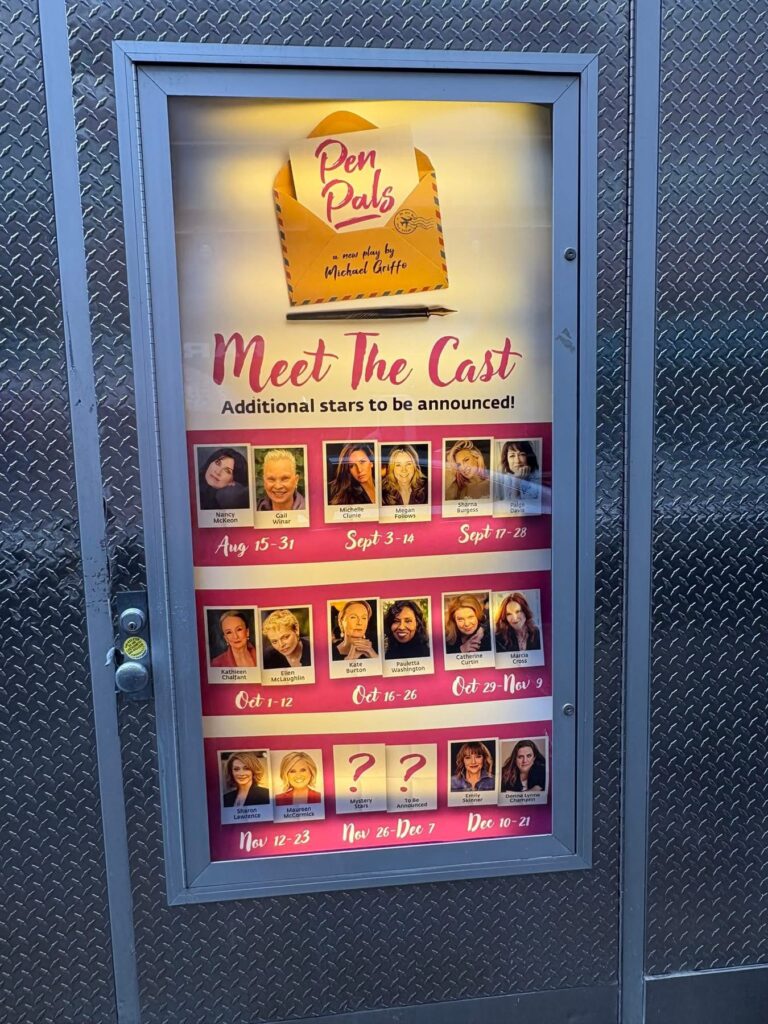
The stage is essentially split into two halves. On one side we have Bernie (played by Paige Davis), she lives in New Jersey and at the start of the play is 14 years old. And on the other side, we have Mags (played by Sharna Burgess). She recently moved from London to Chesterfield, England and she’s not particularly happy about that. She is also 14. Bernie and Mags are both taking part in a pen pals program in their schools.
Each character has a desk and a book full of their letters to each other. And we watch as within minutes of entering the stage, these two adult women transfer into young teenage girls excitedly writing to each other about everything — boys, other girls they don’t like, their favourite school subjects, etc. But, as the show progresses, time passes, and the characters age.
However, as the characters get older and the friendship deepens, and the subjects they write about become more and more serious — neither Davis nor Burgess missed a beat. The characters getting older felt natural. The way the two actors expressed themselves through their demeanour and attitude changed as the characters they played matured. And it felt flawless. It felt natural.
The staging was simple as well. Each character reading the letters they had received from the other. As one character “wrote” their letter (instead of showing the audience the character physically writing — the character just stated out loud, typically while facing the audience the contents of each letter) as the other character would be reading and reacting to it. Most of the time reaction would be something small like laughter, but once in a while, a character would react so strongly that they exited the stage. It was such a simple thing to do — just get up and walk off stage. But it was so impactful to have just one of the actors there.
This show progresses quickly, and I think that’s a good thing. Life can be a rollercoaster of good times and bad, and often those good and bad times happen suddenly and without warning. And that happens in this play.
The play hits on a lot of difficult subject matters. Some of which include: the sudden loss of a loved one, abuse, questioning your own happiness, grief, and so much more. And it has some less serious subject matter — the idea that something you are fundamentally against can be the correct thing for someone else, forgiveness, not realising what you have until it’s gone, and most importantly friendship and the need to have someone that you can be completely open with. Even if that person gets angry at the choices you make; everybody needs a friend that they can be completely open and honest with. And sometimes, I think, that can be easier with a pen pal than someone that we see face to face.
There was a lot of attention to detail in this entire production. Some of my absolute favourites included the music before the show which included “You’re My Best Friend” by Queen and “That’s What Friends Are For” by Dionne Warwick. And, perhaps most notably was the option to be paired with a pen pal (email or regular mail), which was a wonderful touch.
The cast of this show rotates, but it is one I would definitely recommend seeing. Bring your tissues, though. Some of the plot advances are ones that the audience would likely expect, but some of them definitely blindside you. Just like life does.
However, I have to go plan a trip to meet my own long distance pen pal that I have been exchanging messages with for at least two decades. I think it may finally be time to meet up before life gets too in the way.
This show is very clever. It takes something as simple and universal as milk and turns it into a symbol of life, power, strength, consumerism, and even the never ending cycle created by life and consumerism.
The set is very simple — consisting of a few chairs, one table, and a half gallon carton of organic whole milk.
The show opens with one man coming out, opening the milk carton, and he just starts chugging it. And as he does this, the rest of the cast comes out and dances around him.
The next scene is an interpretive dance showing the very first time a cow was milked. This beautifully, and without actually saying anything out loud, showed the absurdity of what that very first time could have looked like.
From there, the audience is treated to a variety of very different scenes: a 21st birthday party in which everyone ends up taking shots of milk, a children’s karate class covering serious topics like divorce, a son and father talking about the recent passing of the son’s grandmother (and the way that the grandmother has died gets more and more absurd as this scene unfolds) resulting in bringing attention to the concept of toxic masculinity (“don’t cry over spilled milk” is a saying for a reason) and even the effects that trauma can have on a person. There is a scene about addiction which reflects heavily on what it means to be a man and how every generation has a new idea of what that is. A woman going on a terrible first date with a man who has serious mother issues. Even children growing up and seeing the horrors in the world — this is an especially silly because the kids being depicted are ages 4 and 5, with the 5 years old suddenly being knowledgeable and all knowing of what life has in store for them (and us all) in the future. There’s a scene of a couple trying to role play in the bedroom only for the role play to suddenly became very real, and then there are multiple scenes portraying a milk mogul named Percival as he creates more and more new types of milk; making himself filthy rich, but losing the main ingredient of what makes up milk along the way — resulting in a hilarious confrontation between Percival and the thing that he neglected when building his empire.
And despite all of these scenes (and some more) seemingly being disjointed, the overreaching message was the same: Milk brings life — we see this everyday whether it is a parent breastfeeding their child or animals giving milk to their young. Milk is the universal nutrients for babies because it is what makes a person or an animal big and strong (or at least that’s what marketing would have you believe). Being big and strong gives you power, but we are only being fooled by the concept of this power. Because realistically, we are all stuck in a cycle of working to get the things that will make us big and strong (whether it be milk, an opportunity, making more money, etc.) which can only result in a never ending cycle of constantly working to be bigger and stronger. Eventually, we will run out of whatever ingredient we are using to get that power and the next generation will come up with something new. And the cycle will continue. Because it’s life. Milk is life — but should it be?
The cast is small consisting of just eight actors: Jake Griffith, Hannah Eisendrath, Cameron Cai, Andrew Shipman, Izzy Valdés, Micah Mabey, Paige Mesina, and Elissa Bartkowski. And honestly, every single one of them carriers their weight and has excellent stage presence. Some of the scenes that are being depicted could definitely be a hard sell for the typical theatre audience, but this crew is dynamic enough that it absolutely works!
If you’re looking for a really good laugh, an absurd premise, and a rather deep overarching message — then this is definitely the show to see!
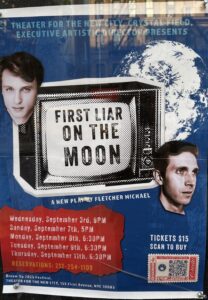
I am not sure what I expected from this show, honestly. I went into it knowing just the basics — a satirical comedy starring the characters of Neil Armstrong and Buzz Aldrin faking the moon landing.
What I got was something right out of Matt Stone and Trey Parker’s handbook and I cannot be more pleased about that!
This show was incredibly self aware, tongue‐in‐cheek, silly, ridiculous, over the top, and I loved every minute of it. It’s clever.
The basic premise of the show is simple: No man has ever walked on the moon, but the Space Race is well on its way and the United States government is desperate to win against Russia — even if it has no idea how. And that is why when two young aspiring actors, Neil Armstrong and Buzz Aldrin (played by Collins Dennis and Teddy Fischer, respectively), go into an audition for the roles of “Astronaut #1 and Astronaut #2″ for a new Hollywood movie. Only to be told once filming has wrapped that neither of them could continue their acting career because they both signed a contract (which neither of them had read) stating that they must take on the roles of astronaut for the rest of their lives. This leads Neil to fall into a life of depression, desperate to just be an actor — to explore new roles and characters, and into a life of drinking his worries away. Buzz, being more content with the lie, has leaned into his new “job” as an astronaut and has even begun a political career.
Flyer for the Show
The play itself begins at a press conference with the character, who is cleverly named “Mr. Redacted” (played by Christopher Hanks), telling the American public about NASA’s newest mission — the first “manned” mission to Mars! And by “manned”, he means, “Chimpanzeed” because that’s the pilot — a chimpanzee named Mr. Bananas.
Standing next to Mr. Redacted is Buzz Aldrin, who is standing tall, proud, just right for the part and Neil Armstrong… who is clearly drunk. In fact, he is so drunk that he gets into a drunken fight with Mr. Bananas (and loses) prompting the government to place him into a rehab facility — and that is where much of the show takes place.
Other settings that this show has include Buzz Aldrin and his caddy on the golf course and Mr. Redacted at his barbers’ shop — where he just wants his sideburns trimmed to exactly 8 cm.
But it’s really the other characters in this show that allows for all of the ridiculous hijinks to ensue.
There is the character called Nevada (played by Nicole Ponce) who is introduced to the audience as another client in the rehab facility that Neil is sent to. Nevada is a smart character — she’s witty, dynamic, believable, coy, mysterious. And her character, in this silly show, only gets more complex from there. Ponce did an absolutely wonderful job in portraying a character that is so layered and she did so with conviction. Not to mention that the chemistry between the characters of Nevada and Neil must be on point for this show to work and it very much was; it felt genuine. Two angry, smart people having no choice but to participate in childlike forms of therapy (an example of this being the characters forced to talk through sock puppets at the rehab facility).
The other actor that absolutely must mentioned is Patrick Walsh, who played the “Ensemble”. As in, he was Buzz’s golf caddy, he was Thomas — the guy who works at the rehab, he was Thomas’ mother, he was Mr. Bananas, he was a reporter, he was Sam the barber, and he was the literal moon! And he nailed it. Walsh even delivers a wonderfully meta monologue explaining what the character of “Ensemble” is and how it still an amazing acting gig!
While this show is about a conspiracy theory — it is also very much just about acting. And not just acting, but how easily an actor can be taken advantage of and the dangers of not reading the contracts you sign. It deals with putting on a role and living with it for so long that you find yourself believing you are that character. This show deals with what it takes to even make a film or put on a production. And this show deals with what it really means to be an actor, a writer, a creative person.
And this is all shown by essentially putting on a movie inside of the show. You see the character development as each character in the show evolves, you see the literal script writing process, you see the rehearsal, and you see the final product.
This show comes down to detail, detail, detail. From the second the audience starts to enter the theatre, they toss their ticket into an astronaut’s helmet. The music playing before the show and during scene changes included songs such as “Dancing In The Moonlight” by Toploader, “Fly Me To The Moon” by Frank Sinatra, and “Rocket Man” by Elton John.
An Attendant holds an astronaut helmet to collect tickets.
And of course, this show delves into what it means to blindly trust — whether that is a person, a contract, a situation, even the government. In a show about government conspiracy, you cannot ignore the parallels to our modern political policies and how much the American people not only have no choice but to just believe what we are told by the government, but even more so, how it is expected upon Americans that we know and accept that our government will lie to us. That knowledge and acceptance that our government will lie to us is just part of being an American citizen.
And this is beautifully shown in a very simple, yet effective way when one of the characters receives an injury to their ear resulting in them wearing a bandage over his ear for the rest of the show. It would be hard to watch a character wearing a bandage on an injured ear and not see the connection to a certain conspiracy theory making its rounds on social media regarding an injury that was allegedly received by the President back in Butler, Pennsylvania.
And what a beautiful, smart way to connect a show about conspiracy to our modern audiences.
Well done.
Theater For The New CityThis show was part of the Dream Up Festival
Theater For The New City Dream Up Festival 9 September 2025
In Search of “True Love” was a remarkably refreshing piece of theatre. It was bare. It was simple. No flashy lights, no soundtrack, no audio tricks, no set: just one woman in a black box theatre bravely standing centre stage and baring her soul. And it all felt so genuine that I had to ask the creator of this show if she was even working off of a script at all.
This show was written, directed, and performed by one person — Ayaka Yamamoto. And it could not have been easy to do because everything came down to her. With no lights changing, no scenery, no other actors to work off of — it was just her talking with the audience. She is a Japanese immigrant who is living in New York City because theatre is the dream. Like many of us, it’s not the path that her parents would have chosen for her — she even has a mother who would love for her to come back to Japan and enter into an arranged marriage. But that isn’t the type of “true love” that she wants.
What is true love? That is what this show asks the audience and that is what the one character (who is the actor) is asking herself. This show is an autobiographical tale about finding that magical thing that is referred to as “true love”. But it begins with the heartbreak.
As love often does, it ends with you hurt and depressed and feeling lonely. Sometimes you may find yourself spending days on end in bed because you just can’t bear to face the morning that day. It is easy for people to say for you to move on or that there is someone else out there — but to actually get back to dating after a break up is hard. You were just vulnerable and open with someone, only for it to end in heartbreak. And then society expects you to just do it all over again despite that fact that you’re now scared to be that vulnerable again.
So you take pleasure in the little things. For Ayaka Yamamoto that little thing was a specific type of Japanese stand up comedy called “Manzai” that she would watch on YouTube. This is a two person stand up routine and quite honestly, it reminded me of British sketch comedy — I could see Monty Python sketches that were very similar to this idea. You have one character asking for advice and the other giving them very normal advice, which the first person then takes very literally and to the extreme, resulting in a hilariously awkward situation. And this comedy was the simple small thing that made getting out of bed again each morning a possibility.
In the next moment, we are with Ayaka on the last day that she is working as a babysitter for a family. She has grown to love this little three year old boy that she has come to know over the past six months, but it’s now time for her to move on to a new job. And this is when she finally realises what “true love” is.
The thing with being a babysitter is that you know you’re going to build a bond with that child, but you don’t necessarily expect that child to grow the same bonds with you because you don’t expect them to necessarily remember things in the long term. You expect, as the adult, to walk away hurt from that job because you know going into it that you’re going to have to say goodbye to the kids one day. You rarely expect the kid to hurt when the babysitter says goodbye because you expect the child to forget you soon. Which in and of itself, hurts — but it only hurts you, not the child.
So imagine the surprise Ayaka felt when the child, a three year old child, expressed sadness at her leaving. She felt needed for the first time in a long time. But more importantly she felt happy. And that’s when the point of this show becomes painfully clear and unfortunately it is a lesson that can be hard to learn.
You simply cannot have “true love” and expect that to mean happiness. You need the happiness first. In fact, happiness, I would argue is “true love” because until you have happiness alone, you’ll never have “true love” because you won’t be happy. And unfortunately, I think people forget too frequently that life isn’t a Disney movie or a Broadway musical — you have to find happiness with yourself before you’ll ever have happiness in any sort of relationship. But it’s a lesson that we all must face eventually.
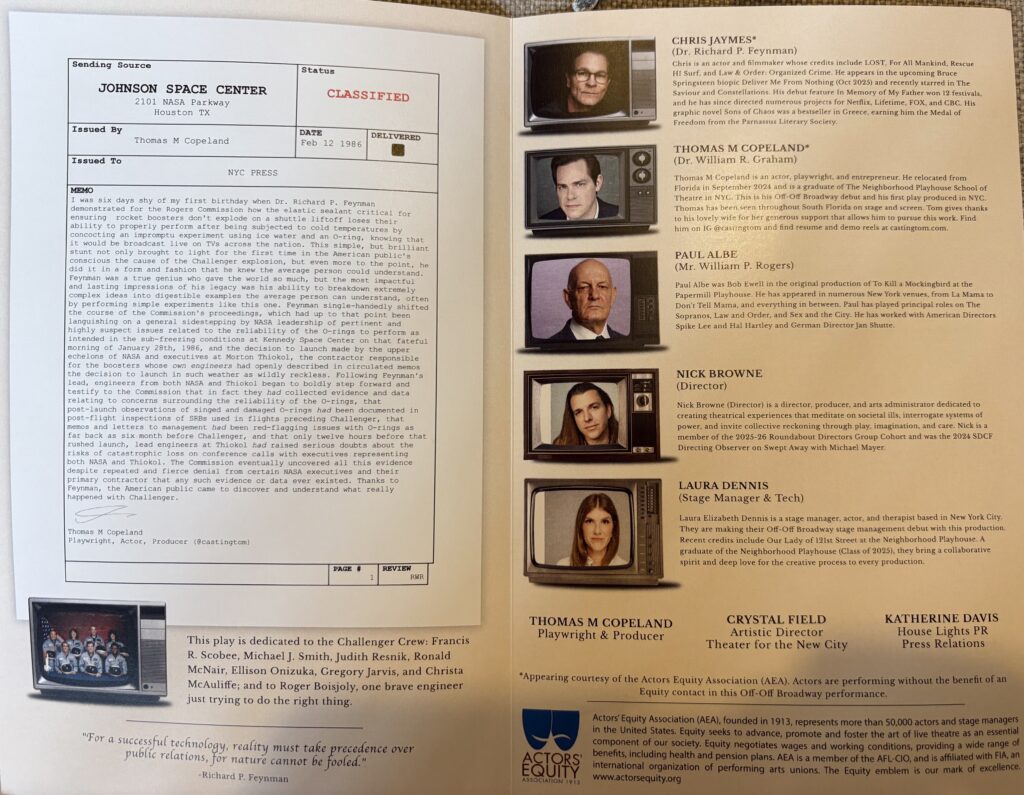
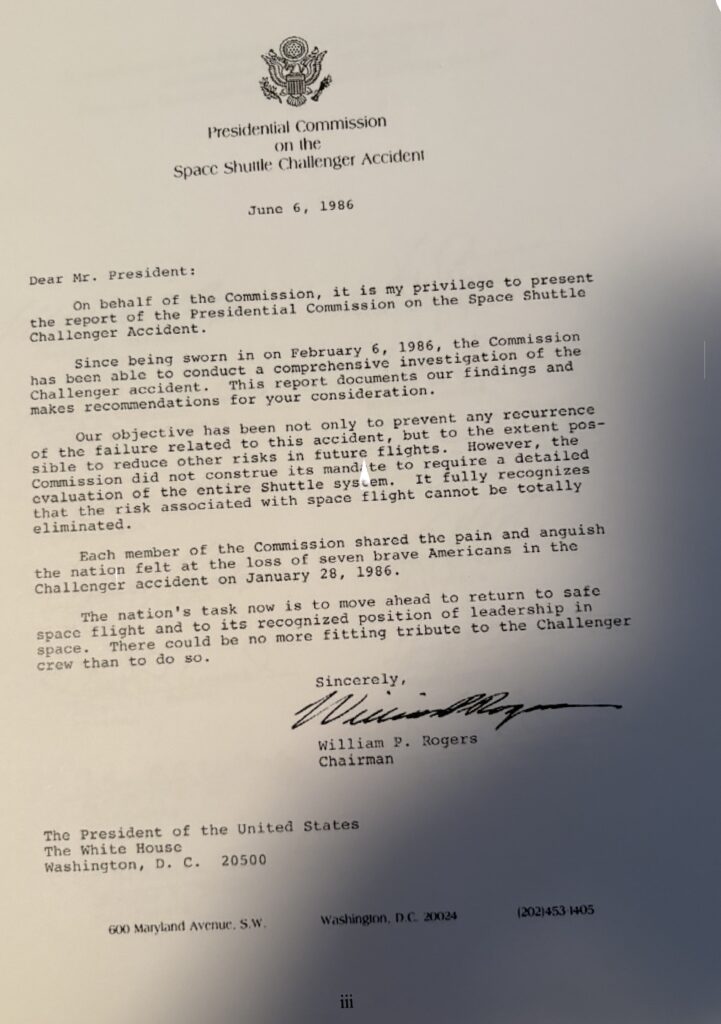
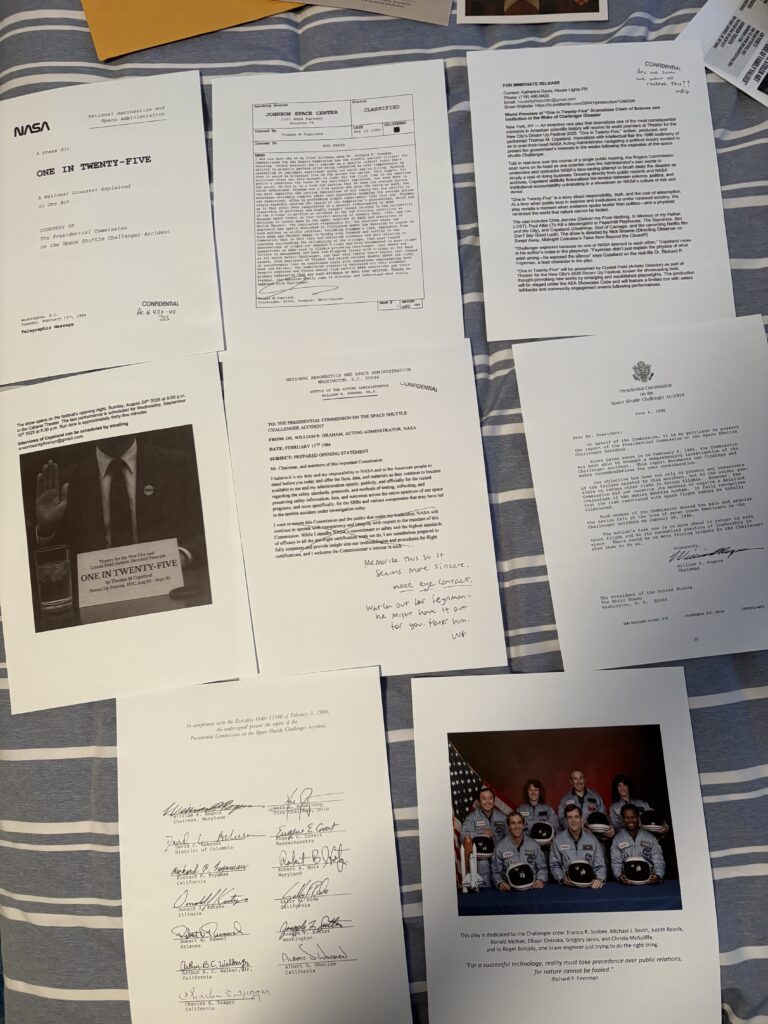
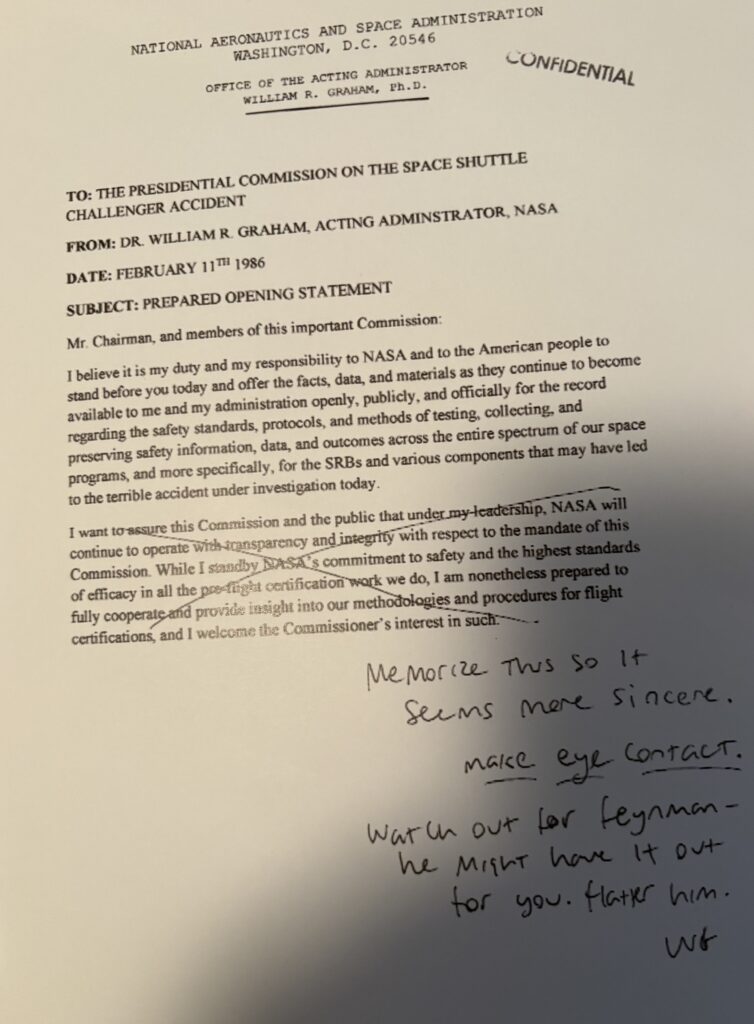
This show centres around The Presidential Commission on the Space Shuttle Challenger Accident, also known as The Rogers Commission. The entire show takes place within the walls of one room and the audience becomes more than just spectators — we become the members of the gallery/members of the commission that is being appealed to as Dr. William R. Graham, the acting administration for NASA (played by Thomas M. Copeland) tries to convince Dr. Richard P. Feynman, a commission member (played by Chris Jaymes) that there was no way to see this accident coming. The head of this commission is Mr. William P. Rogers (played by Paul Albe).
I think the easiest way to explain this commission, in its simplest form, is to compare it to a criminal trial. Dr. Graham would be the defendant, Dr. Feynman the prosecutor, Mr. Rogers the judge, and the audience would be the members of the gallery.
The show opens with audio clips taking the audience through the entirety of the day that the shuttle exploded. The shuttle launches, the excitement in people’s voices, the news casters announcing the launch, then the panic, the screams of terror, the horror, the news stations reporting that the shuttle exploded, and finally President Ronald Reagan addressing the American public to assure everyone that we will find out what went wrong so that it never happens again.
And it is here that we meet the characters in the show. Dr. Graham is a physicist who is the current acting administrator of NASA. That means that he and his team are the people who do the mathematical equations needed to figure out the risk of catastrophic failure for the space launches. It is worth noting that while Dr. Graham is not the person who is directly doing these math equations, he is the person who signs off on the work and is ultimately responsible in making sure that all factors have been taken into account when putting together these equations and that the math is correct.
Mr. Rogers is the appointed chairman of the Rogers Commission. He was appointed by President Reagan and was a former Secretary of the State and a former Attorney General. He is the man that must give the results of this commission to the President (and therefore may face any wrath that Reagan may have if the results do not shine a positive light on NASA).
Dr. Feynman is a theoretical physicist and was assigned to be a member of the Rogers Commission. He is the voice of reason in this show (and historically) as he is the only one who can see beyond the mathematical equations that are supposed to guarantee safety and understand that lives aren’t promised by an equation because there are always outside factors that an equation cannot account for.
The staging of this show is simple, yet effective. The vast majority of the show consists of the three actors sitting behind desks. However, that is the only type of staging that would realistically make any sort of sense for the setting. There were two beautiful moments that broke from this: the first is when Dr. Feynman shows everyone at the Rogers Commission the risk factor report that breaks down what was used to determine if any components of the solid rocket boosters needed to be replaced (this is vital because a faulty O‐ring was found to be the cause of the explosion and with there being a massive oversight in how risk factors were calculated — mainly the effects of how cold weather changes the ability of the O‐ring to function properly — the whole disaster could have been avoided). The second time comes when Dr. Feynman performs a simple, elementary school level, science experiment to prove his point as the commission progresses. Dr. Feynman (as well as all of the characters on stage) has a glass of water in front of him, with a clear water pitcher next to it, full of ice water. So it makes for a stunning visual for Dr. Feynman to pull an actual O‐ring out of his pocket and show everyone how easily it can be bent and contorted into different shapes. He then fills his glass with water (critically, there was no ice in the pitcher in front of him), walks across the stage to Dr. Graham and very awkwardly, but also with conviction reaches his hand into Dr. Graham’s pitcher of ice water and grabs a handful of ice, which he places into his cup of water. Dr. Feynman then places the O‐ring into the cup of ice water for maybe 30 seconds before being able to show everyone at the commission how the O‐ring, in such a short period of time, became brittle, unable to change shape and now only able to snap if it were forced to try to expand. It was an unseasonably cold day in Florida the morning of the Challenger launch. The effects of cold temperature on the O‐rings was something that should have been and could have easily been tested. But it wasn’t.
Which brings us the point of this show — human error is inevitable. Even if humans create machines to do everything for us, it still is only as good as the person who programmed it. It also takes other humans to catch the errors of others. A machine simply cannot reliably take in all potential contributing factors that is needed for operations that can be life or death. So while it is impossible to remove human error altogether, it’s also impossible to exist without humans playing a part in everything. So who should take the blame when things go wrong? Whether it’s humans wrongly assuming they’ve covered all of their bases when putting together a program or a risk factor assessment or simply not checking the work of those below you and still allowing that work to make it through and into the hands of the bosses — it’s the fault of someone and people should be held accountable.
One thing that struck me throughout this show was just how little of a factor it was that there was a teacher on board of that shuttle. In fact, it is only briefly mentioned at all and that’s in one line spoken by Dr. Feynman in which he is admonishing the choice of President Reagan and NASA to even send a teacher to space because it was really done as a publicity stunt to improve relations with the general American public. And that’s horrible — but it isn’t the main point of this show. In the grand scheme of things, her being a teacher and not an astronaut is inconsequential because there were so many times that a human could have stepped in and stopped the launch if only someone had done more than just assume that what was already being done was correct.
The icing on the cake for this show is the press kit. The detail put into making “confidential files” from NASA showing the thought processes and ideas of the different characters (and from the characters’ own perspectives) was simply beautiful.
All in all, this show is deeply thought provoking. I did not expect to be enthralled by this story because honestly, it occurred three years before I was born. I know about it, I learned about it in school, I have even seen the video footage. But I never truly understood how big of a tragedy this was before seeing One In Twenty‐Five. And it is not because of the loss of life — it is because the loss of life could have so easily been avoided.
I find it interesting that this show comes down to the number “4%”. When something goes wrong once out of every twenty‐five times it is tried — that is something going wrong 4% of the time. And 4% sounds like a really low percentage. But once it is laid out as being once out of every 25 attempts that there is catastrophic failure… suddenly 4% is huge.
Breaking The Trust is a dark comedy revolving around four sisters, their recently deceased brother, and the many secrets that both hold this family together and rip it apart at the seams.
Jeff Prewitt on the Poster for Breaking The Trust
The show opens with three of the sisters already at their deceased brother’s home. There is Martha (played by Jane Seaman) who is, at least on the surface, the greediest of the sisters. From very early on all the way until the end of Act I — money and the potential inheritance seems to be what she cares about the most. She is also an entrepreneur and is currently making doggy clothing.
We also meet the character of Donna (played by Deborah Unger) — she is perhaps the wisest of the siblings, at least when it comes to being able to figure out if a person is truly a good human or not. And even more importantly, she is able to accept people for who they are, even if who they are isn’t good.
And in this scene, we also meet Lorna (played by Shauna Bloom) who is the youngest member of their immediate family. She is, as a person, lost and is constantly seeking something — anything — to help make life worth living. She desperately wants to see the good in everyone and struggles to understand not only “how” a person could be bad, but also cannot wrap her mind around the “why” — what could possibly cause a person, any person, to choose to repeatedly do bad things? Lorna also has an abusive husband named Jesse, who is never seen on stage, but who is referenced numerous times.
And finally, there is one more character in the opening scene — his name is Ronnie and he is their deceased brother. He was cremated after his death (a decision that causes an uproar among the sisters) and sits in an urn on the coffee table.
The first scene with the three sisters (who are waiting for the fourth one to arrive) sets the tone for rest of the show. In this scene we get the first inkling that Ronnie was not the stand up gentleman that Lorna so desperately wants him to be. In fact, it is revealed very early on that Ronnie was physically abusive to his ex girlfriend and even killed his ex’s prized horse. Of course, this was old news for Donna and Martha, but for Lorna — this was shocking new information about her brother… a brother that she says, over and over, made it clear that she was his favourite sister, that loved her.
It is also during this time that the audience, along with two out of the three sisters, learn just how wealthy their brother had become — though none are sure on exactly how he became so rich. It is revealed that he had a large number of Krugerrand — a gold coin produced in South Africa and the amount that Ronnie obtained comes to be estimated to be worth around 4 million American dollars.
The Show’s Program
And in true sibling fashion — they wonder how he got the money. Was he in a gang? Did he steal it? Was he murdered over the money? No, no, he got drunk and drove his truck into a telephone pole which killed him.
At this point in the show, the audience finds out that when the sister’s father died, he left every single penny and object to Ronnie and nothing was left for any of his daughters. This, of course means that any and all inheritance left over from their parents, is part of what would be passed along to each of the four sisters. Ronnie, however, has put everything he has into a trust and his lawyer, Jordan Gibbons will reveal who gets what after the funeral. It’s important to note that the only sister who starts the show with the knowledge of this trust is Donna, who is the trustee. She does not know the contents of the trust nor how much is in it, but she signed all of the papers to make her the trustee.
In fact, in a heartbreaking admission — Lorna admits to being in a lot of debt since her husband is unable to maintain a job and therefore she is the sole provider (while she is losing herself mentally and spiritually), so the inheritance money could not have come at a better time. And as children, Ronnie swore to her that he would take care of her. So to Lorna, this is perhaps Ronnie’s way of fulfilling that childhood promise.
Finally, the fourth sister enters the stage. Her name is Nora (played by Wynne Anders) and is the eldest of the sisters. She is a cancer survivor, and is married to a man who goes by the name Perez (played by Michael Gnat) — who has joined her for the funeral.
Perez is a bleeding heart retired college professor who feels forever indebted to the woman who died while saving his life while he was living in Africa — a woman whom he had an affair with and who he clearly loves even though she is gone. Nora is concerned that Perez has Alzheimer’s disease. A very notable aspect of the character of Perez is his insistence in stating the truth — regardless of it is stings or not.
The next character to enter is Byron (played by Jeff Prewitt) — he is Nora and Perez’s son, who was just released on parole from prison after stealing from the art museum that he used to work at. Both of the characters of Perez and Byron are very intelligent characters and both actors — Gnat and Prewitt, respectively, did an excellent job in overlaying the humour, with the wit, and with the subtle jabs that a character of that intelligence needs to be able to dish out.
Headshots of the cast; Shauna Bloom, Jane Seaman, Wynne Anders, Deborah Unger, Michael Gnat, and Jeff Prewitt
Now that all of the cast of character have arrived — the true hijinks begin. The sisters have a conversation about the fact that Donna had Ronnie cremated because apparently Ronnie wouldn’t have like that. In fact, Lorna points out that when they were growing up, Ronnie used to tell her about a nightmare he had about being cremating and his ashes thrown into a river.
As the show progresses, the audience (and the character of Lorna) learn the truth about Ronnie — SPOILERS WARNING:
It is revealed that Ronnie did more than kill his ex girlfriend’s horse — he also killed Lorna’s puppy when she was a child. And the entire family — the other three sisters, Ronnie himself, and even their parents all lied to Lorna and insisted that her dog was killed in a hit and run. It is also revealed that Ronnie had only left anything of value to two out of his four sisters. Donna and Nora are both set to receive 1/4th of the inheritance each, with the rest being donated to a church — Ronnie was far from a religious man and it is clear that him leaving money to a church was solely for the purpose of screwing over two of his sisters.
Learning all of this is something that Lorna simply cannot fathom or comprehend. By the plays end, Lorna announces that by coming to the home for the funeral, she has learned that her whole life has been a lie. The brother that she thought loved her really just liked to use her as a punching bag. She has learned that her beloved dog didn’t die in an accident, but was intentionally killed by her own brother. And perhaps worst of all, everyone but her has known this entire time.
This revelation of who Ronnie truly was, breaks Lorna, who leaves before the funeral can take place. But before she does, when only her and Perez are around to see it — she makes Ronnie’s dream come true — she flushes his ashes down the toilet.
It is also revealed, but only to the character of Perez that Byron ended up doing prison time because he had teamed up with Ronnie to steal an original Picasso painting and they were going to sell it. However, Ronnie told Byron that the buyers tricked him, showed up with guns and not money, and took the painting. However, Byron has figured out the truth — Ronnie did sell the painting and he lied to Byron about it so that Ronnie could keep all of the money for himself. By the shows end, Byron — being rather intelligent — figures out the combination to Ronnie’s secret safe, steals the gold Krugerrand, and drives away before the funeral takes place.
And the only other character who knows about it all is Perez who is now tasked with making a very hard decision. Should he tell the truth, the thing he believes in, even though he knows it will destroy any sense of family and trust in one other that the three remaining sister have or should he stay quiet, let the funeral proceed as normal, never reveal that the urn no longer has any ashes in it and never reveal that Byron ran away with all of the fortune — perhaps letting the blame fall on Ronnie (after all, none of the sisters actually know how the gold was acquired or even have actually seen the gold — maybe they’ll think there simply never was any gold), in hopes that the remaining sisters can salvage any sort of resemblance to a family again?
On the surface, this is a show about grief, family, and greed. But when you get into the more layered aspects, it’s really a show about trust, promises, the need to see people for what they are, the ability to let go, and even the importance of a little white lie at times versus the truth. After all, sometimes the truth doesn’t help anyone or it can cause great harm (while also not changing anything for the better in the long run). Sometimes the truth just makes no difference in the grand scheme of things.
I did find, negatively, that some actors had better control of the stage than others. The three stand out actors in this show were Deborah Unger (who played Donna), Michael Gnat (who played Perez), and Jeff Prewitt (who played Byron).
Unger had to portray a hard, yet very soft character. She needed to be able to be stern and level headed, but not just mean and unlikeable. In fact, her acting reminded me a lot of Kathy Bates, so naturally I am curious to see this actor play a villainous character — I think it would be fun for her to perform and for the audience to watch.
Gnat’s character has to be likeable even though he has stepped out on his marriage. The audience must even potentially pity him at some points. But then at other points, he’s the life of the party, purposefully pushing people’s buttons, and enjoying a good laugh. Perez, as a character, is hugely motivated by the necessity for the truth to be known — which is why it is such a treat to see this character being forced to make a decision: let things just be or ruin the happy facade by explaining the truths.
Prewitt may not have had the most emotionally deep character to portray, but he had command of the stage and was able to grab the eyes of the audience regardless of what else was happening. This was important because especially by Act II, Byron says a lot with body language and facial expressions and very little with actual words.
I must also commend Shauna Bloom (who played Lorna). Her character spent a lot of time being clueless, so when she finally breaks down, it’s quite nice to see the physical and emotional aspects of the character shift and turn into someone who can be dark and angry.
Speaking of Act II — there was no reason for it beyond perhaps the actors safety. Act I ends with a jar full of pennies being opened and the pennies flung about the stage. And then there is a five minute “Intermission”, which I suspect was really only there so that the pennies would be swept off of the stage. However, I found breaking for only five minutes did nothing but distract from the show and mess up the flow/pacing.
Outside of the pennies being a potential slipping hazard — there is no reason (that I can think of) not to just leave them on the stage, wherever they land, for the remainder of the show. The characters are only at this home due to the funeral. And while (most) of the characters can see Ronnie for the man he really was — they are still grieving. It’s still a loss, an unexpected one at that. And that still hurts. So I don’t think the characters would care enough to clean the pennies up. Conversely, if the pennies are being removed out of safety concerns, perhaps it would work better to have one of the sister (most likely Donna) sweep up the pennies, while berating her sister for throwing them.
This show has a lot of really good, really thought provoking sections, but outside of the three actors really spotlighted above, it just didn’t feel genuine. I just didn’t feel the chemistry between the sisters that I so desperately wanted too. The moments that felt like genuine family arguments or even genuine laughter at past memories felt fleeting and few and far between. And that’s a shame because with the right chemistry, this could be a wonderful deep dive on the inner workings of not just the human mind and what makes it change, but also on the human psyche and how far a person can be pushed before their morals and values are put into question, and furthermore, when is it okay to break our own morals and values. Is it okay to do be immoral for the greater good?
Theater For The New CityThis show was part of the Dream Up Festival
I knew going into this show that I was not very familiar with Carole King’s work. In fact, there were only a total of four songs in the entire show that I actually knew — the most notable, of course being the song “(You Make Me Feel Like) A Natural Woman”.
This show has all of the making for a wonderful show: a live band, an impactful story, overcoming trials and tribulations to make it out on top, catchy songs, amazing singing, and great actors.
Yet, I found it hard to get behind the story.
Carole King is an American singer‐songwriter who dreamt of writing songs, but it was not considered a job for a woman at the time. Carole (played by Jenna Parrilla Alvino) at the age of 16, had skipped two grades, landing her as a freshman in college. Her mother, Genie King (played by Joan Hoffman) discourages Carole from pursuing her dreams in favour of becoming a teacher. She is also still bitter about her divorce from Carole’s father — he had cheated on her.
And it is not long before we meet a Sophomore at the college in which Carole instantly has a crush on. His name is Gerry Goffin (played by Tristan Takacs) and much more importantly, he is a lyricist, which is something Carole needs because she can write the music, but not the lyrics. And Gerry can write the lyrics, but not the music.
Gerry and Carole team up in order to have success selling their music for bands to sing. But Gerry and Carole do not just become business partners — they begin dating and more than that, they begin a sexual relationship. Which is problematic when you remember that Carole has skipped two grades and is only 16 years old when she falls pregnant. The average college freshman is 18 years old. The average college sophomore is 19 years old. And if she were an average college freshman, this would be no problem. But she wasn’t. She was 16 and he was an adult. I understand that “times were different”, I understand that he “did the right thing” by marrying her once she became pregnant. But for not a single other character to even mention “hey, that’s not really okay” seemed odd. Even Carole’s mother was concerned over the fact that Gerry repeatedly stepped out on the marriage, but seemed to have not a care in the world that the relationship was predatory in nature. When you cannot ignore the power dynamic between Carole and Gerry nor the fact that she was a minor — it is really, really hard to root for that relationship to work out.
Carole and Gerry do in fact find success writing songs and even earn themselves an office working under the famed producer, Don Kirshner (played by Lynn Baskin). I did find this casting choice to be a bit of an odd one. Don Kirshner, the real life human, was a white man. Lynn Baskin, the actor portraying Don in this production, happens to be a black man. Normally colour blind casting is something I absolutely applaud. But there is a racial element to this show that simply is not delved into.
While some of the bands that Don Kirshner produced music for were bands that were not composed of white members, the music was still “white” music. Almost everything was turned into something traditionally white music — even when sung by bands like the Shirelles or The Drifters. In fact, there was only one scene in which race was a factor at all. Carole wrote a song that was given to the Shirelles to sing, but the Shirelles want the song changed. They wanted it to be “less twangy” and “more elegant”. In other words, the song needed to still be white, but not country, because that’s a white genre that black singers couldn’t get away with, especially during the shows time period.
Beyond that, race never really seems to be mentioned. And I think it was a missed opportunity. I understand that the script does not explicitly have scenes that go into depth about the racial tensions in both the time period and within the confines of the music industry. But having a historically white producer, who is likely not understanding why that song was “too twangy” for the Shirelles would have at least implied some of that tension. After all, if Don Kirshner were a black music producer, would he have ever given Carole King’s music to them? Or would he have been more socially aware of what would have been seen as acceptable.
That being said, there is literally nothing I can say about the performance of Lynn Baskin. He was a wonderful singer, his comedic timing was on point, his acting was more than believe. It’s purely a question of what can be shown without being said and ultimately what the goal of the creative team behind this specific production is. If the goal is to not really bring race into the picture — or rather, it isn’t a goal to bring race into the picture, then there really is no need for Don Kirshner to be white.
The characters of Cynthia Weil and Barry Mann (played by Joan Schubin and Patrick Lavery, respectively) — ultimately they became another song writing team working under Don Kirshner, who also start a romantic and sexual relationship. What made these two characters feel special was very simply the chemistry between the two actors. It really did feel like we were watching love blossom between then and that was beautiful.
The only really negative thing that I can say about this specific production of this show is this — some of the wigs were distractingly bad wigs. And when the wigs are the worst part about any shows production, then you’ve got a pretty damn good production.
There is one more actor in this show that without a doubt deserves a shout out. Nicholas La Russa, who played a member of The Drifters, just has such a pure voice. I have seen this specific actor in a number of shows at Music Mountain Theatre and each and every time, I am blown away by Nicholas’ singing ability.
Heathersis a show that I know well. I love a good dark comedy and certainly enjoy a show full of camp. So Heathers the Musical is definitely right up my alley.
The Show’s Program
The show opens in the year 1989 with Veronica Sawyer (played by Sara Al-Bazali, in this performance) and other students of The Westerberg High School as they despair about living life as ordinary students, who are not high up on the social hierarchy (ie — the students are not the jocks nor are they the titular Heathers and therefore they are at the bottom of the food chain). The student who is seen as the absolute lowest in this social hierarchy is Martha Dunnstock (played by Syd Sider in this performance) — an innocent minded student, with a long standing crush on the football star Ram (played by Xavier McKinnon) who she once shared a kiss with back in kindergarten.
The three Heathers are Heather Chandler (played by McKenzie Kurts) — she is the lead Heather, dressed in red. Then there is Heather Duke (played by Kiara Lee, for this performance) — she is the Heather that is used the most by the other Heathers, even acting as a desk so that Heather Chandler can write a note. She wears green. And finally there is Heather McNamara (played by Elizabeth Teeter) — is the middle rung of the three Heathers, and she wears yellow.
The other two main characters that must be mentioned are Kurt (played by Cade Ostermeyer) — Kurt is Ram’s best friend, they play football together, and are almost always seen onstage as a pair.
And of course, the character of Jason “J.D.” Dean (played by Casey Likes) — J.D. is a fun character because he starts off as a mysterious loner who slowly descends into chaos as his god complex grows.
Two sets from the show
The plot of the show is pretty simple, Veronica wants to be a popular kid and to become a popular kid, you have the be friends with the Heathers. So, she gets the three of them out of trouble by forging a hall pass — forgery happens to be Veronica’s specialty as she is able to mimic the handwriting of just about anyone. The Heathers make Veronica popular, but also miserable, and in exchange, they use her forging powers to mess with other students — including that of her best friend, Martha.
Enter J.D. who falls in love with Veronica, leading into a plot full of trickery, deceit, false suicides, unintentionally turning hated characters into beloved, tragic martyrs and inspirations, at least one attempted suicide, and almost having an entire school blown to bits.
The first thing that is impressive about this show is the detail. When the first fight scene breaks out in the school, it were the ensemble members (and swings filling in) who really caught my eye. They acted just the way that one would expect high schoolers to react to seeing a fight break out in the hallway — they loved it! Throwing up rock-n-roll hand signs, silently cheering, and clearing having a blast. It is also worth mentioning how much of this show is done in slow motion — whether that be the jocks shooting spit balls at a nerd or J.D. punching Ram across the face — having the actors move in slow motion allowed for every single second to be clearly shown to the audience and really played up the campiness of the show.
The second thing that really struck me about this entire production is simply that each and every actor appears to be a very talented singer as well. Heathers the Musical does not require amazing signing ability. The physicality of the performance, the dark story line, the humour, the camp — those are the things that this musical calls for and needs for it to be successful. The fact that every single actor, once they had their chance to shine was able to belt was a huge added bonus!
The Cast Prepare To Take Their Bow
I loved the choreography and more importantly, the chemistry between the characters (and honestly of the actors too) of Kurt and Ram — the two popular jocks, was fantastic. Not only did they have choreography that quite literally had one climbing on top of the other but they truly felt like best friends just trying to party and get laid.
In fact, feeling like genuine teenagers is one of the things that this cast really was able to nail. The awkwardness of being a teen, the audacity of the things teenagers will say to parents, the need to be popular and to fit in, and the need to feel important are all things that most, if not all, teenagers experience. Whether inside of the walls of a school or just inside the constraints of life — we are all in some sort of social hierarchy. Where we fall in that hierarchy may change dependant on circumstances or timing or even where we are in life, but the social hierarchy always exists. And more importantly, everyone has damage.
Everyone has a story — good, bad, ugly. It’s what we do with what we learn from our damage, our trauma, and how we then in turn use that knowledge when we interact with other people — the other people in our social hierarchy. How we treat others, regardless of our trauma and how we navigate through society’s social hierarchy is what is really at the heart of this show. Under the camp, the silly, the dark subject matter, this is a show about treating others with respect no matter what. That’s really what this show comes down to.
I was not initially too keen on seeing this show for two reasons: 1. The ticket price. Theatre is my happy place and I have no qualms with sitting in the last row of a theatre (and therefore paying less) if it means I am able to see more shows. 2. I know the story of The Phantom of the Opera already, so I thought — how much more can they really do with that story?
A lot, apparently.
I am going to do my best to write a cohesive review, however, this show relies heavily on secrecy and I intend to maintain that.
Growing up, when I watched The Phantom of the Opera I would pity the Phantom. He was always a villain, but also mysterious, charming, and a misunderstood soul… and that is just kind of where the original show leaves it. Masquerade however, asks you to do more than to pity the Phantom — it asks you to see yourself in him.
Program for Masquerade
If I had to sum up the theme of this show, I would say it’s about learning to be vulnerable. The show very quickly takes you into a masquerade ball, complete with dancing — but it’s the act of wearing a mask that is truly important. In college, on the very first day of my freshman year acting class — my professor went out of his way to inform us that we all are already actors because we act every single day and our roles vary drastically on our surroundings and even who are the people around us. And truthfully, that lesson hit so hard because my professor was absolutely right. We bite our tongue to be polite around coworkers, bosses, teachers, etc. and then we change into someone else around our best friends and sometimes people don’t take their metaphorical mask off until they are alone, in solitude.
Whether a person is literally wearing a mask or metaphorically wearing one isn’t actually important. There is power in hiding your face or your emotions or even of just blending in with a crowd. But to take that mask off, let your vulnerabilities show, and accepting the judgment that may come with that is what this show is truly about. And it is achieved exquisitely.
The sets are detailed, insanely so. And realistically, it has to be because of how immersive this show is. The number of times that the actors speak directly to you, not the entire audience in the room, but to individual people and make them into (nameless) characters of the show is pretty much constant. Whether Carlotta is addressing the audience in the dressing room of the theatre before the performance of “Don Juan Triumphant” (in which the entire audience are now playing the roles of the chorus members in this fictitious opera), being handed a note that was written by the Phantom, hiding with a character as he attempts to escape from the people who control him, or being inches away from a crashing chandelier — it’s impeccably detailed (right down to one of the notes addressing the Phantom as “Erik” – a detail that is really only found in the novel by Gaston Leroux).
The Card for “Don Juan Triumphant” with the show’s cast list. (Characters from Masquerade)
It was also not lost on me how complex this show much be to put on. The entry times were set in 15 minute increments and there are multiple casts performing at once — just all performing different scenes and at different times so that the different groups of audience members never bump into each other. There was actually a technical difficulty that occurred when I was there. And if you happen to be a person who does not fully appreciate how a magic trick is done until you understand the inner workings of it — then a technical difficulty that pauses the show can be a wonderful bit of insight on how the show is able to pull off the magic needed. And it wasn’t until this technical difficulty happened that I was able to fully appreciate how technical and precise everyone in the cast and crew needed to be. Once the performance was set to begin again, the actors will take it from the top of the scene that was interrupted. However, depending on where you are in the theatre at that time, you may still have to wait for the music to catch up to the scene. And it is always fun, I find, to see the actor relax because the show is paused, and then turn right back into the character they were portraying as it starts back up.
The acting in this show cannot be understated. There are of course the characters that you expect to see — Christine, Raoul, The Phantom, Madame Giry, Piangi, and Andre, etc. but there are new characters as well who are used to tell the backstory. The vast majority of the music is from the original score of The Phantom of the Opera, though there are at least two songs that I did not recognise — they fit in perfectly. I also noticed which character sings which line is not always the same as in the famous Andrew Lloyd Webber musical.
Some of actors of note are: Betsy Morgan who portrayed Madame Giry. She is one of the first characters that you get to interact with and she really sets the tone of the entire show. This role — really pretty much every role in this show — requires a good amount of improve because the actors are speaking directly to the individual audience members, asking you to complete tasks or to hide the character or even asking you actual questions. So the actor needs to be able to think quick on their feet and not only respond appropriately to whatever the audience member says or does, but also has to keep the show flowing because if one group is moving too slow, it will mess up all the other groups who have entered after them.
Jacob Lacopo played Joseph Buquet and he was an absolute pleasure to watch perform. Lacopo had one of the most physically demanding roles in the show. It requires a good amount of acrobatics and this actor made it look flawless. This was especially impressive because it was during his big scene that the technical error occurred and the show had to be paused. This meant that the audience was able to see him exit, out of character, and then reenter, get into character, and perform as if nothing had happened. It was simply beautiful.
Carlotta was played by Satomi Hofmann and honestly, Carlotta is probably my least favourite character in the show. And I have seen many productions where Carlotta is of course a massive diva, but not always an amazing singer. Satomi Hofmann is an amazing singer. And she’s funny. I imagine it must be fun to play this role because part of her character is to be rude to the people who have come to see Masquerade because in character, we aren’t there to see Masquerade, we are there to be her chorus members backing her up on stage. This role is also very heavy on needing to be able to improve because she asks an audience member to do a specific task. If that audience member does not understand the cue, she has fix that without interrupting the flow of the show.
Christine was played by Francesca Mehrotra. I was so impressed with this performer. The character of Christine often has to say a lot with her facial expressions and body language — she must be able to look conflicted, confused, full of wonder, pity, anger, love — and that is often achieved when the character is not signing. Mehrotra has an absolutely beautiful voice, but what struck me was her ability to have such subtle emotional changes without saying a word.
Raoul was portrayed by Paul Adam Schaefer who gave an immaculate performance. I appreciated his take on the character of Raoul who felt much more gritty in this show than I have ever seen him before. I often felt that Raoul feels decently passive, perhaps even confused, for large chunks of The Phantom of the Opera, but not in Masquerade. In Masquerade, Raoul makes his purpose and intent much more pronounced and this was wonderful to see.
The Phantom was portrayed by Hugh Panaro. What a joy it was to watch him perform and see him really delve into this character. As I mentioned above, this show is intimate, with the actors sometimes grabbing your hand or placing things/taking things out of your hands. The Phantom has to be able to do these types of actions very quickly, subtly at times, and is therefore reliant on the audience members being in the correct place at the correct time and doing the correct action. He has to be a villain, but also one that the audience does not detest. In fact, if you leave this show only pitying the Phantom, I fear you may have missed the point. You have to sympathise with the Phantom. Panaro has the difficult job making the audience see themselves in his character — a character who lets not forget, kills people. Panaro is, of course, an excellent singer (anyone playing the Phantom has to be), but more than that, just like with the character of Christine, the Phantom has to be able to change his facial expressions and body language in the blink of an eye and it must be done subtly since the audience is so close.
The only real downside of this show is since the show is constantly moving, the action never stops. Which means, if you’re in the back of your group, you may miss the beginning of the action in the next scene. Also, I fear this likely effects anyone who has to use the accessibility options more than anyone else because instead of walking through the building, at a relatively quick pace — anyone using the accessibility options have to wait for the elevator, which I fear takes extra time and almost insures they will miss some of the performance.
All in all, if you’ve ever dreamt of the Phantom of the Opera grabbing your hand and whisking you through the tunnels underneath the opera house — then this show is for you. If you have ever wanted to experience a show instead of watching a show — this is for you. And it is well worth the ticket price.
I went into The Outsiders completely blind. I have never read the book that it is based off of nor have I watched the film adaptation. I went into this show completely unaware of the plot. And honestly, by intermission, my first thought was “how West Side Story”. Of course, anyone who has seen this show knows that beyond feuding gangs and an unapproved love interest — that is really where the comparison of the two shows end.
Billboard for The Outsiders
This show follows the character of Ponyboy Curtis (played by Brody Grant), a 14 year old boy who’s parents recently died in a car crash, leaving him and his two older brothers — Darrel, the eldest brother who has assumed a fatherly role to his brothers, and Sodapop, the middle brother who is suffering from a broken heart (played by Brent Comer and Jason Schmidt, respectively). Taking on this fatherly role has taken a toll on Darrel, which has substantially strained the relationship between the three brothers.
The show begins with the lights not all the way down. This is because it isn’t until the first song begins that the lights fully go down and we, the audience, are introduced to all of the members of the first gang — The Greasers. This is done in a beautiful manner in which Ponyboy uses light to introduce each Greaser one by one. Before we are introduced to the characters, though, we can see them going about their daily business behind a scrim, which raises as the characters are introduced.
The Stage
The Greasers are not well off financially, they live on the wrong sides of the tracks, so to speak. But they respect their own. Ponyboy, specifically is not your typical Greaser. He is able to be rough and tumble, but he is a dreamer — he loves getting lost in books and movies and escaping the world through fiction.
The rival gang is called The Socs — because they “live like socialites”. So they are wealthy, upper class, and tend to think of themselves as better than The Greasers.
Ponyboy’s best friend and fellow Greaser is Johnny Cade (played by Sky Lakota-Lynch), who is a central character of this show. Johnny had recently been attacked by The Socs, which sets the scene for the rest of the action that happens. It is also notable that Johnny does not have a good home life, with parents who often fight. This leads to him being given a knife by Dallas.
Another very important character is Dallas Winston (played by Alex Joseph Grayson) who is the head of The Greasers gang — the other members all look up to him (except perhaps Darrel who has attempted to move on from the gang lifestyle), who has a criminal record, and who also runs away from his problems.
It is not long into the show that Ponyboy himself is jumped by The Socs, who attempt to cut his hair (their hair is very important to The Greasers) and he is knocked unconscious. The effects of being knocked unconscious are beyond belief — the use of scattered lighting, a high pitched ringing, and dampened audio all helped achieve the effect of Ponyboy being knocked out.
Once Ponyboy wakes, he is informed that he is now officially a Greaser because he has gone through the “initiation” process (being beaten up by The Socs). And thus starts the adventure.
Ponyboy loves going to the drive-in to see movies and it is here that he meets Cherry Valance (played by Emma Pittman) — the girlfriend of the leader of The Socs, Bob (played by Davis Wayne in this performance). Ponyboy and Cherry realise that neither is what the other expected them to be, which causes a confrontation between The Socs and The Greasers which eventually leads to the death of a character leading to the downfall of many.
Playbill and Understudy Card
This show poses many questions to the audience — why do teenagers rebel? Why do we as a society believe stereotypes about any groups of people? Can you outrun your problems — both physically and metaphorically? Or will it always catch up to you in the end? And perhaps most importantly, will things turn out alright if we just learn from the actions of our past and the pasts of those around us? Can change really happen?
This show is impressive — the sets are intricate — complete with a rain fall fight scene between the two gangs, but also fairly simplistic (for example: a car that The Greasers have is also turned into a bed for the Curtis brothers, so the set is also adaptable for the various scenes). The choreography is intense, precise, and still looks like a genuine fight is taking place. This is all enhanced by the use of lighting and sound effects, and of course, a cast filled with amazing singers.
One thing that I absolutely loved about this show is the number of young actors that is in it. Many of whom are making their Broadway debut with their roles in this show. And it is wonderful to see young actors take on such heavy roles as the ones in this show which deal with very heavy subject matters such as abuse, grief, guilt, and the struggle to keep trudging even when things are at there worst.
The one thing Ponyboy keeps coming back to is the phrase — “Stay Gold” which is used to mean to remind the characters to remember the good in the world. Perhaps that’s a lesson we all could use.
John Proctor is the Villain isn’t just a show — it’s a lesson. And being a lesson, it is fitting that the show takes place in a high school located in a rural, small town in Georgia. It should be noted that the playwright (Kimberly Belflower — making her Broadway debut with this show — and what a debut it was!) is from a small town in Georgia, but more importantly is an educator herself. And her education background shows!
The Billboard outside the Booth Theatre
Many of us know the story of The Crucible and we were taught about how noble and heroic and honourable the character of John Proctor is… except realistically, he’s not. And this show exemplifies this not just by explaining it to the audience in the context of students learning about the play, but also within the characters themselves.
This show centres around a few main characters: Shelby — a girl with a reputation of being promiscuous who has been away for roughly six months and no one knows exactly why. Carter Smith — a teacher at the school that the students attend. Mason — a boy in the class. Raelynn — a girl dating the character of Lee and is the main character of this story. She is best friends with Shelby, who has had sex with Lee. Lee — Raelynn’s aggressive and sex hungry boyfriend. Ivy — a student whose father is accused of having an affair on her mother. Beth — an innocent student who is rather religious and very trusting who only wants to see the good in people. Nell — a new girl who moved to this small rural town from Atlanta, Georgia and is therefore meeting and learning about many of the characters at the same time as the audience (and therefore is able to provide an outsider’s perspective to the other characters). And Bailey Gallagher — she used to be a student at the very school that these characters attend and she now works there. It must be noted that she also knew Carter when she was a student.
The Stage
This show takes place in 2018, with an emphasis on seeing the world through the eyes of high school girls, who are learning about the world — a world where the “Me Too” movement has started and the society is beginning to listen to the victims. It deals with very intense themes including, but certainly not limited too, power dynamics in relationships/abusing that power dynamic, engaging in sexual acts with minors, the internal struggle that many people feel when someone they personally know and trust is accused of something heinous and how hard it can be to accept those accusations as true, blaming the victim, and unfortunately, the likely outcome in far too many cases.
The show opens with Carter Smith teaching a sex education lesson to the class. He is not a sex ed teacher, but rather he teaches literature. He has no choice but to teach sex ed due to budget cuts (a thing I am sure the playwright is very familiar with). The students are not particularly interested in the sex ed lesson — in part because they are old enough that they already know about sex and realistically should have been receiving this class for years. But also because in small town, rural Georgia sex education is not the most important thing and there is a heavy emphasis on abstinence only. Between the religious nature of many of the families in the town and being generally conservative on the political spectrum — anything that might be seen as even remotely controversial by the parents in the school district is a challenge for this school to actually do. And that means comprehensive sex education is just not a thing.
But the students know better. Or at least, as the play progresses, the students learn better. And for an extra bonus — this show is very aware of the pop culture during the show’s time frame including quoting Taylor Swift and giving the audience (and the character of Nell) a recap of past events ending with the phrase, “And that’s what you missed on Glee”.
John Proctor is the Villain does a wonderful job of paralleling the actual play of The Crucible with the students (especially the female students), the teachers, and even the parents in the town that are never actually seen on stage. Once the opening scene of the sex ed class ends, the teacher — Carter Smith, begins to teach the class about The Crucible and explains how John Proctor is the hero. This sparks Shelby, you has just returned from being on a “sabbatical” for six months to disagree with Mr. Smith.
It is at this point that the show really takes off because for most of the audience — we have only ever known John Proctor as the hero. But Shelby points out numerous things: Abigail was John Proctor’s employee, she was a virgin with a crush on her boss, he never apologises to her, nor does he ever apologise to his wife, Elizabeth. In fact, John Proctor dies without ever even saying that he loves Elizabeth. Realistically, in the time period of The Crucible him dying damns his wife and his children to a life of poverty and hardship — and for what, really? To preserve his name. Just a name. Not a person, not the many lives he destroyed along the way, but the concept of a name. And honestly, I don’t know how many people in the audience had ever thought of John Proctor and The Crucible like that before.
John Proctor is the Villain also takes care explain some potential reasonings that the characters in The Crucible do things that we would think of as odd like dancing in the woods even though it is illegal and lying about why. And then we see our lead female characters reach their breaking points and just need to scream and yell and dance. And it puts it all into perspective.
Towards the beginning of the show, some of the female students decide that they would like to start a feminism club as an extracurricular activity at the school. However, this is denied because it would be too controversial for the town. This is when Mr. Smith steps in and offers to be the faculty advisor for the club and even offers to frame the club with works of literature so that it wouldn’t be seen as just as feminist club and therefore would be acceptable for the parents in the town.
In order to delve into this show further — I need to put a SPOILER WARNING:
The character of Shelby (played by Chiara Aurelia) is a very intricate one. Shelby has a promiscuous reputation in part because she had sex with Lee (played by Noah Pacht in this performance) who is Raelynn’s (played by Amalia Yoo) boyfriend. This, of course, causes tension and awkwardness between the characters of Shelby and Raelynn. However, with the help of Nell (played by Morgan Scott) Shelby and Raelynn are able to rekindle their friendship. A lot is revealed about Shelby — her reason for leaving, her past sexual partners, and why she even feels the need to be “promiscuous” (realistically, she is not a promiscuous character — she was groomed). It makes for a character that is by no means perfect, but also not at fault either. I imagine this is a difficult role to play — the actor has to be able to be liked enough for people to not instantly judge her character from the limited information we start with and then transform the character into essentially a hero.
The character of Ivy Watkins was played by Maggie Kuntz and I found her performance fascinating. The character of Ivy has to be conflicted. There is a rumour going around town that Ivy’s father had sex with one of his employees — which means he cheated on Ivy’s mother and again, this town is very religious. This leaves the character of Ivy very confused and unsure what to do — should she be angry at her dad? Should she feel better that the cheating was supposedly consensual? Can she love her father and hate him at the same time? And worst, as the show moves on, the rumour begins that her dad also had sex with Shelby and that’s why Shelby was away for so long. The character has to learn the kind of man her dad really is and it’s heartbreaking to watch.
Bailey Gallagher is another conflicted character (played by Molly Griggs) because she grew up knowing Carter Smith the teacher. She trusted him as a kid, even developed a little crush on him, and now she works with him at the school. But Bailey had heard rumours about Carter before… and she always dismissed them because she knows Carter and he’s a good guy. Which makes it even more important and powerful when she finally realises that’s she’s been dismissing the wrong people.
Perhaps the most interesting character, in my opinion at least, is that of the teacher — Mr. Carter Smith. Carter is played by Gabriel Ebert (who was absolutely amazing). What makes this character so difficult to play, I think, is that he isn’t a straight forward character. The audience and many of the characters believe he is, but he has dark secrets that are not revealed until we are well into the show. These secrets have to come as a surprise to the audience in order for the message of this show to be loud and clear — so when the audience gasped when everything came to light — I was thrilled.
The character of Carter starts off as incredibly likeable, charming, progressive even for someone in Georgia. He’s for feminism, he wants to help… but does he? Carter is the John Proctor of the show and the fact that it takes the audience by such surprise is beautiful. It is revealed that Carter has a habit of not only cheating on his wife, but doing so with girls that are not only minors, but who are less powerful than him. Often, he goes after his own students to groom them. And as this becomes evident throughout the show, the audience has to turn on Carter. We have to hate him. And there is just something so amazing about watching a likeable character becoming so detestable by the shows end. It takes a special kind of acting ability to sway an entire audience’s perspective eight times per week.
I was able to ask Gabriel Ebert after the show, how it felt to play someone who has to become so hated by the time the curtain falls. He simply smiled and stated, “it’s necessary”. And he’s absolutely correct.
Once it is revealed that Carter had seduced Shelby (and that she was not his first victim nor will likely be his last), the audience gets to learn the fates of Carter, Shelby, and Raelynn (among others, but these are the most important). Carter is forced to take a short leave of absence. He is allowed back into the classroom to teach. Shelby is forced to take classes from another teacher. The town, as a whole, the school, as a whole — does not believe Shelby (even if many of the characters do by the shows end). In fact, Shelby gets punished as if she were the problem.
And finally, the show ends by cutting to black at a pivotal moment — the character of Beth (played by Fina Strazza) has a decision to make. Beth is a very conflicted character who very much trusts Carter. She doesn’t want to see the bad in Carter. But she is also likely to be Carter’s next (at least attempted) victim. Throughout the entire show she cannot wrap her mind around the idea that someone she trusts so much could be a bad person. At the show’s end, most of the students have come around to believe Shelby and take a stand against Carter — even Bailey. But Beth, right at the end, runs towards center stage before the lights cut to black. It must be stated that it is very much up to interpretation if Beth has run to join Raelynn and Shelby and the other students against Carter… or if she was rushing to stand by Carter’s side. I like to think she joined the other students. But I cannot say for certain.
I really wish this show was running longer because it is an excellent work of theatre that is really able to flip a very well known play on its head and make it relevant for a modern audience.
I was not exactly sure what to expect from The Boys From Kingsbridge — I knew it was a “gritty police drama” framed against the success of the Yankees baseball team and their success in winning the American League Championship Series and thus earning the team a spot in the World Series.
I was honestly, a bit concerned that this may be a very pro‐police show — which could be a rather hard thing to pull off in today’s society where the police officers themselves are often the ones taking the criticism when a cop does something wrong. And I am not saying that the individual police officers who do morally wrong things (and especially the police officers that do take it way farther than a situation needs to be taken) should not be held accountable — they absolutely should. But this show points out that while yes, bad cops should absolutely be punished, but also the people in the charge, the politicians making the laws, need to be held accountable, too. Because, as this play states, most of the police are trying to uphold the law, whether they agree with that law or not. They are given quotas to meet and sent to impoverished areas to enforce crimes that are often not really important just so that the police force can keep bringing in money. This is a system, it is argued, that the good cops, the average cops, are essentially stuck in the cycle set up by the higher ups.
There is of course, some truth in the fact that the police forces, as a whole, are systemically broken and racist. And for a lot of police officers, just like people in any other job, they comply with the orders they are given — not because they necessarily agree with the orders or the policy, but because if they refused it would be career suicide, at best, and perhaps even criminal at worst. That being said, the system being broken doesn’t absolve the individual police officers who do go too far. In fact, it should inspire the police officers to work to make change, but I fear for most, it’s just about keeping their jobs and not making waves. I imagine that at least for some, the endless cycle of being forced to do things that you don’t believe in morally would hopefully inspire change and not just beat the person down into submission. But I’ve always been hopeful. The show does take special care to point out the high suicide rate among members of law enforcement and takes care to explain that it is often due to being overworked, having broken or faulty equipment, and having no choice but to do things that they feel are wrong.
The show includes two actors — Steven Sarao, who is also the writer, playing the character named Steve. And opposite him, as his police partner and best friend, is James Lorinz portraying Mike.
Steve is a book smart man (having attended Harvard), driven to make a positive change in the world, wants to see reform in law enforcement, but struggles in feeling that he is nothing but a work horse, a lackey, for the more powerful who do not have the best interest of the innocent members of society in mind, but rather they are interested in cutting corners and lining their own pockets.
Mike is much more of a streets smart type of guy. He knows he has little ability to change the system that he works within. Mike (and Steve) have both been studying for the Sergeant’s exam — to see if they could be promoted. Mike has failed this exam multiple times, but Steve consistently passes it. However, Steve never takes the promotion and instead works with Mike in hopes of Mike being able to pass it too.
Mike and Steve go way back, having known each other their entire lives and really only ever parting ways when Steve attended Harvard University. Their friendship is truly a codependent relationship and as the play unfolds, it is revealed that it has been this way for a long time. The two friends have had a hard life growing up complete with abusive parents, rough neighbourhoods, and fist fights having to be a way of life.
The show opens with Steve telling the audience about his friend Mike and how they will never see each other again. He continues to monologue about growing up in Kingsbridge, and his love for the Yankees, and most importantly about Mike.
Then it is Mike’s turn to give his opening monologue in which he gives his point of view on the same things that Steve spoke about. And finally, the audience see the two characters interact — they do act like long time friends, giving each other a hard time, cursing each other out, and just chatting like close friends do.
As I mentioned before, this show only had the two actors. Therefore all of the other characters — a police sergeant, a couple being arrested, etc. were either not present on stage at all or the two actors mimed moving the other people around (an example would be placing their hands on the arrested couples heads and leading them into the police cruiser). While this worked for the majority of the show, there was at least once where it was not made clear that two people were being arrested and not just one until a good minute or two after the event happened and it was the dialogue that gave it away.
The sets were simplistic; the front of a police car, a podium, a bench, a radio, a desk… nothing elaborate, but the show simply did not call for extravagance, in fact, it called for simple and worn down.
The costuming was also pretty minimal, really only consisting of the two actors wearing their police uniforms. I did find it odd that neither of the uniforms had any sort of badge on it anywhere and the guns that the officers carried having bright red tips was a bit distracting. But I have to wonder if legalities of some sort prevented the usage of more realistic uniforms and firearms.
The show did have one glaring problem that is hard to overlook. At one point, the two characters are in their police cruisers, just chatting, but it’s during a “sacred time” where the characters get to enjoy their coffee and relax a little bit before the day really starts and they start receiving “jobs” (911 calls) that they have to respond to. It is during this scene that the audience see both the characters of Mike and Steve with open books in their hands. I thought that the characters were parked, reading books, enjoying the quiet part of their shift… until they mention the need to pull over. It was then that I realised that these character were not parked and enjoying a book during a slow part of their shift — the actors were reading their lines from the script. Unfortunately, this was not lost on other members of the audience because I was asked immediately upon exiting the theatre by another patron if the actors were still on book.
There was one other thing that I found odd about this show…and WARNING: SPOILERS AHEAD:
The show opens with a radio talking about the Yankees and immediately after is the opening monologue spoken by the character of Steve. This is the monologue in which Steve tells the audience about how hard it is to be a police officer. This is when the audience is informed of the high suicide rate among law enforcement and how the police officers also get the short end of the stick. And it is in this monologue that it is mentioned that Steve never sees Mike anymore.
It becomes apparent on this opening monologue that one of the two characters is not going to survive this tale. And since this show opens with Steve, I would have thought Mike would unfortunately lose his life. In fact, a major plot point throughout the show is that Mike is desperate to tell Steve something, but he struggles to actually say the words. I was sure that perhaps this secret that Mike must tell Steve was going to be along the lines of him being sick and terminal. So it was a huge surprise to me when Steve is the one killed in the line of duty. And then the show ended. With the choice of Steve being the one to die, I felt there needed to be an additional scene where, heartbreakingly, Mike cannot handle it anymore and takes his own life — harking back to the words that Steve spoke in the beginning.